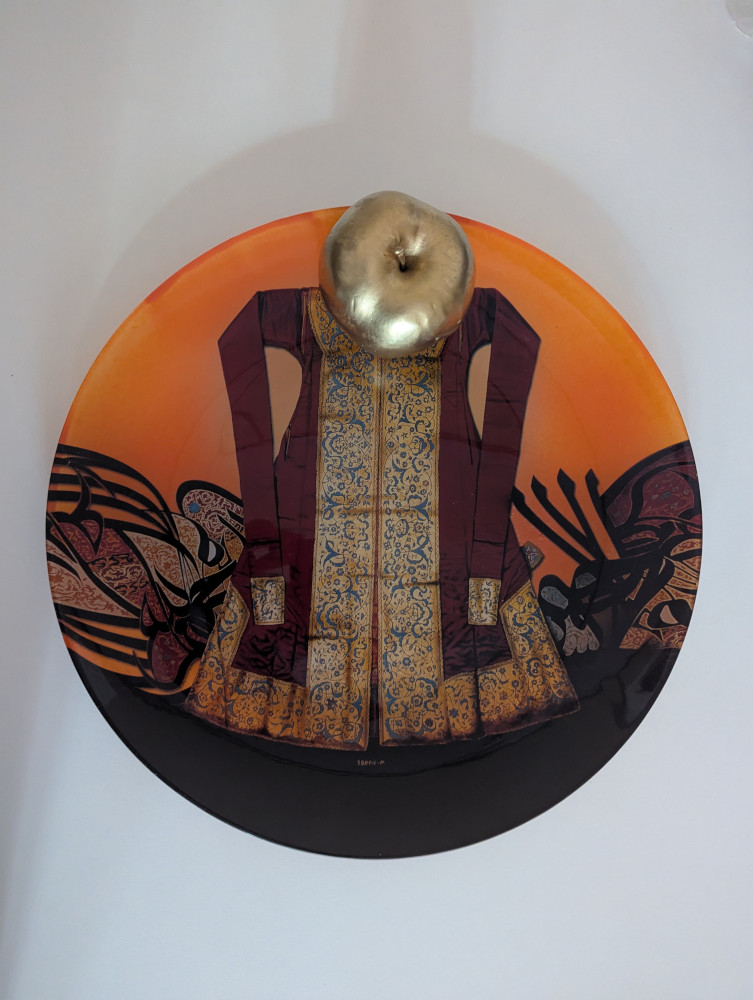
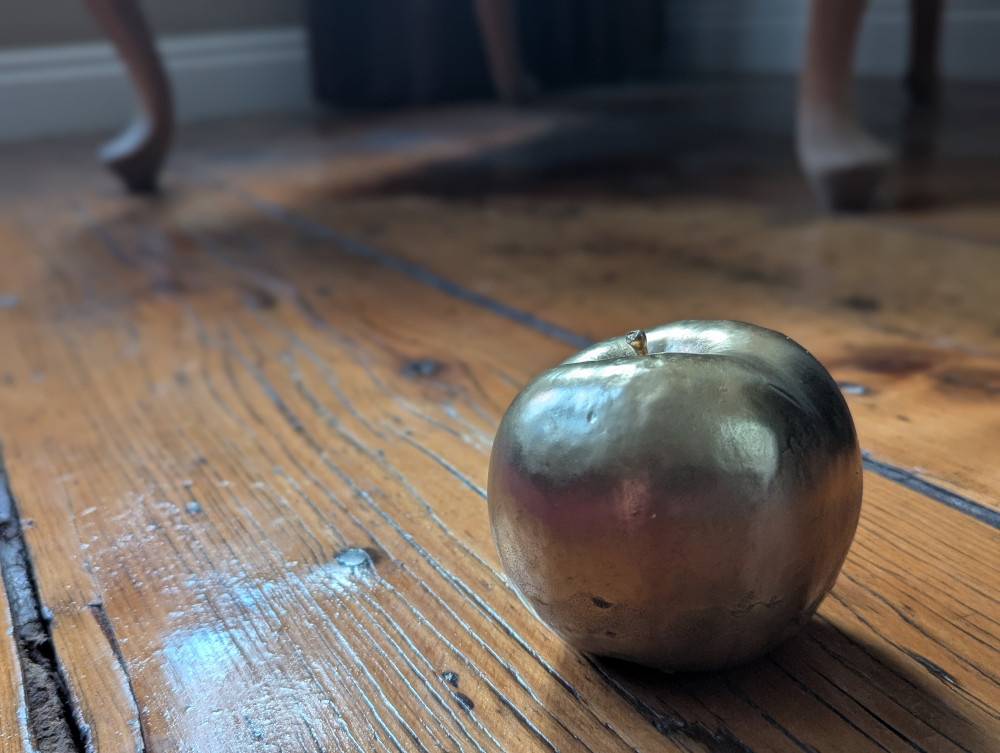
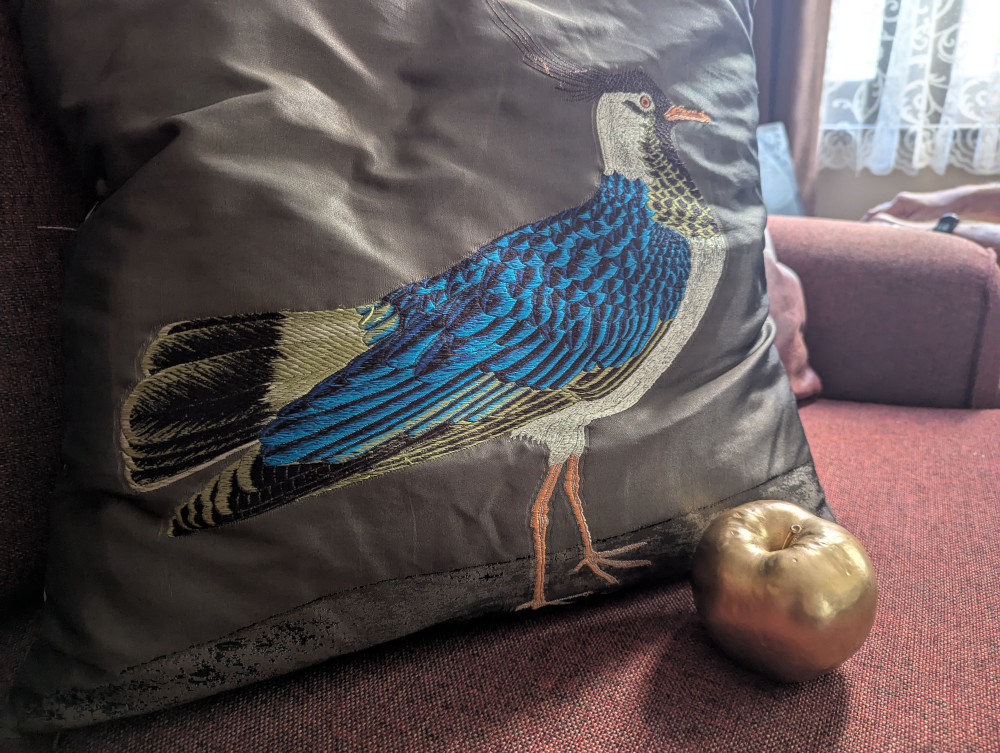
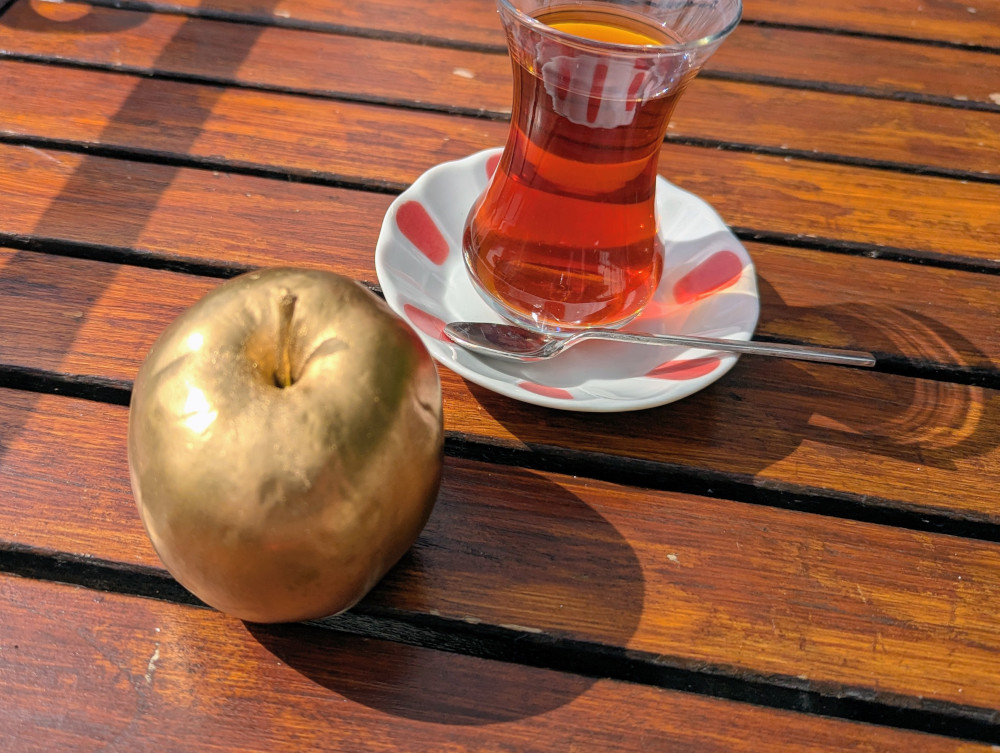
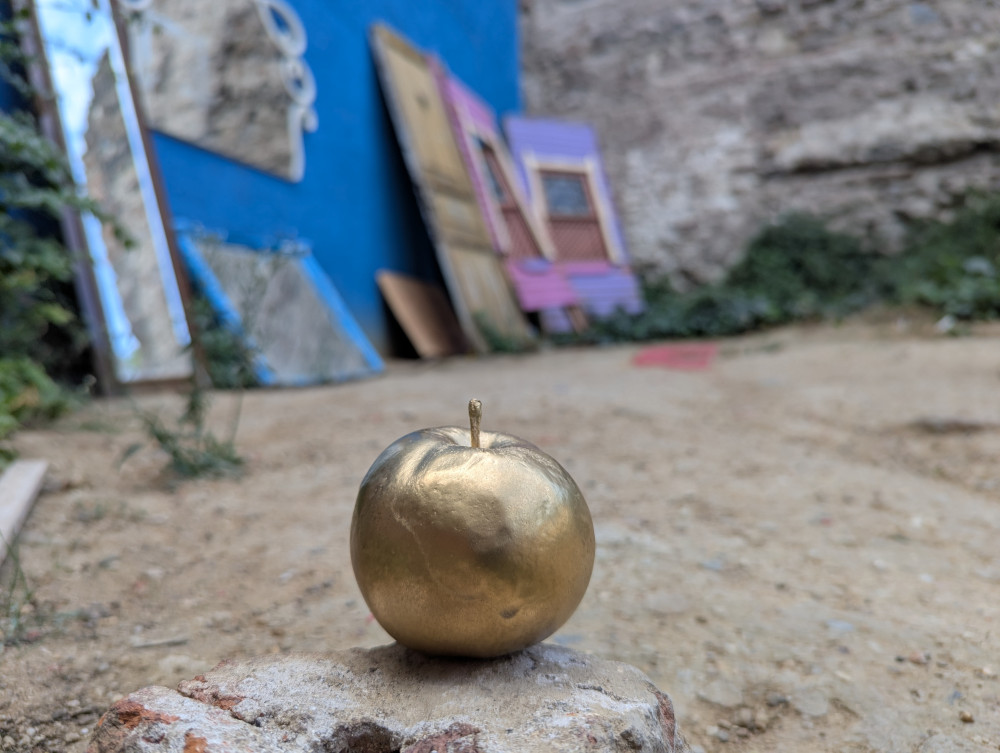
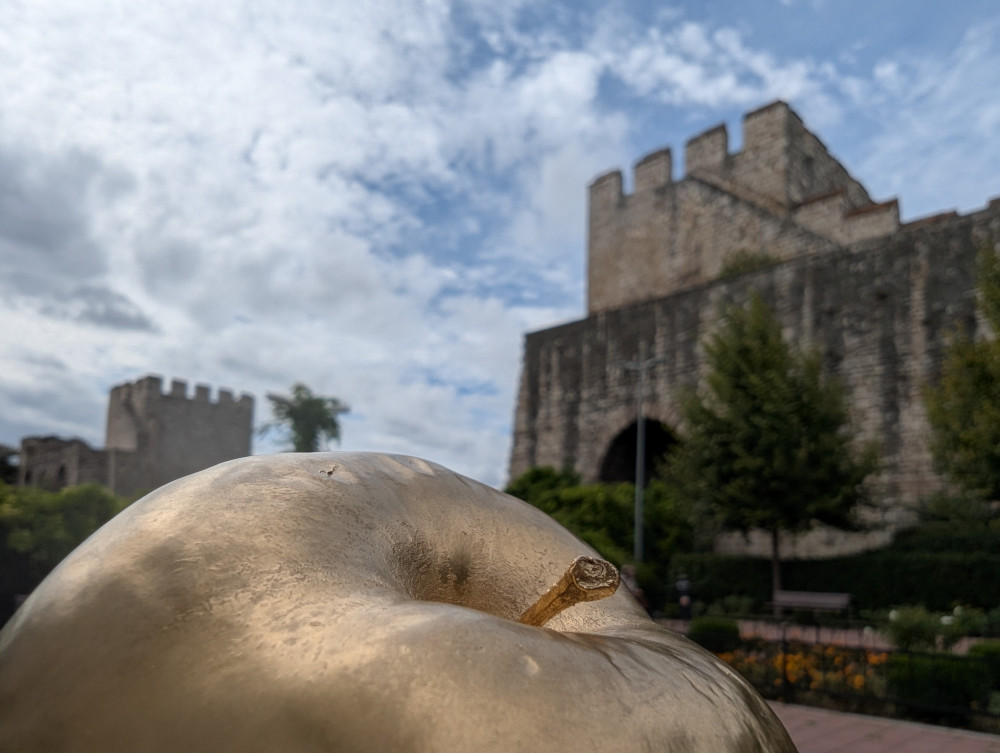
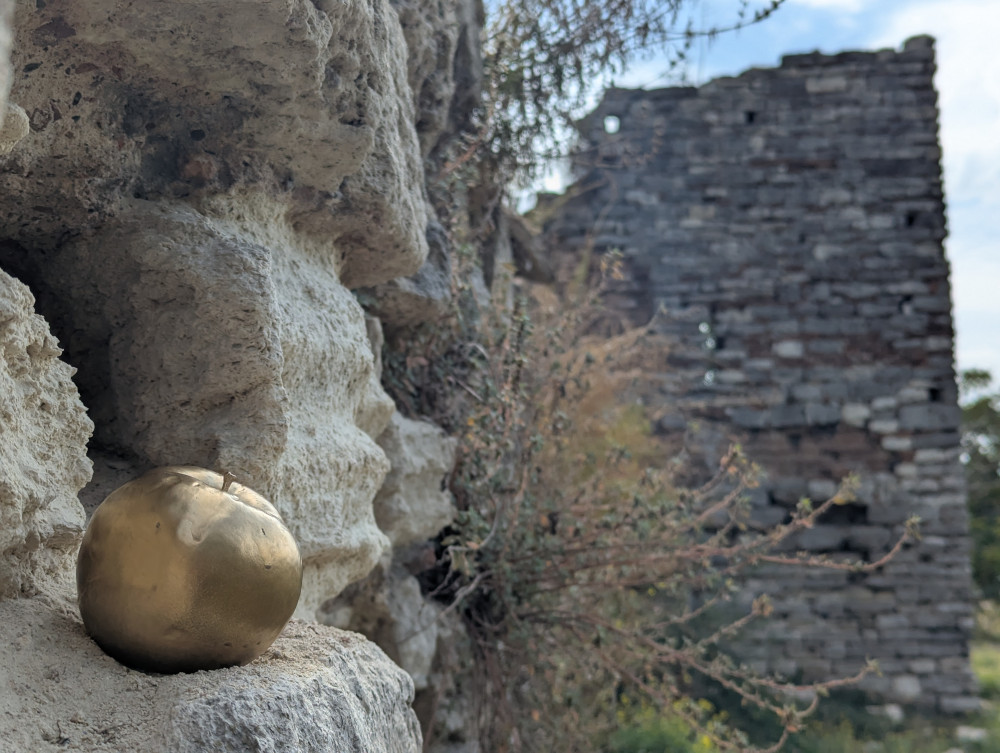
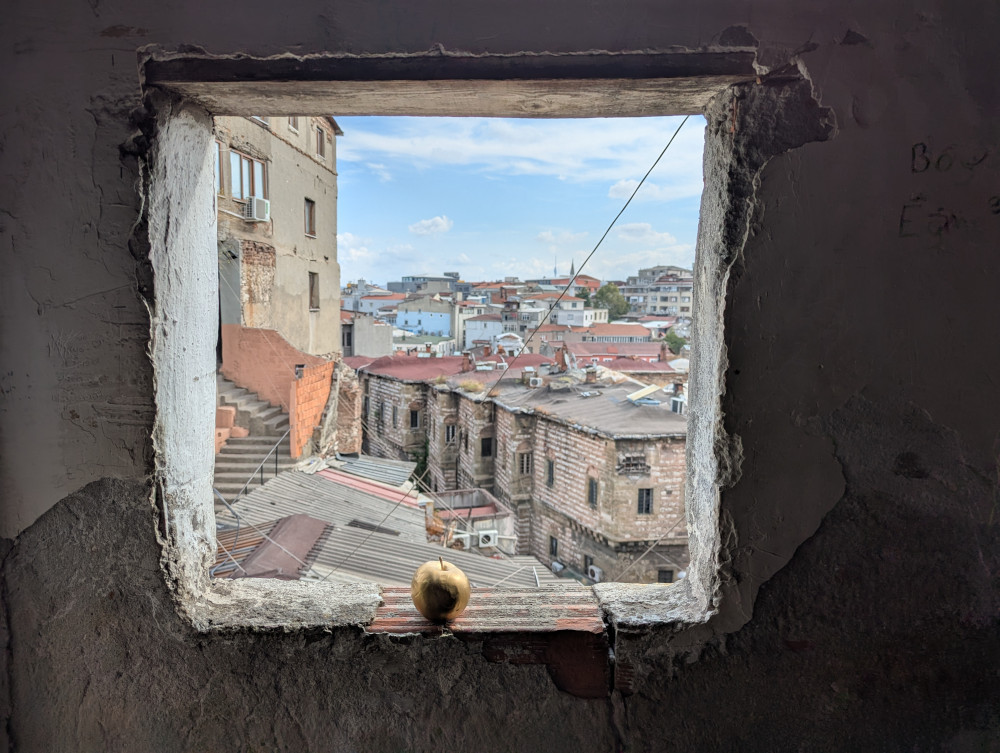
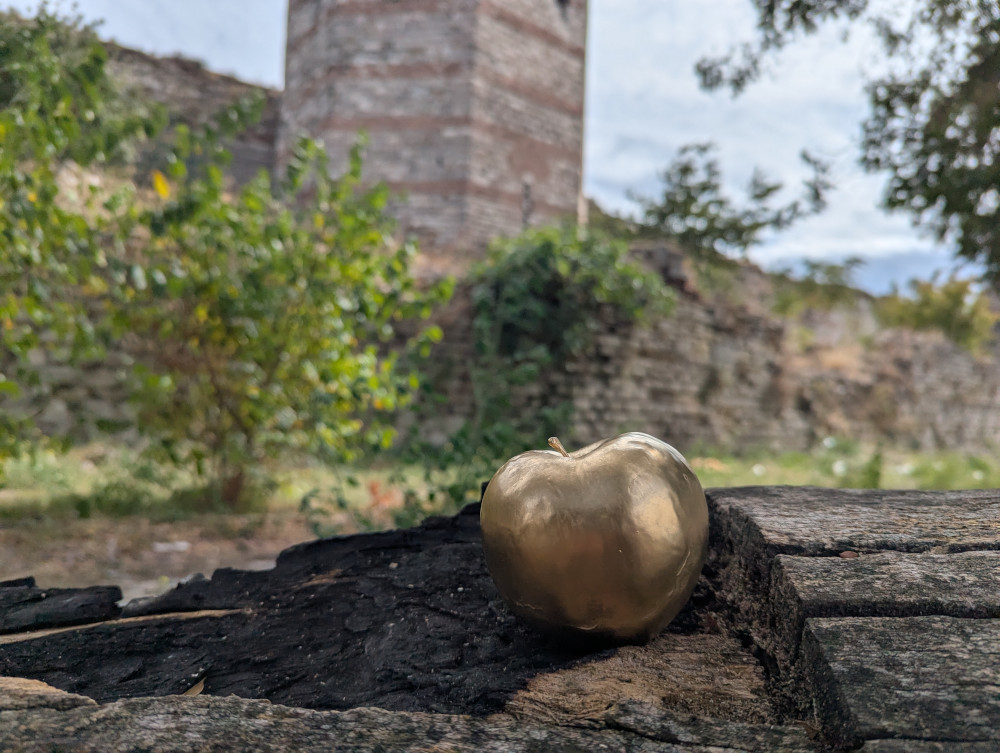
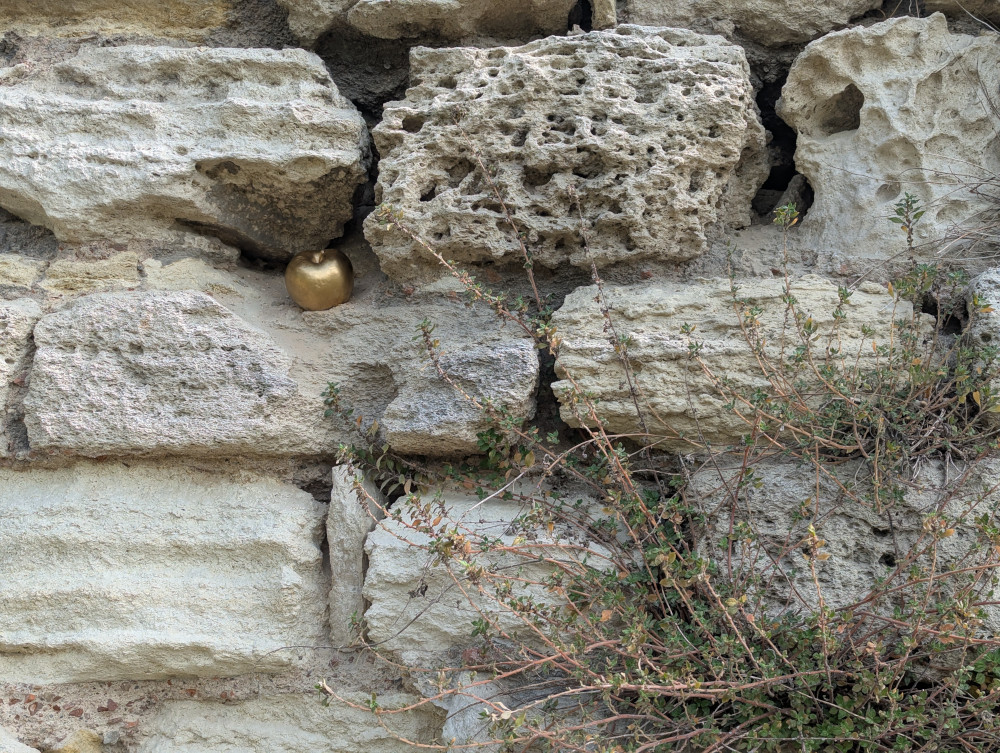
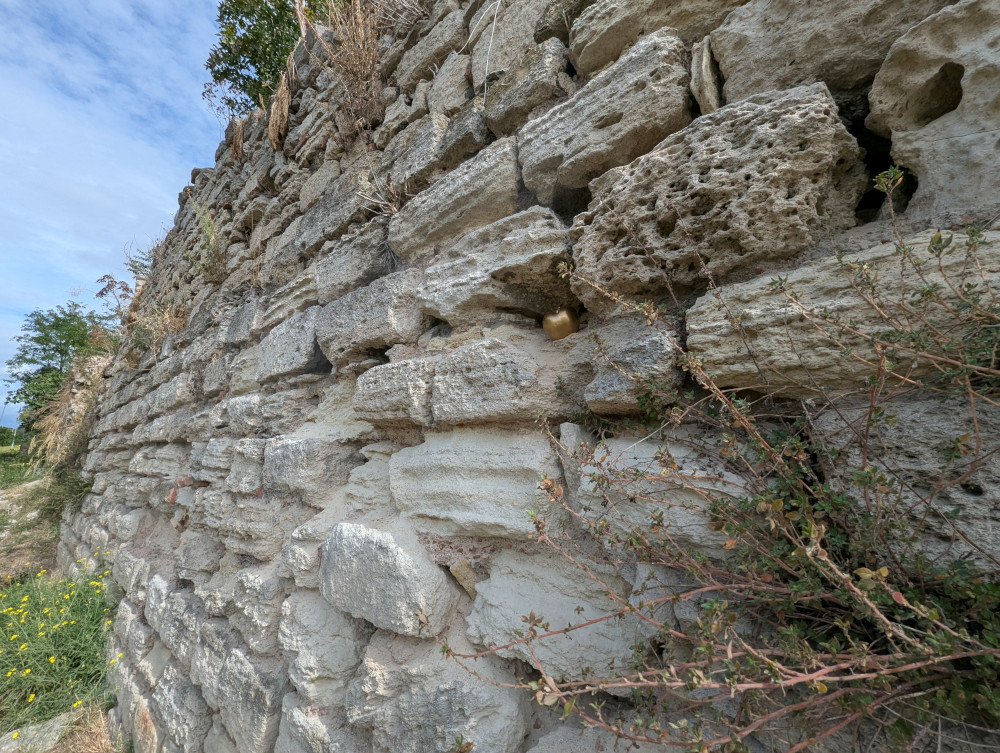
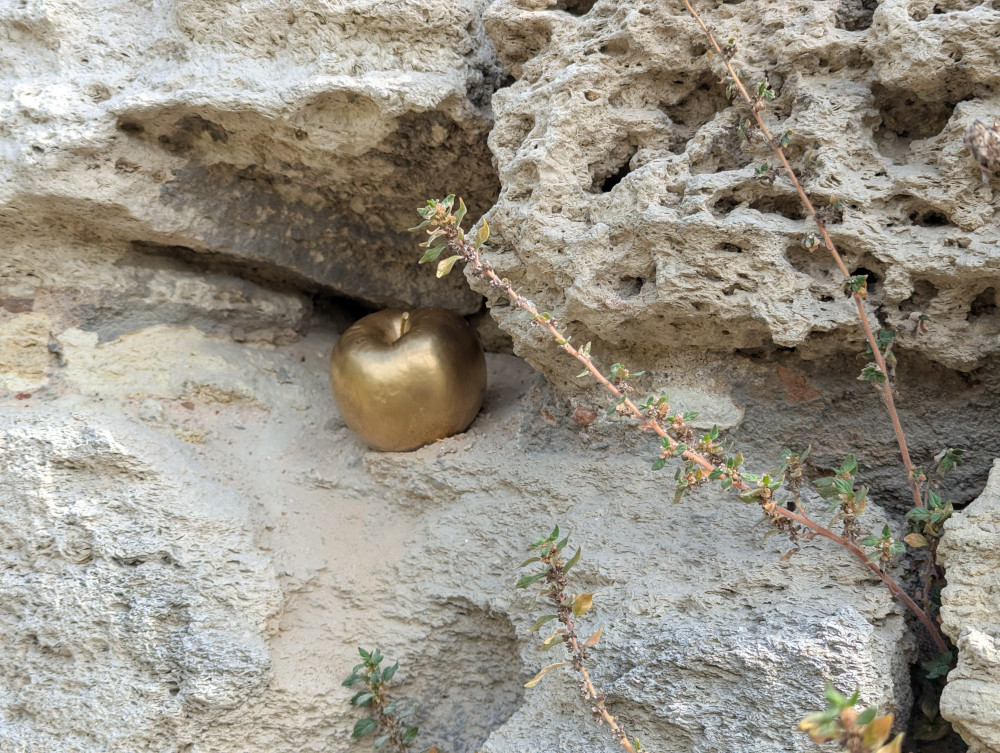
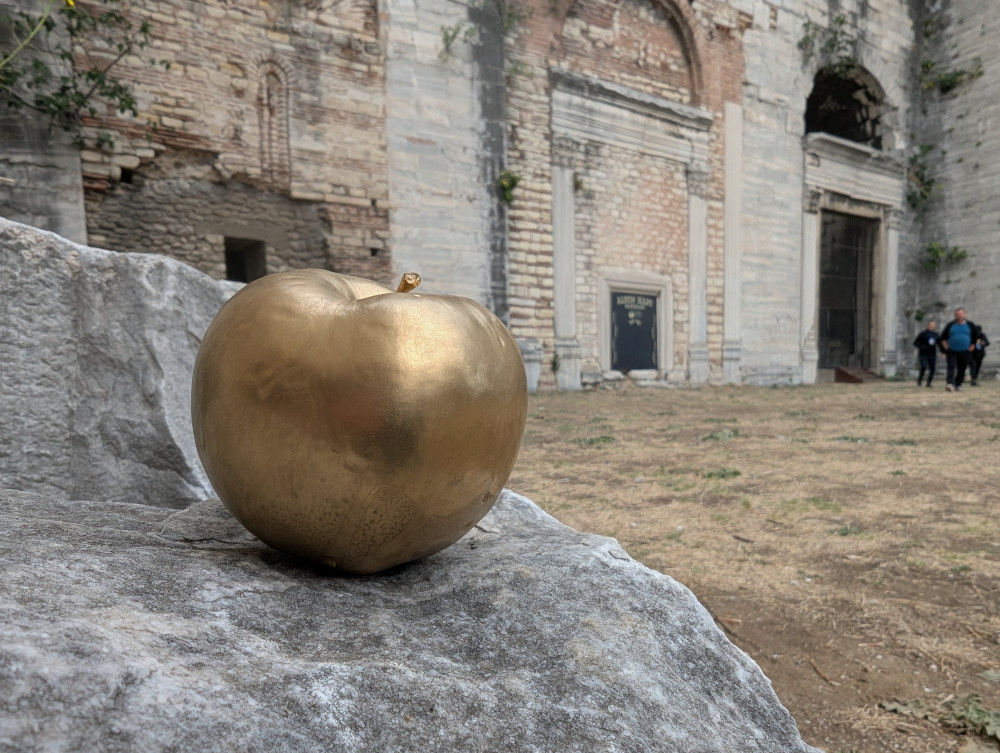
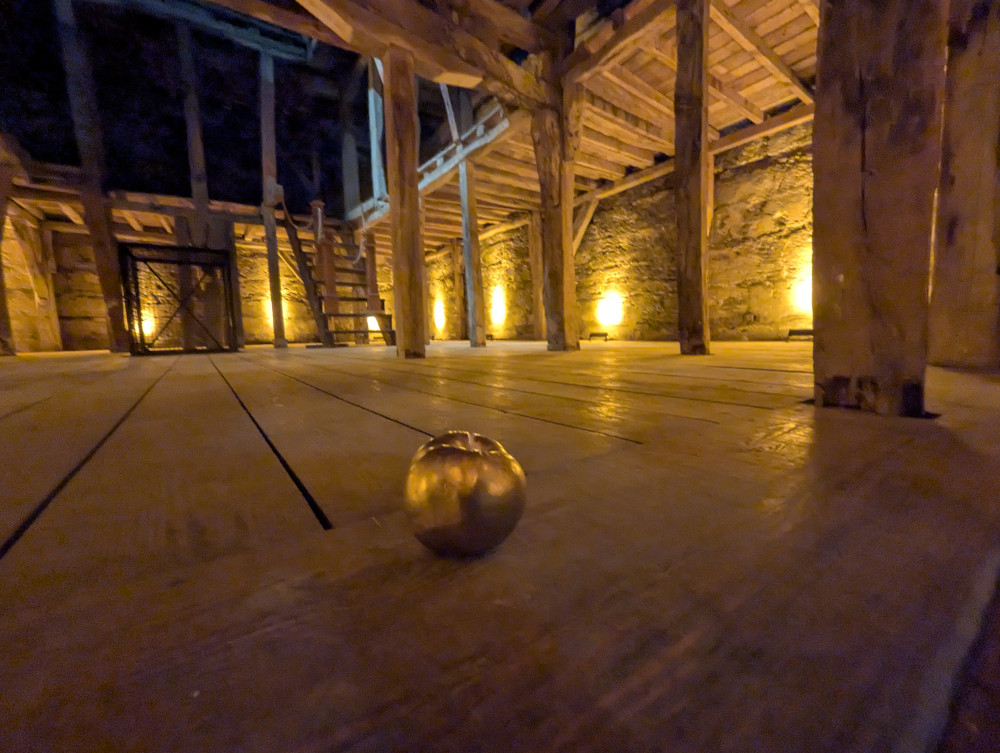
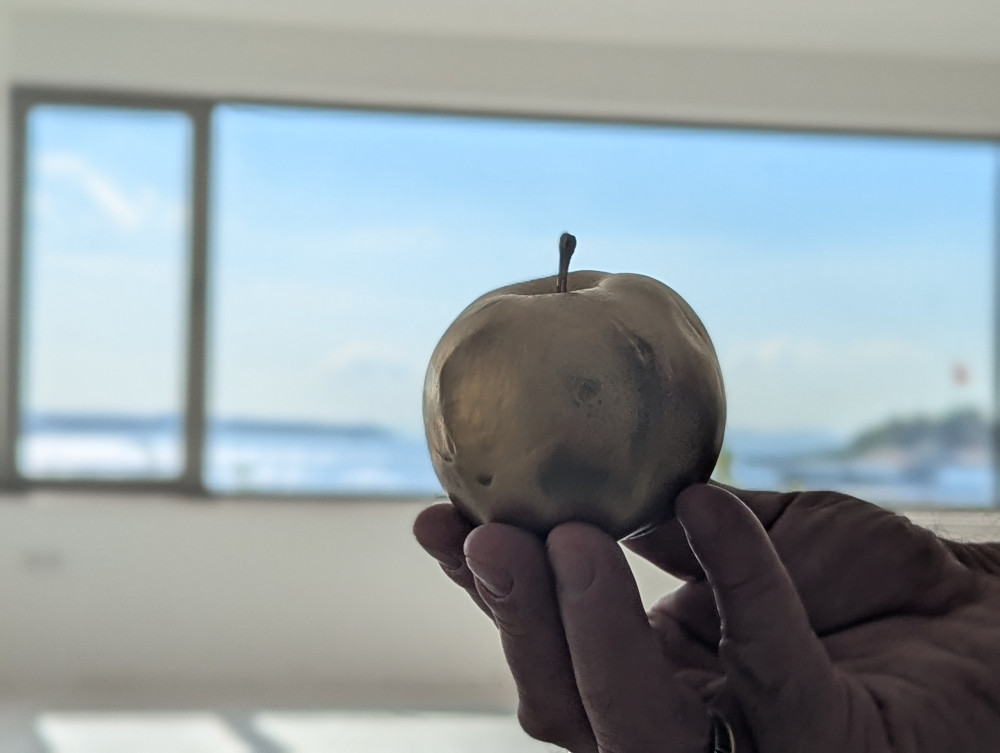
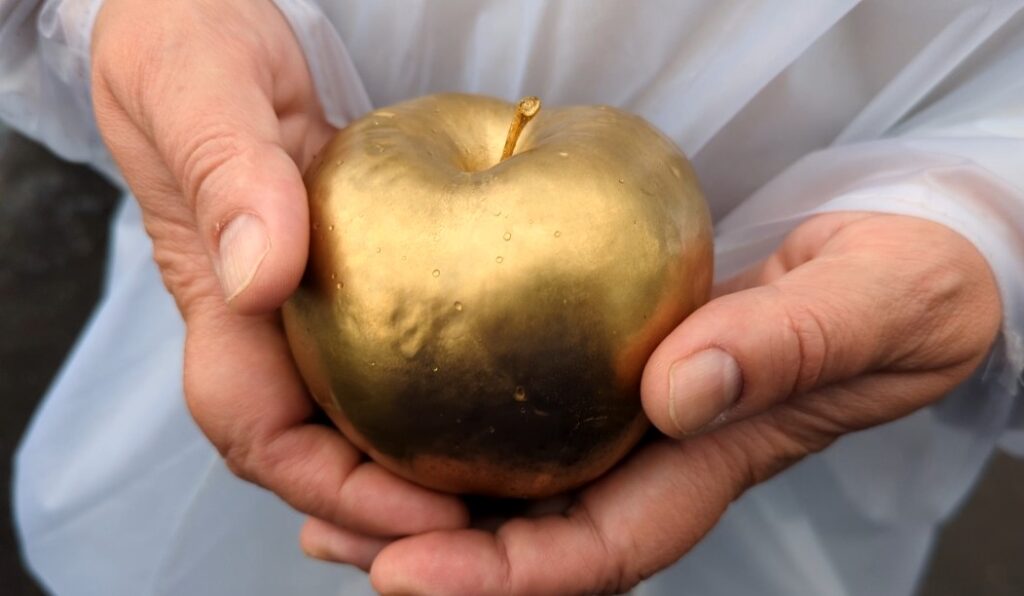
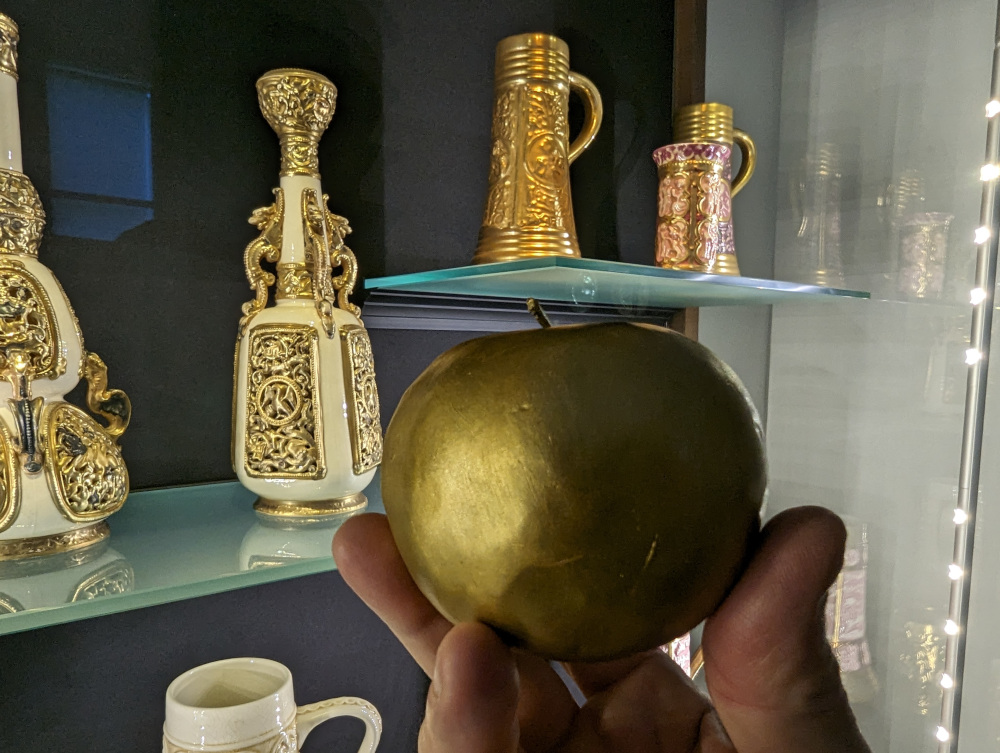
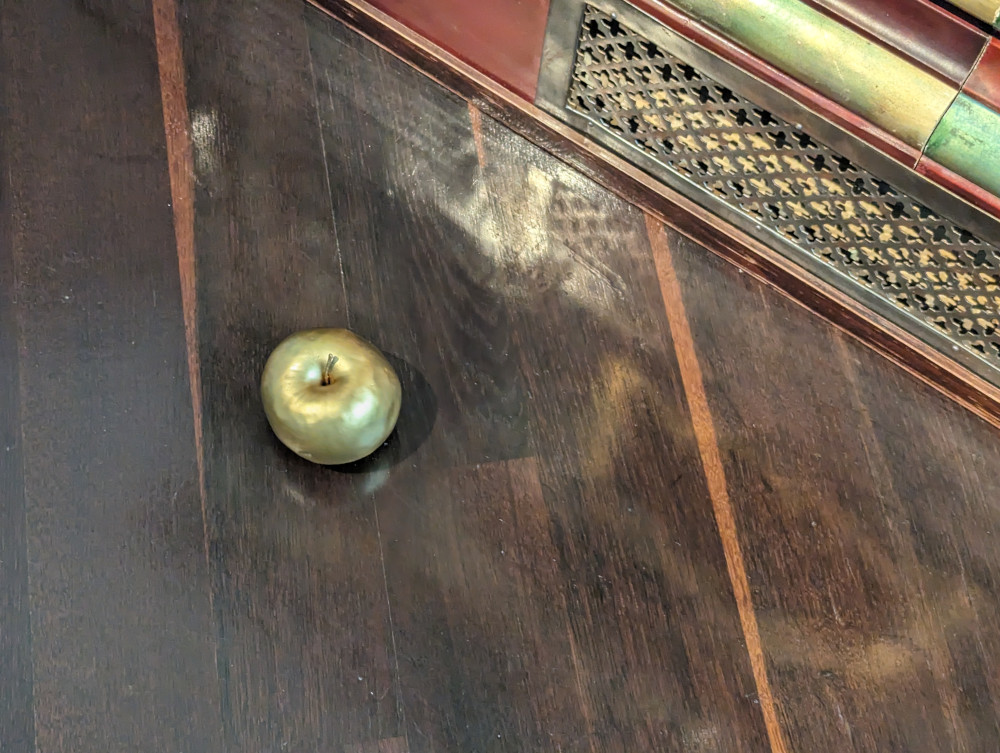
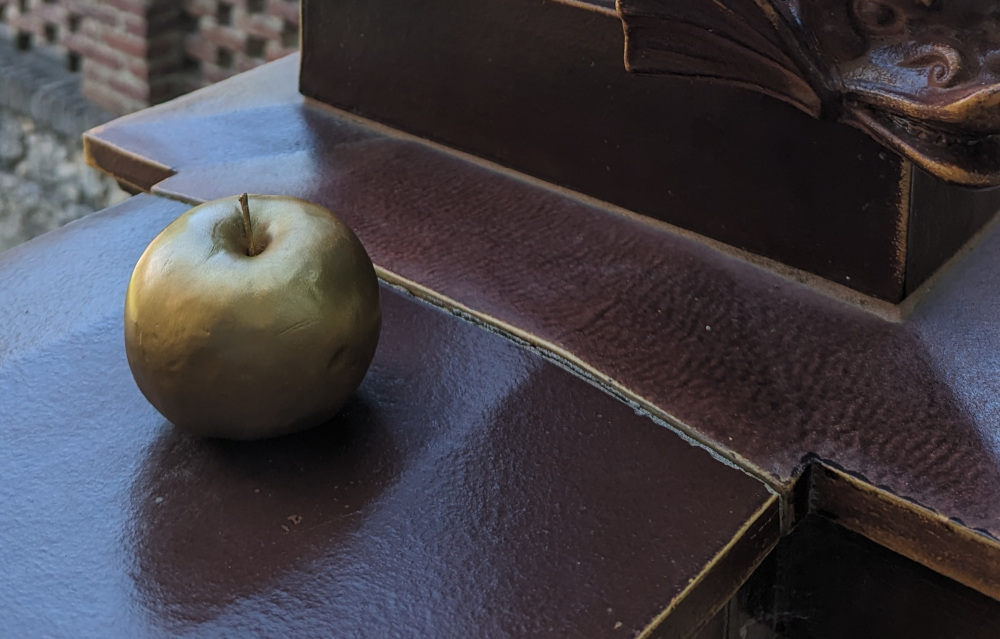
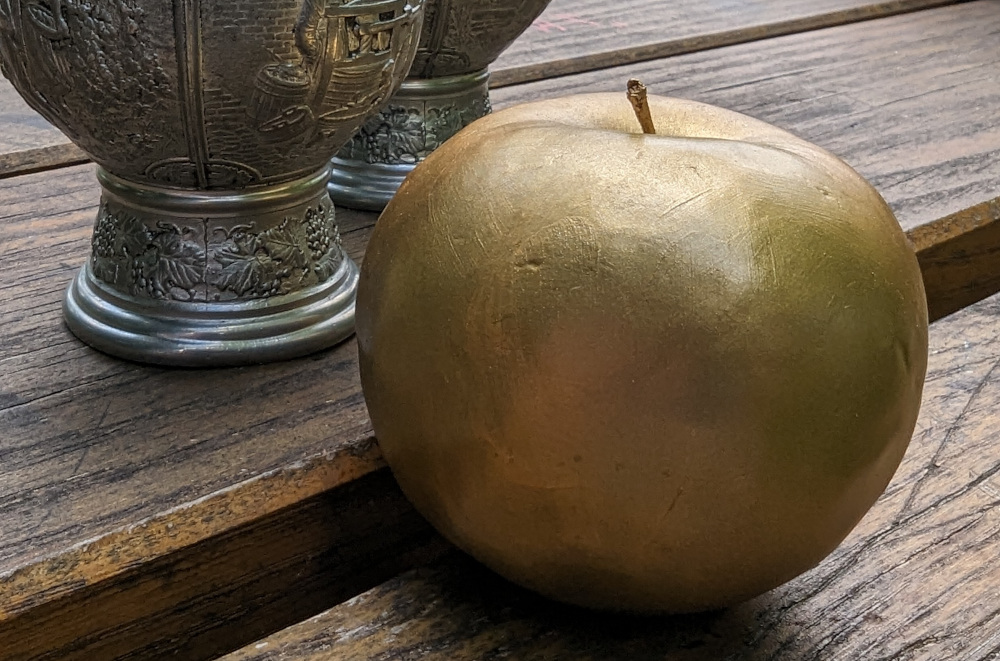
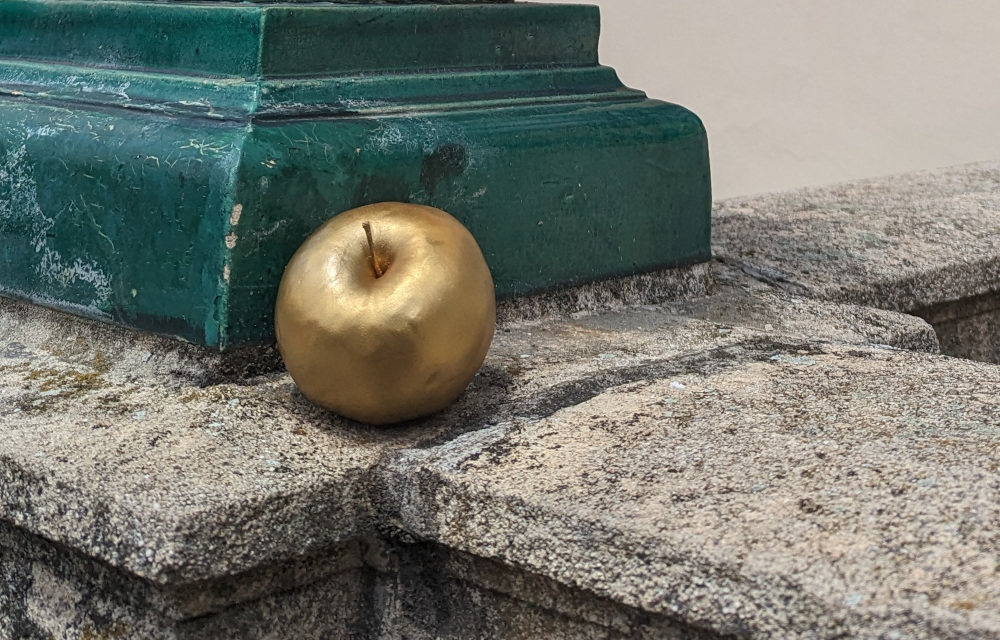
The Golden Apple of Istanbul is a site-specific project unfolding through photography and a performative gesture. It explores how symbols travel through cities, histories, and bodies, and how meaning shifts when an object moves from being held to being released.
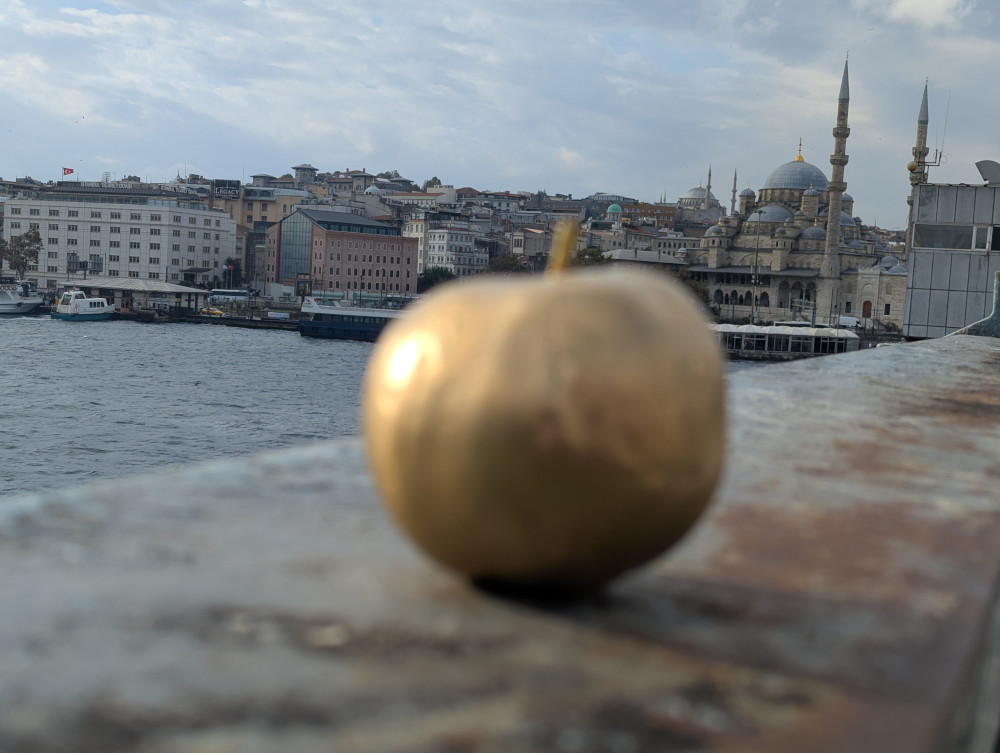
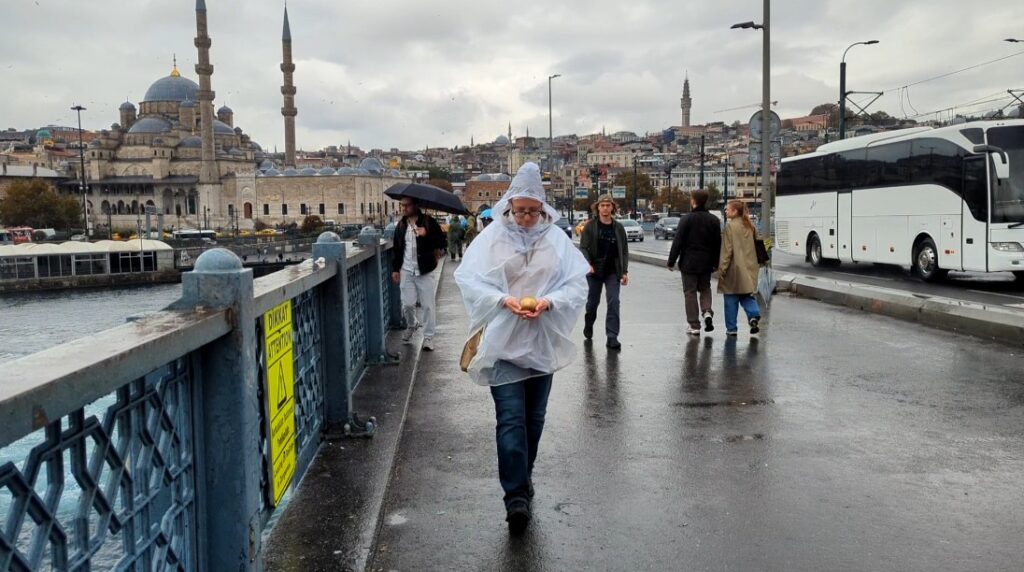
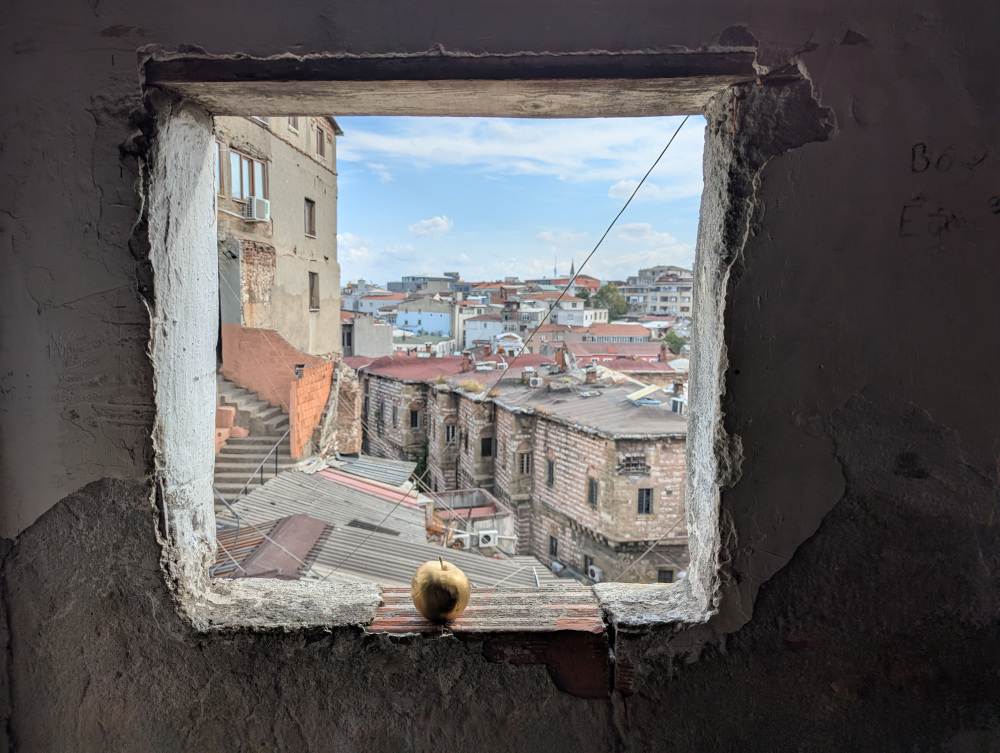
A real apple, coated in gold paint, appears across historical and everyday locations in Istanbul. Photographed against the textures of the city (streets, bridges, water, architecture), it becomes both an object and a mirror, reflecting ideas of power, desire, value, and transience.
Photographic exploration
The first stage consists of a series of photographs made across different parts of the city. The golden apple is carried, held, placed, and framed within Istanbul’s layered urban landscape. Neither staged nor theatrical, these images register quiet encounters between the object and the city, moments of pause, attention, and subtle displacement.
The apple functions here as a wandering symbol. Once associated with conquest, imperial ambition, and ultimate reward, it is reintroduced into everyday space as fragile, temporary, and exposed to weather, touch, and time.
Performative gesture
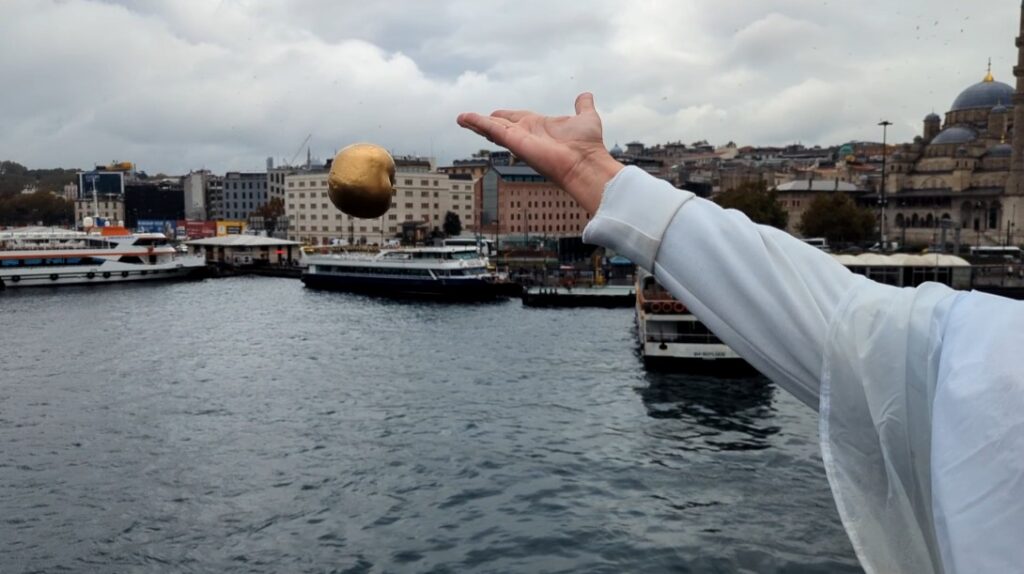
The photographic sequence culminates in a simple action. From the Galata Bridge, the golden apple is released into the Golden Horn.
This gesture transforms the apple from an image into an event. No longer possessed or displayed, it becomes an offering to the water, to the city, to history itself. Floating briefly among fishermen, boats, and passing gulls, the apple drifts without destination.
The act was carried out privately, without announcement, during a period of heightened artistic activity in the city, remaining outside any official framework. Passersby became incidental witnesses rather than an audience, encountering the action without explanation.
Conceptual context
Historically, Istanbul has been described as the “Golden Apple of the World”, a metaphor for power, desire, and the ultimate prize of empire. By releasing the apple into the Golden Horn, the project gently dismantles this image, shifting it from possession to passage, from monument to movement.
The golden apple ceases to function as a trophy. Instead, it becomes a message without an addressee, a symbol set free and allowed to drift, disappear, or transform.
Process and documentation
The project is documented through photography, preparatory images, and a series of photographs from the performative action. Video documentation will be added as an extension of the work. Together, these materials form a narrative that exists between image, gesture, and memory.
What remains is not the object itself, but the trace of its journey, a fleeting intervention connecting city and artist, myth and everyday life, holding and letting go.
Golden Apples: a visual poem in five episodes Created for the 5th International Symposium of Land Art, 2025 | Rácalmás, Hungary
About the project Aranyalmás Rácalmás (Golden Apple Rácalmás) is a site-specific visual poem exploring memory, dreams, and transience. The project’s name plays with Hungarian words: Rácalmás is a town whose name contains the word “apple,” and Aranyalmás adds the image of a “golden apple,” a rare fruit symbolizing the uniqueness and value of the place.
The series unfolds in five episodes, where golden apples guide the visitor through questions of presence, attention, and letting go. Each episode combines objects, gestures, participatory actions, and photography to create ephemeral narratives across the island and the bridge.
Prologue
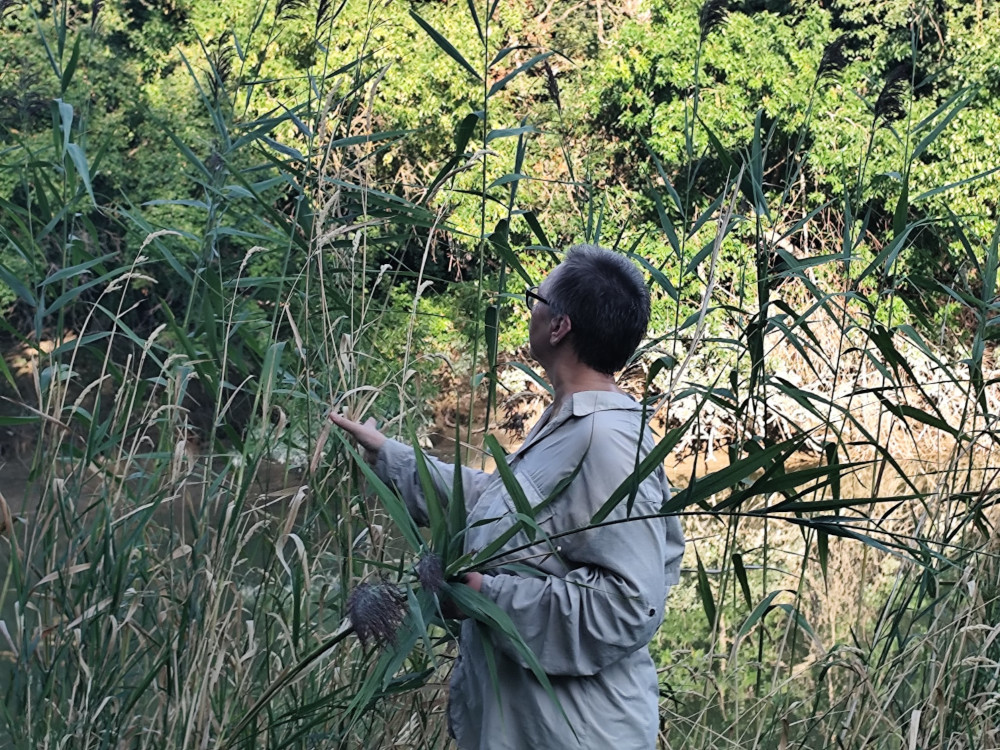
On the island, among trees and grasses, the promise of paradise appears both evident and hidden. Every apple becomes a question, a memory, a dream, and a treasure. Some apples embark on a journey along the water, carried by currents of life and time; others remain, waiting to be discovered. This project is about transience, choice, and transformation, and how we preserve and reshape memories.
Episodes Overview
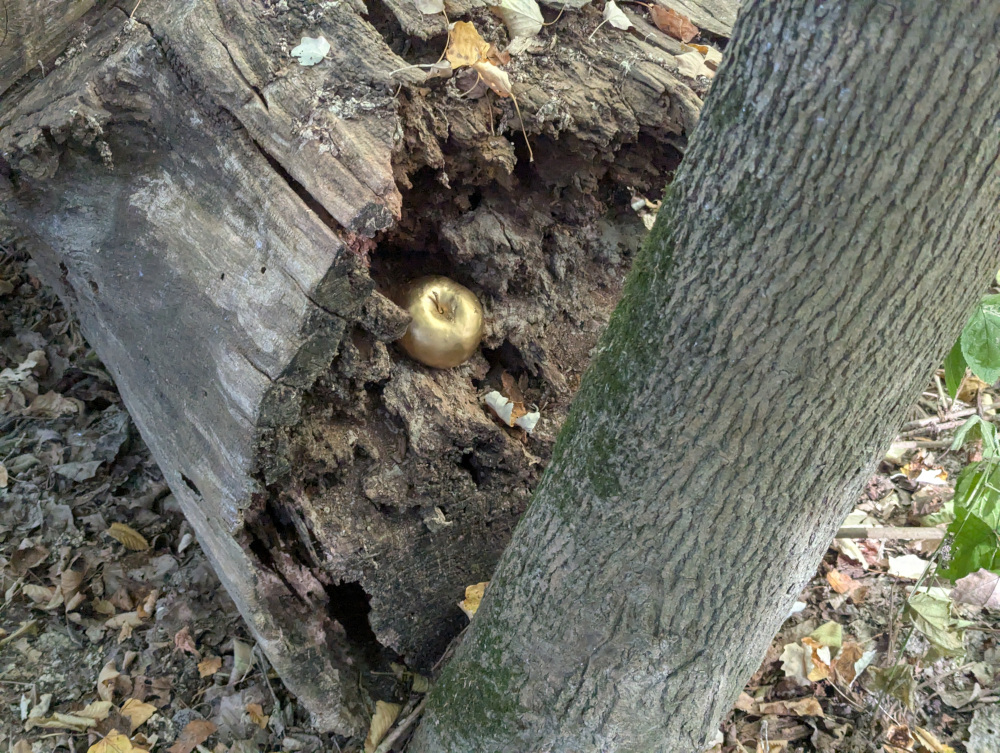
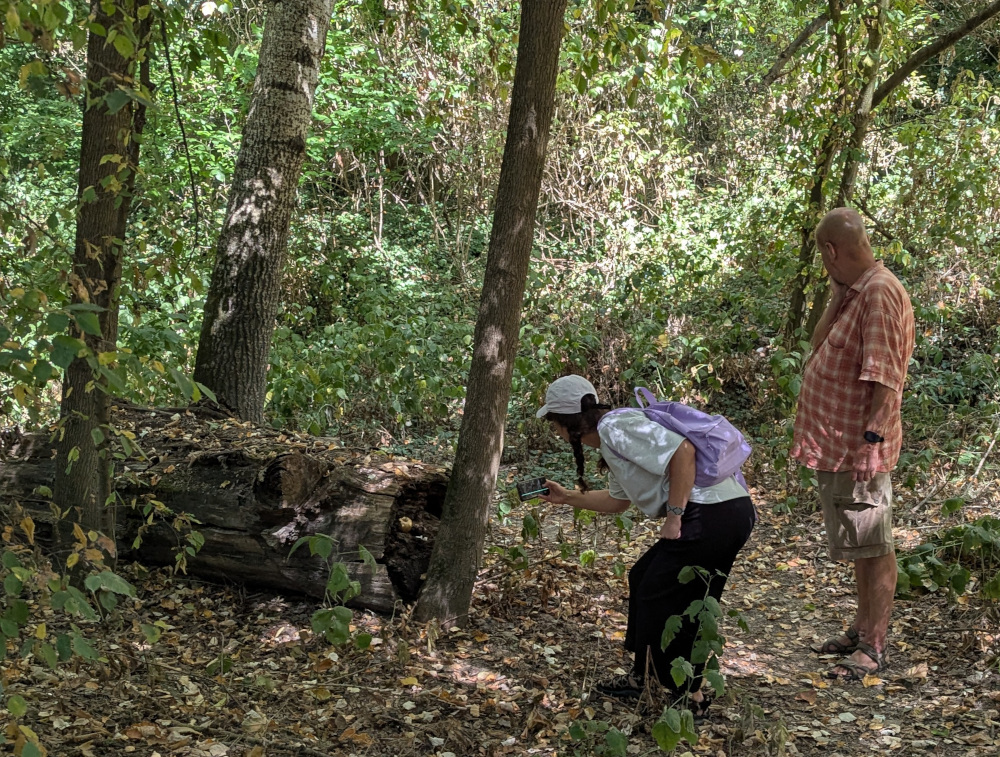
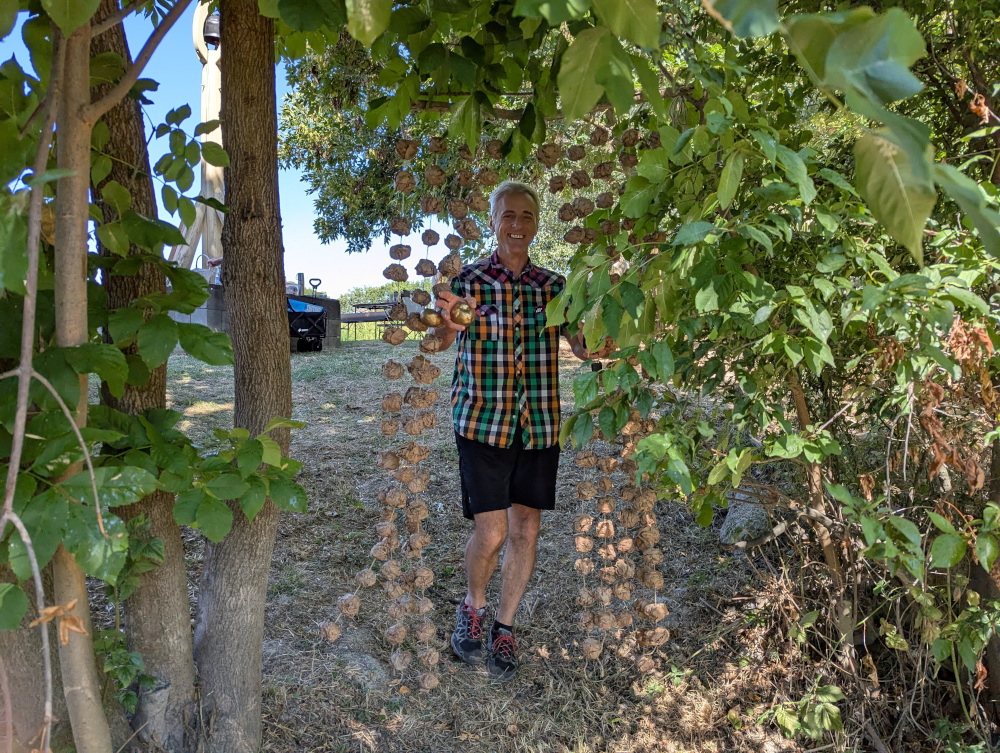
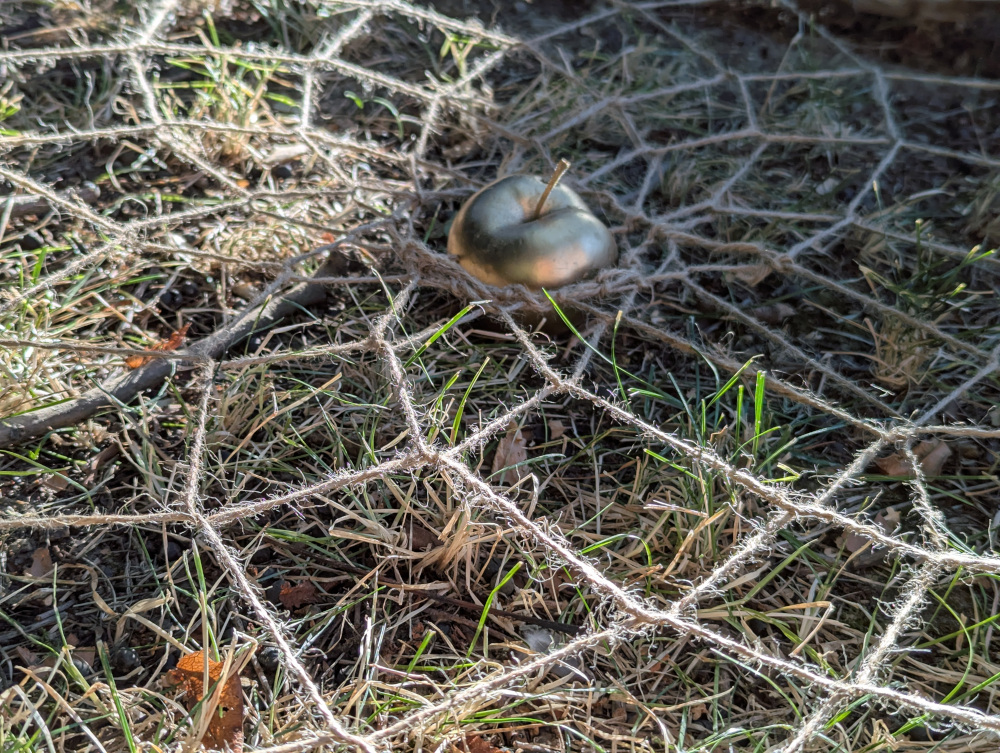
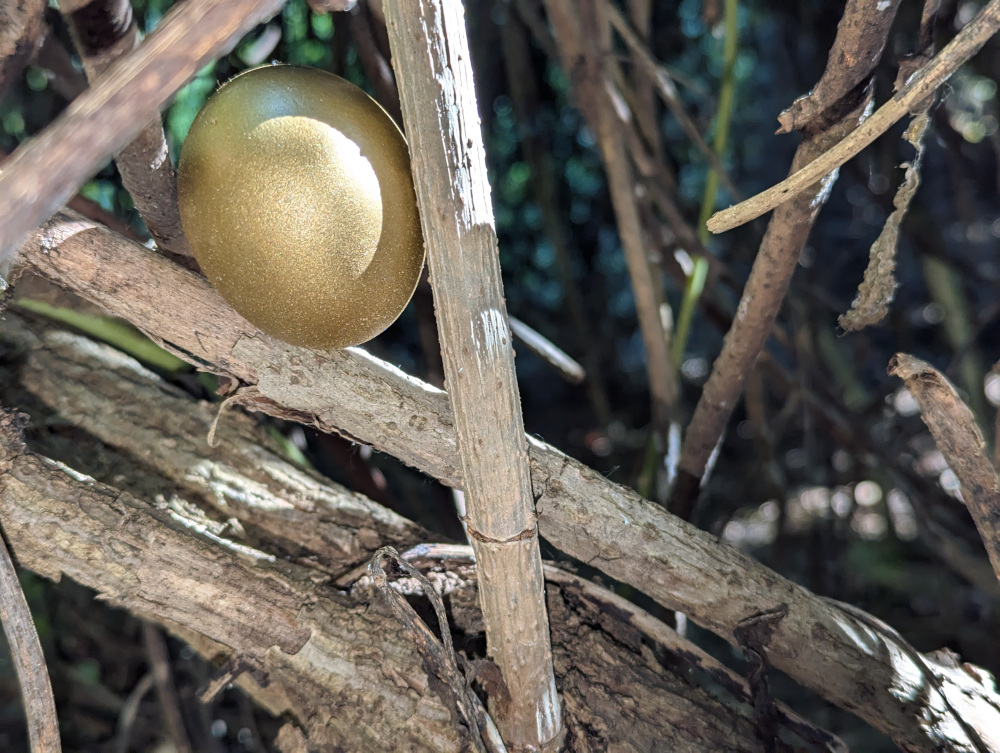
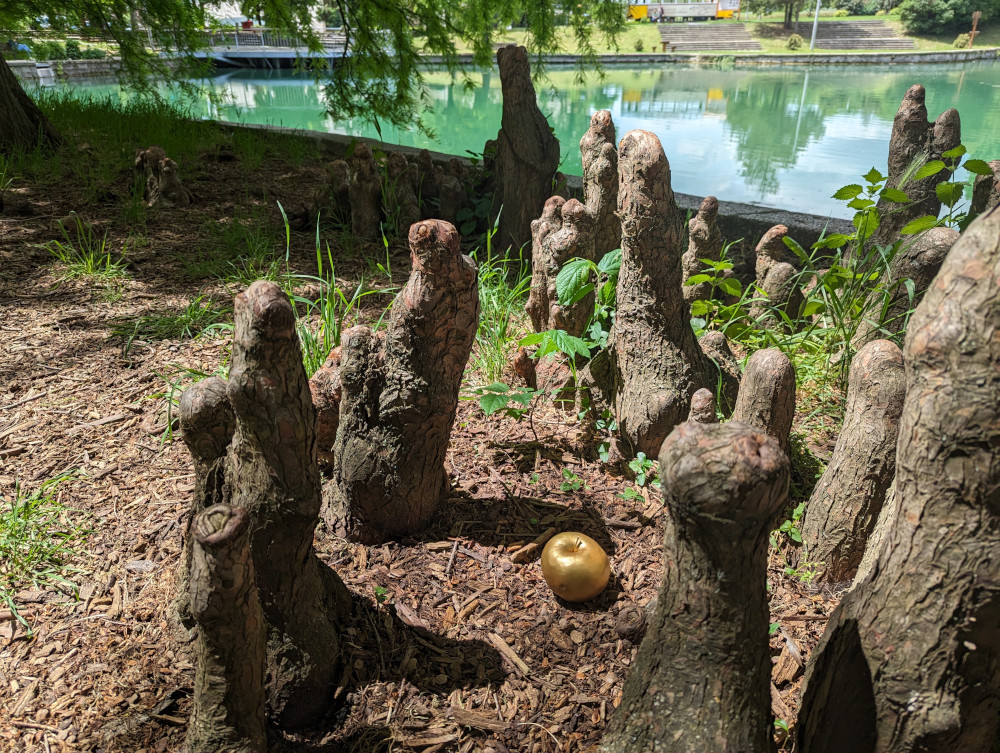
Episode 1. Almák-Álmok / Apples-Dreams Apples are the fruits of nature. Dreams are the hidden fruits of the soul. Golden apples are hidden on the island among roots and driftwood. To those who find them – joy.
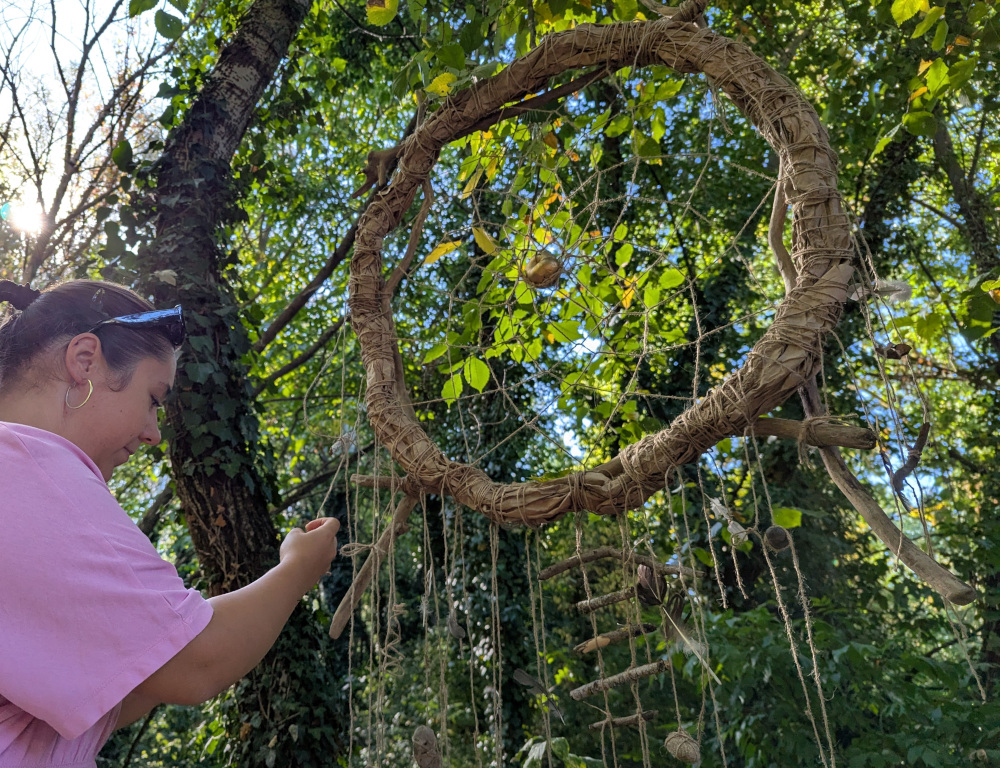
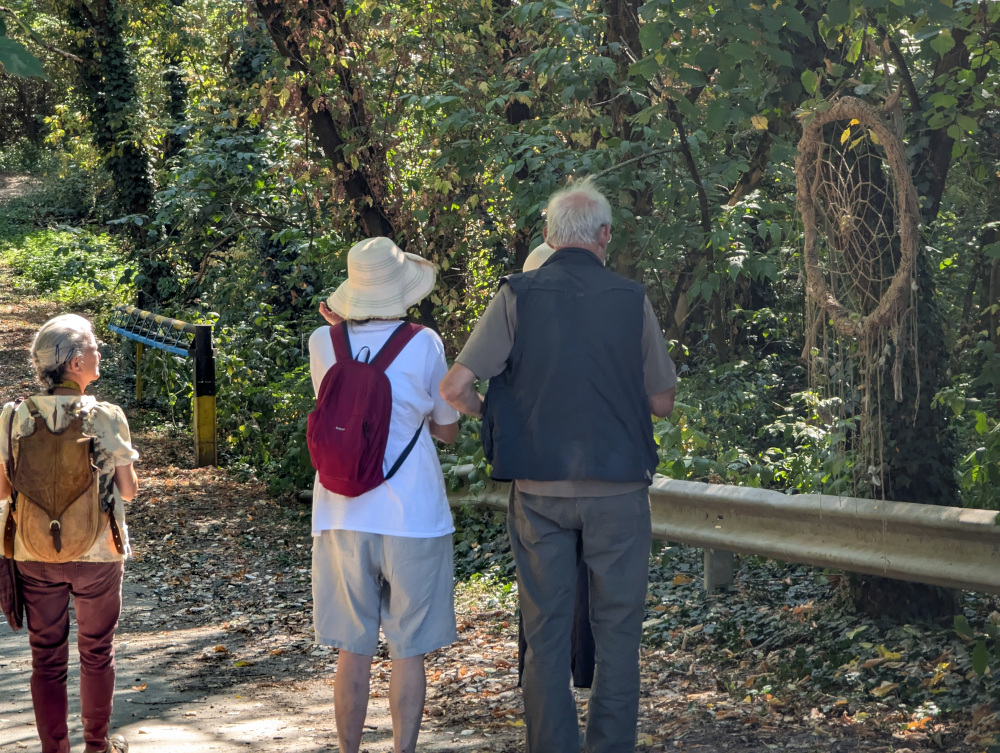
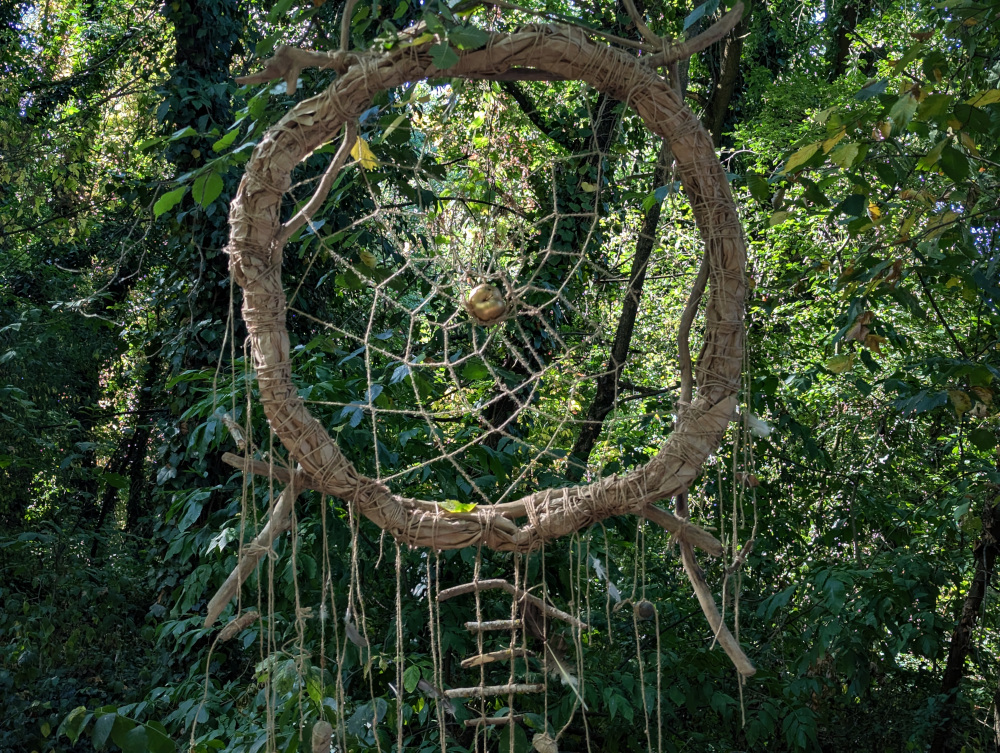
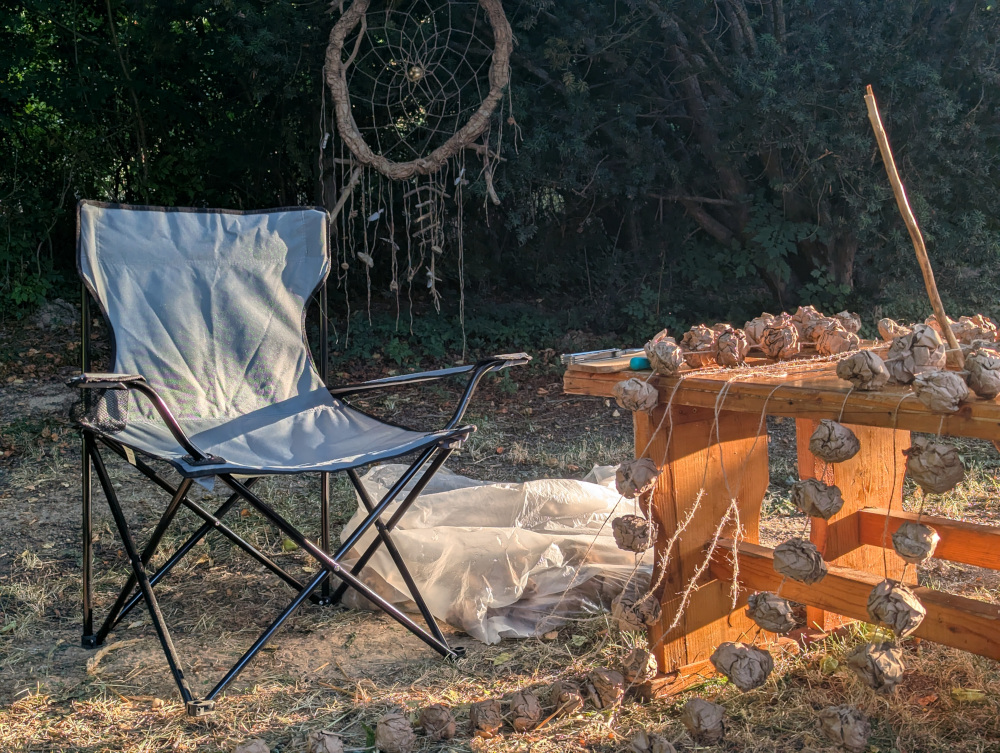
Episode 2. Álomfogó – Almafogó / Dreamcatcher – Apple Catcher A special catcher gathers dreams and wishes. Visitors can tie pebbles, feathers, or knots to its threads, leaving traces of their own stories.
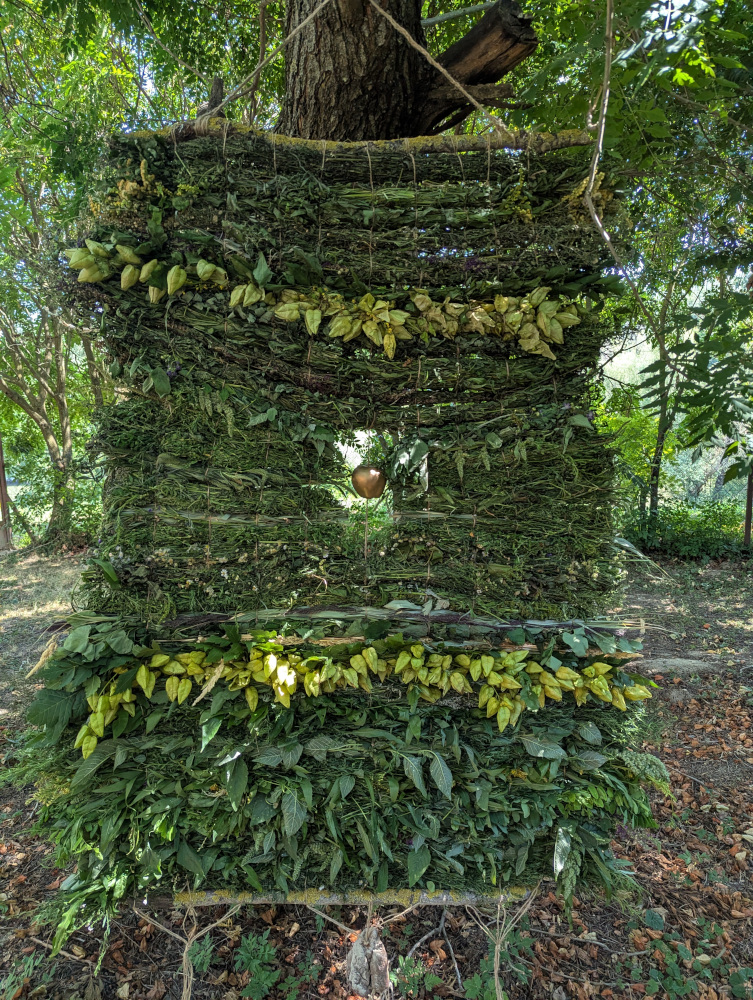
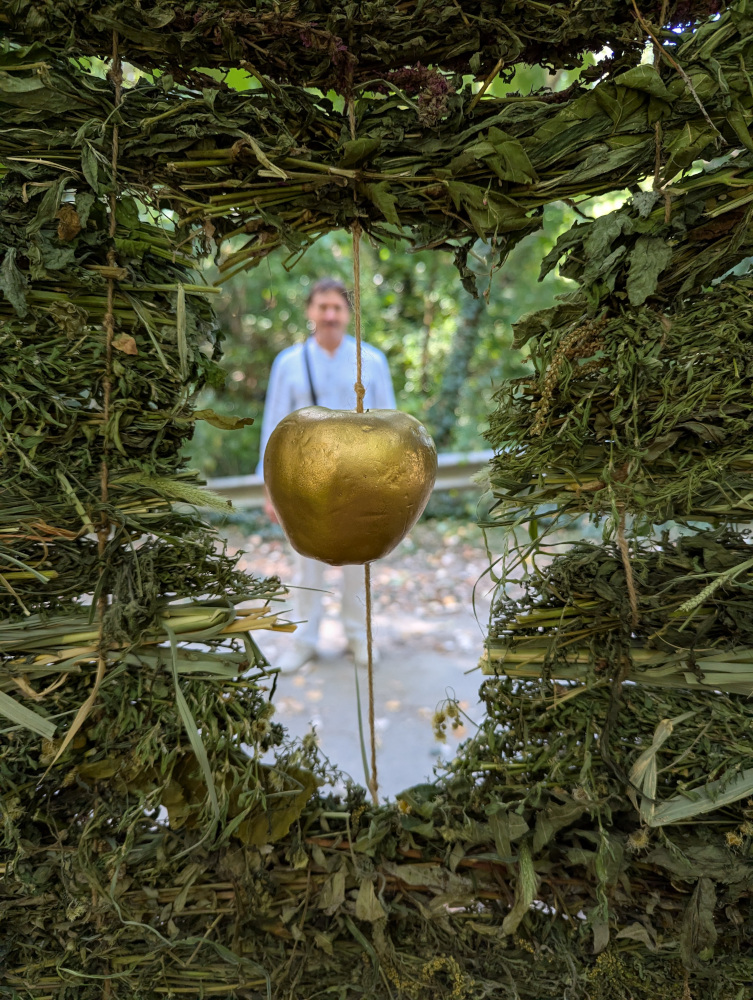
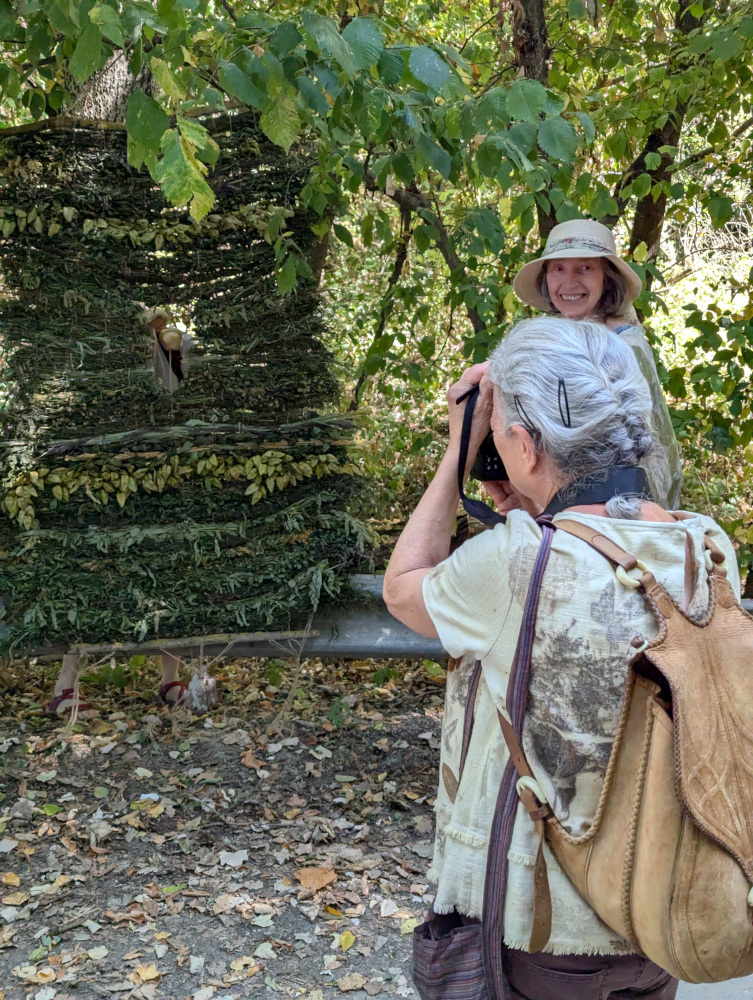
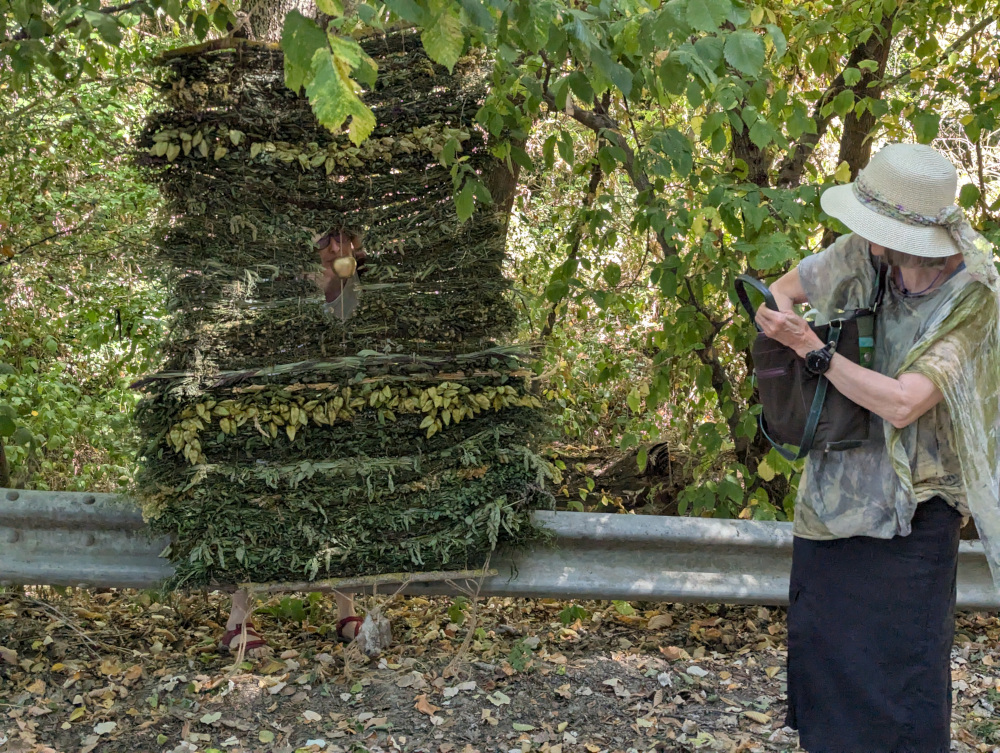
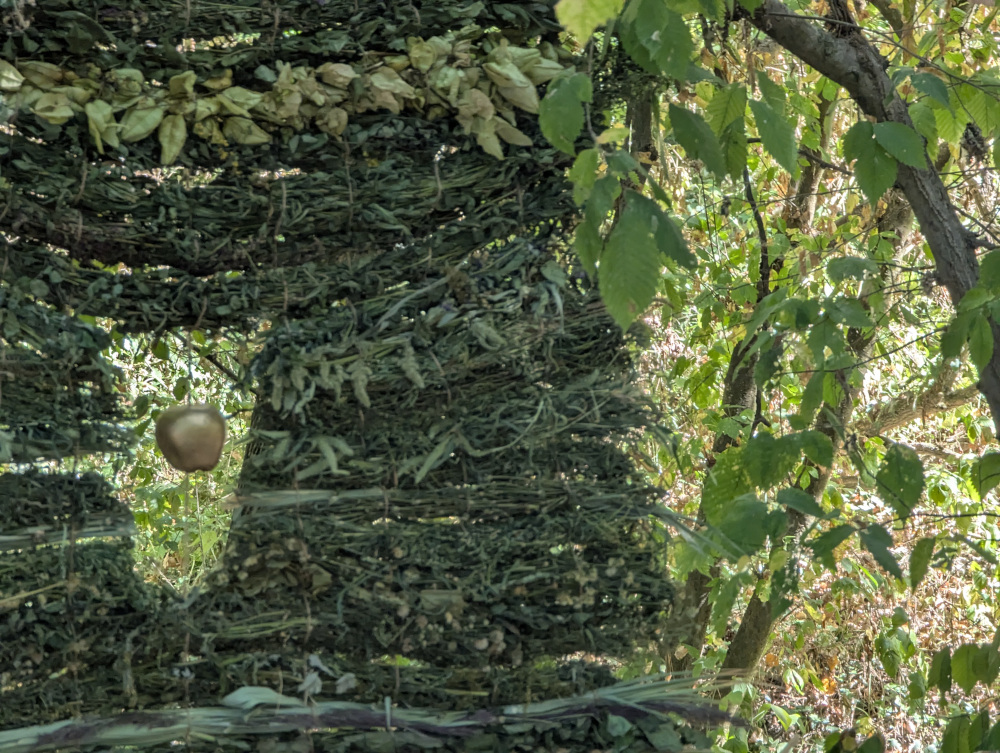
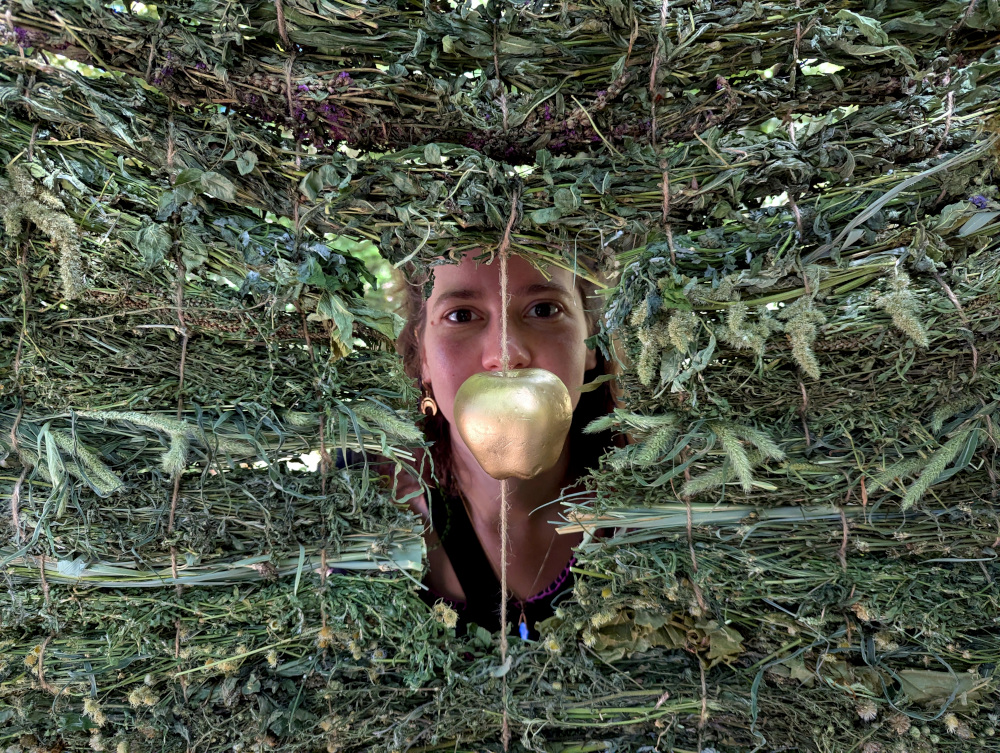
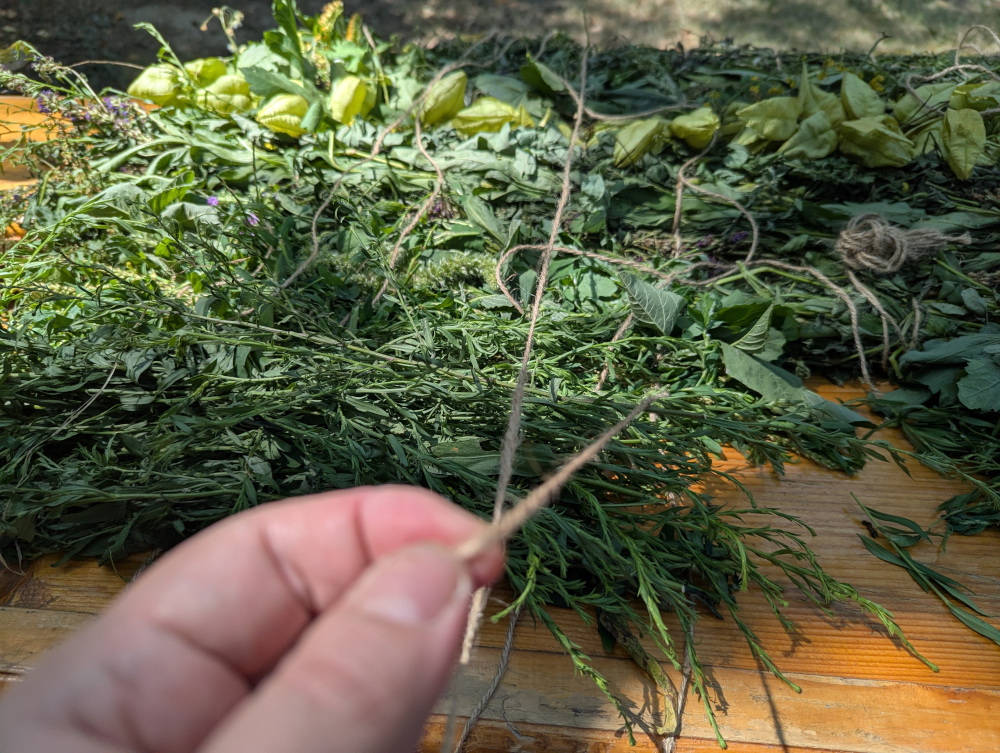
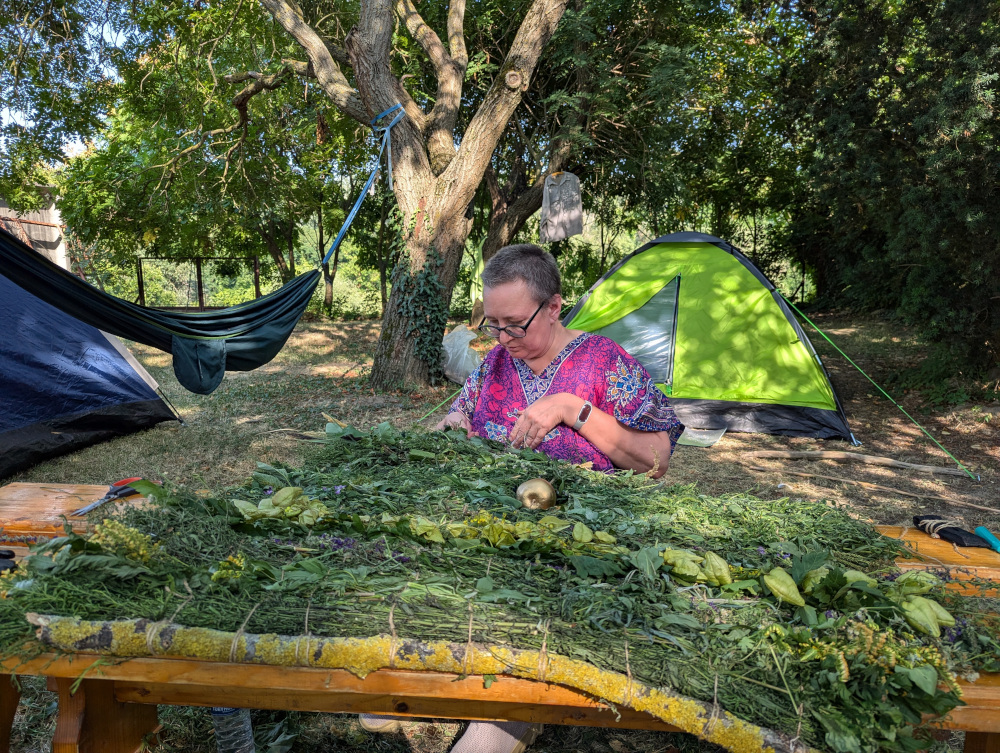
Episode 3. Fűggöny / Grass Curtain Grasses woven into a mat frame a golden apple at the center – the heart of the island. Visitors can photograph through the golden apple, capturing fleeting moments.
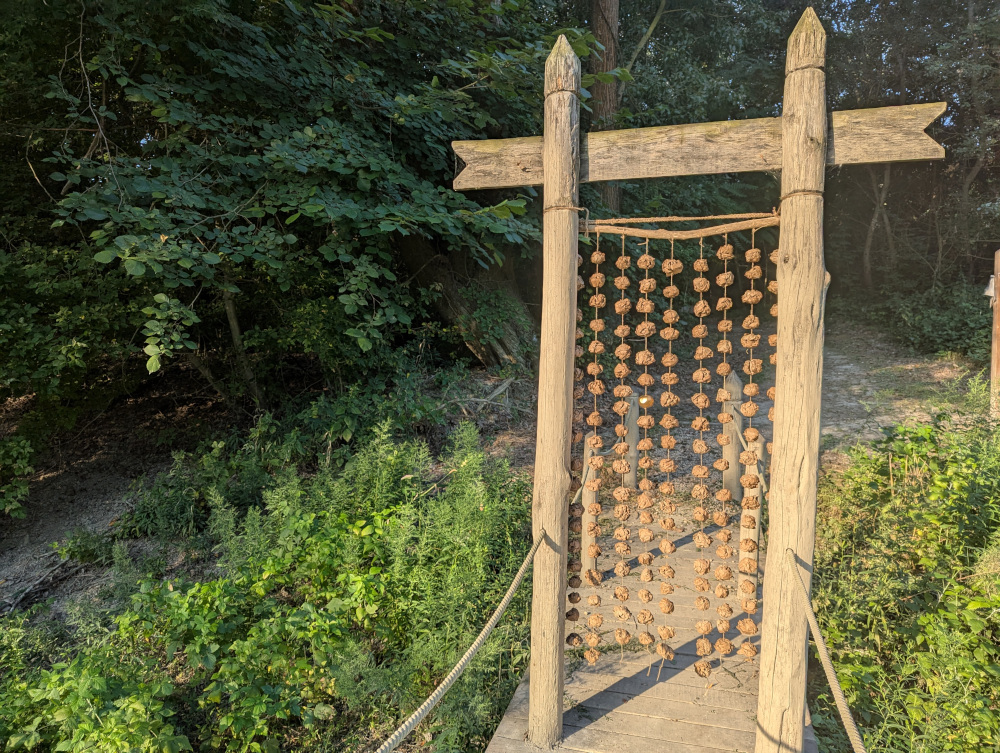
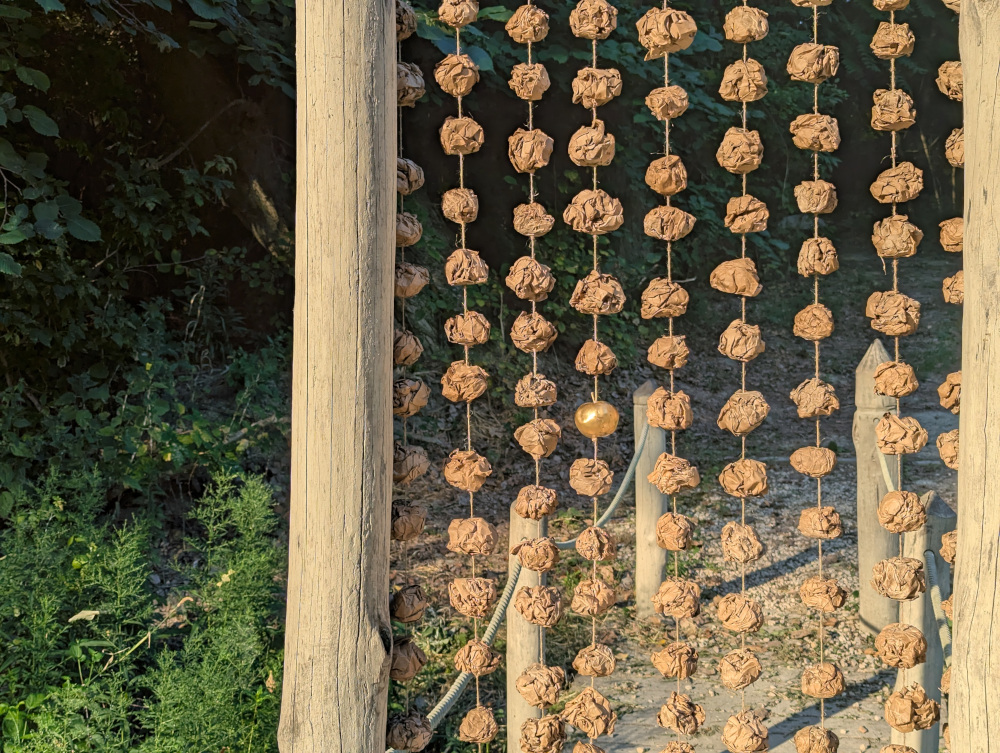
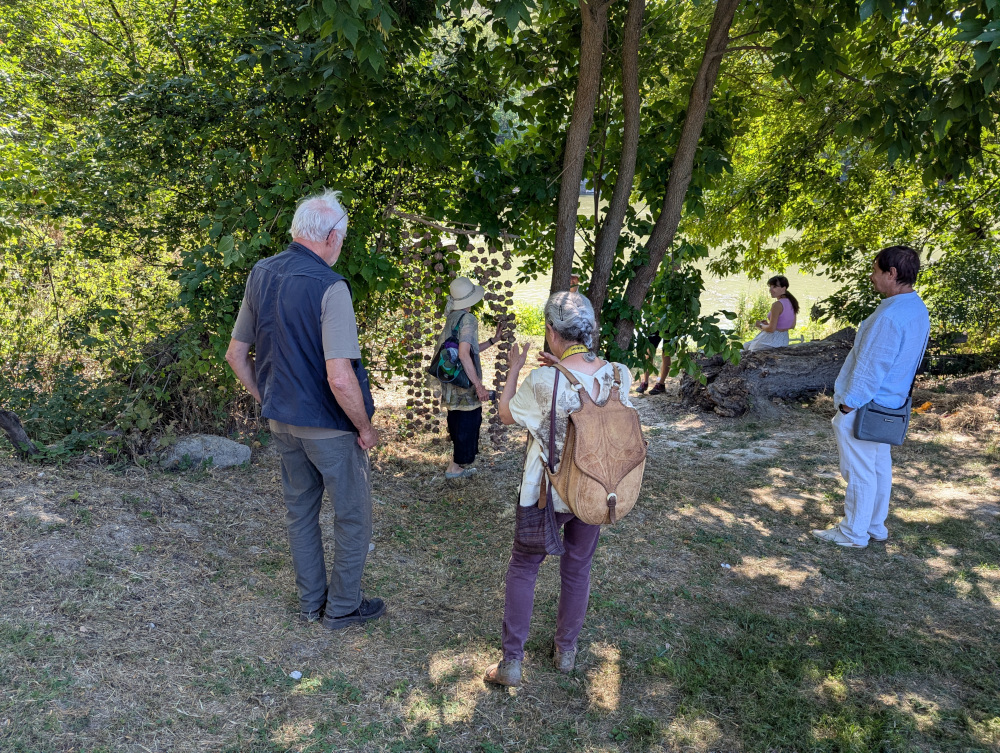
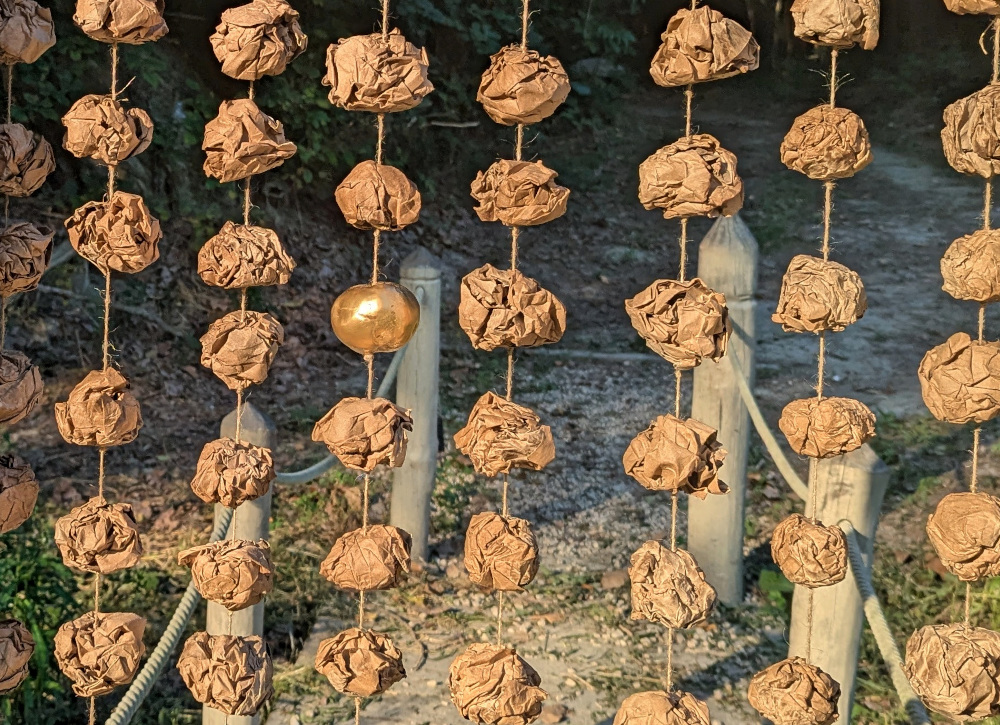
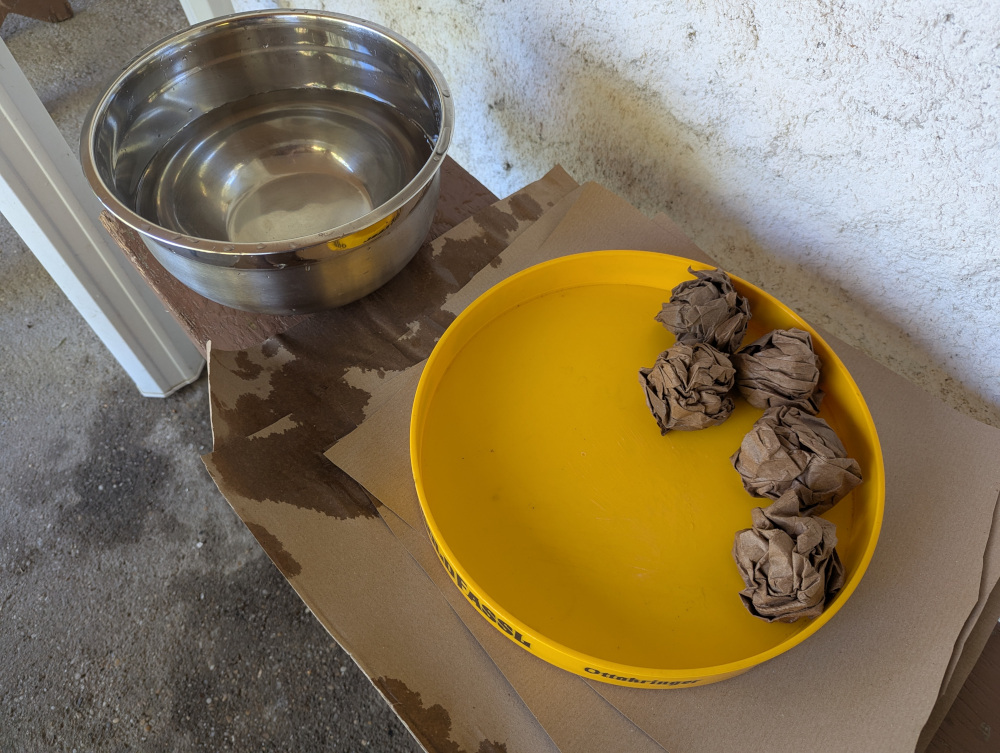
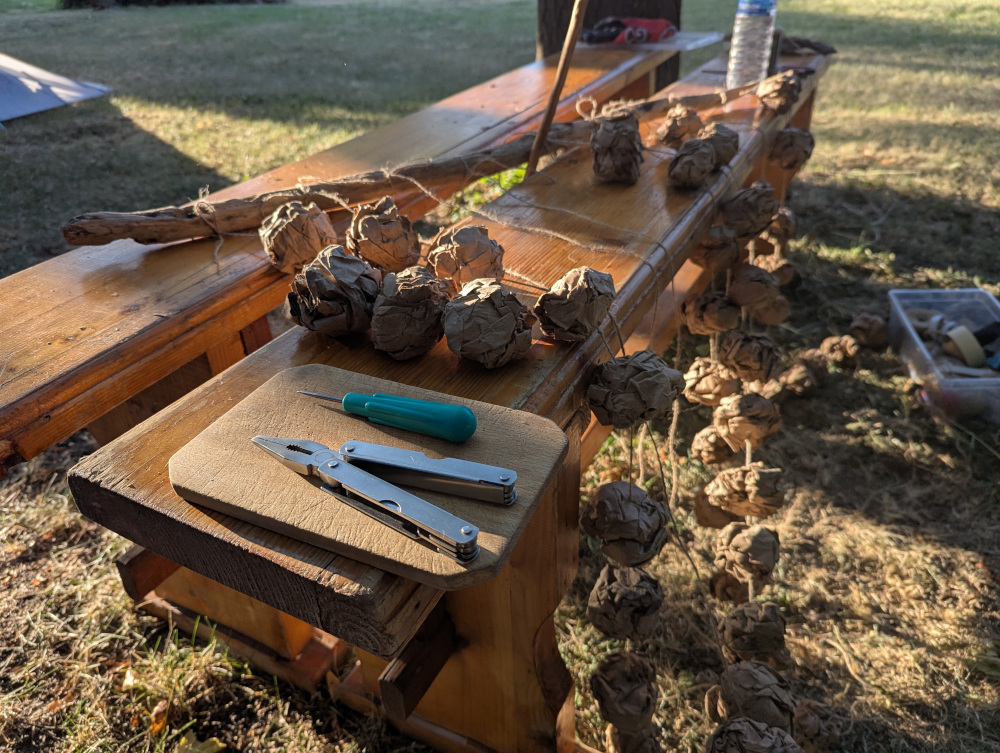
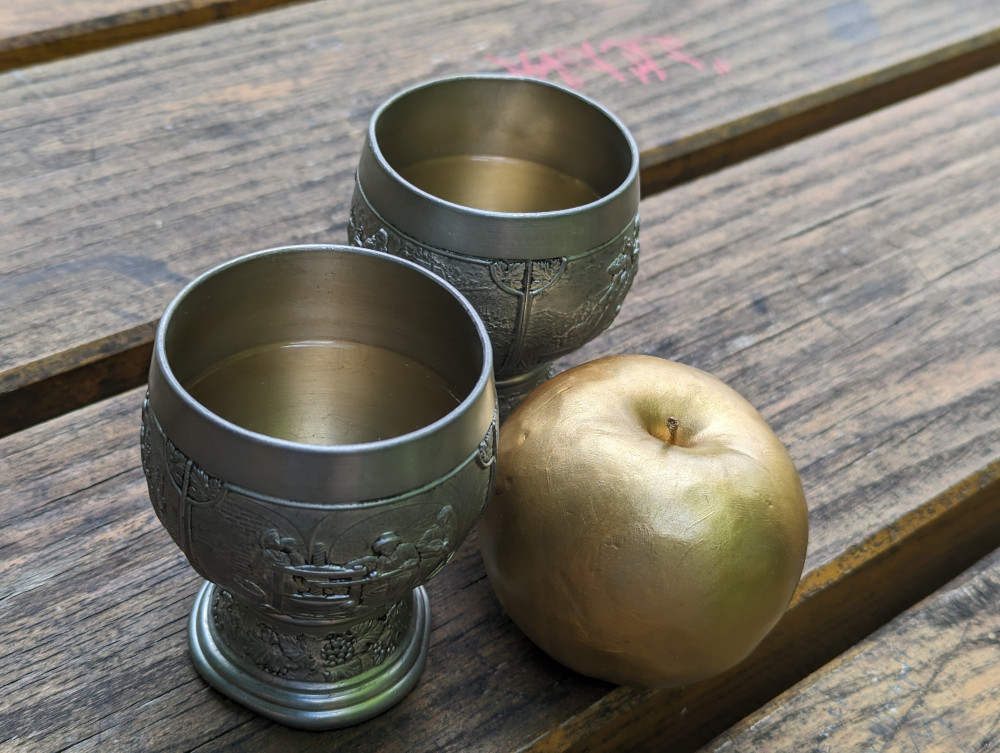
Episode 4. Különleges? / Something Special? Among a hundred crumpled paper balls, a golden apple shines in the sun. This object invites reflection on how we seek the special and how it transforms perception.
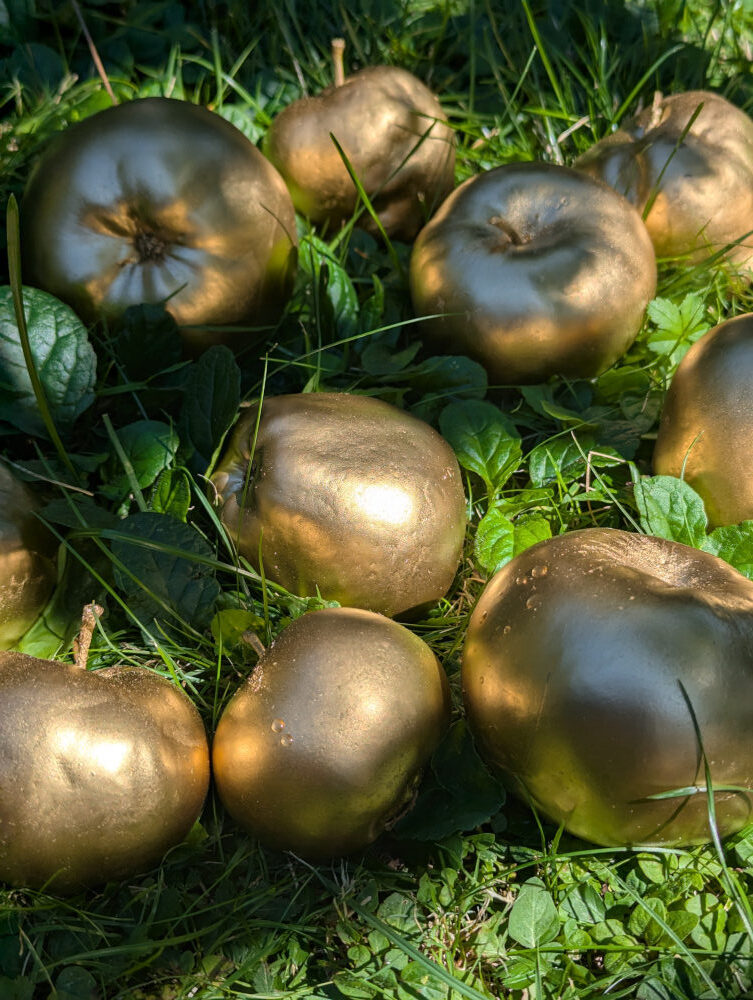
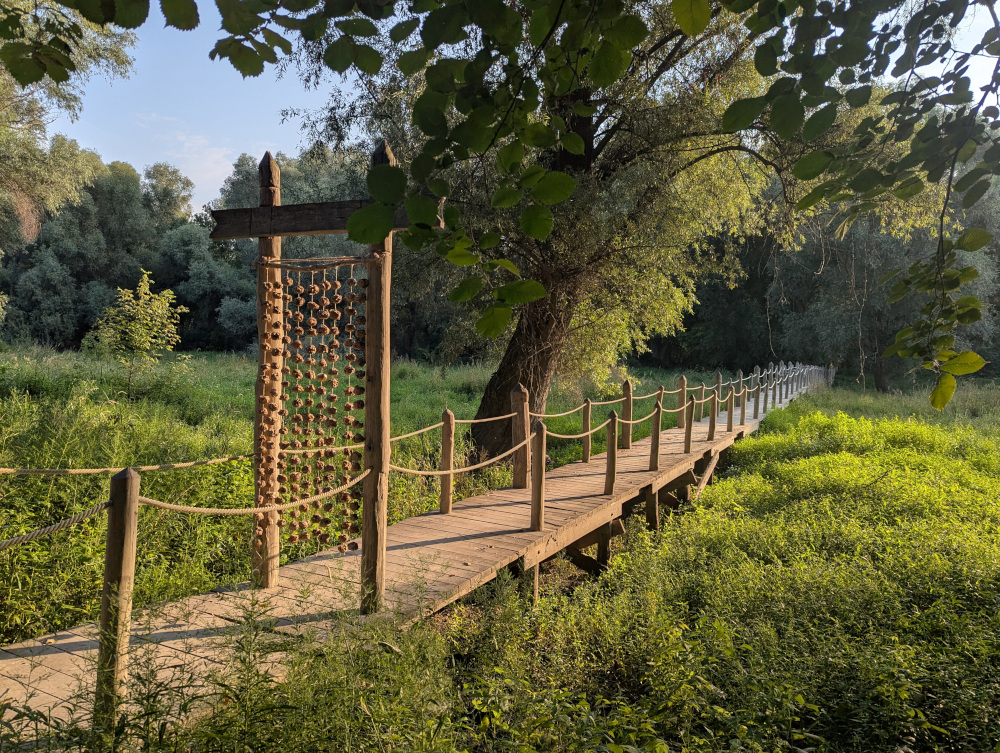
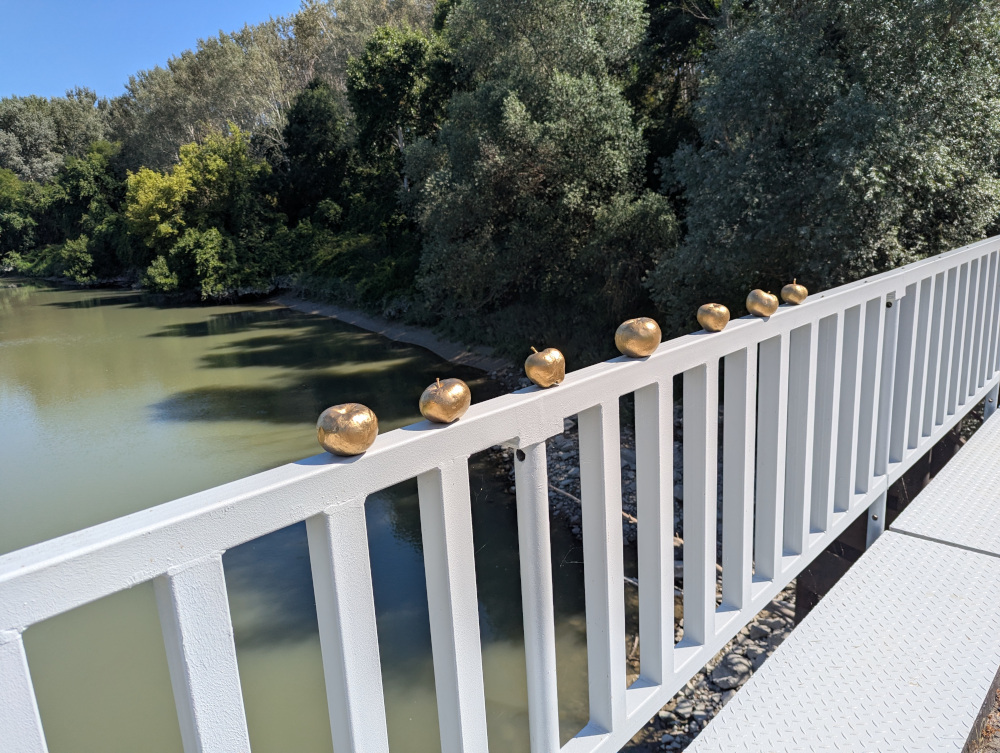
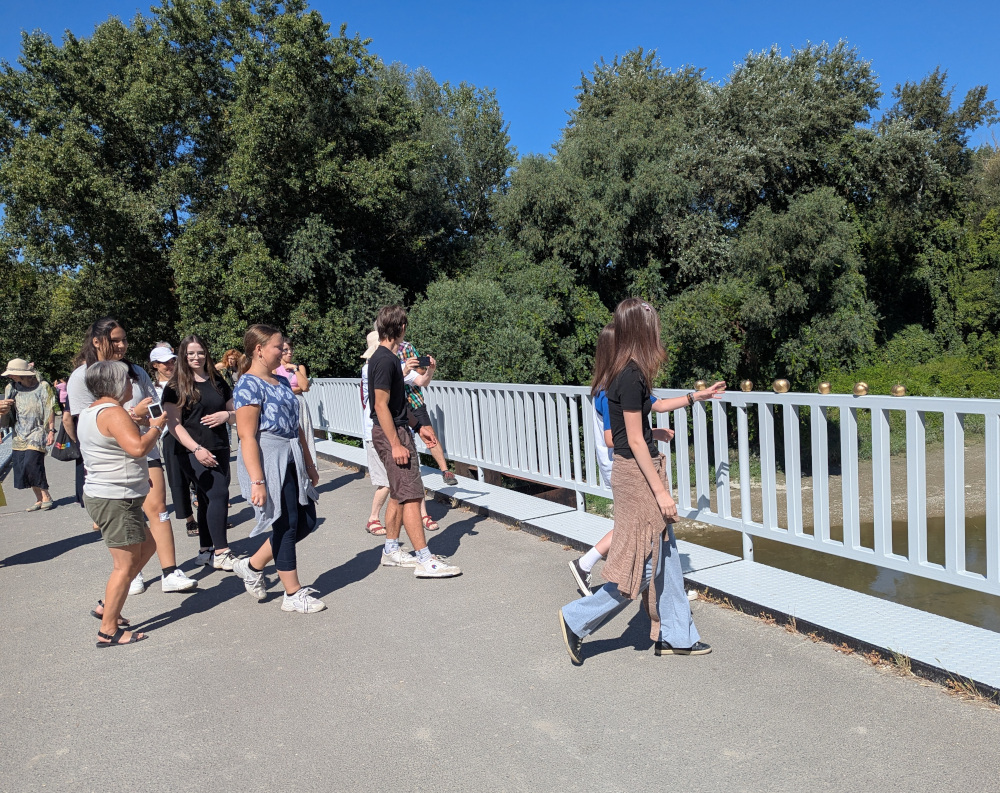
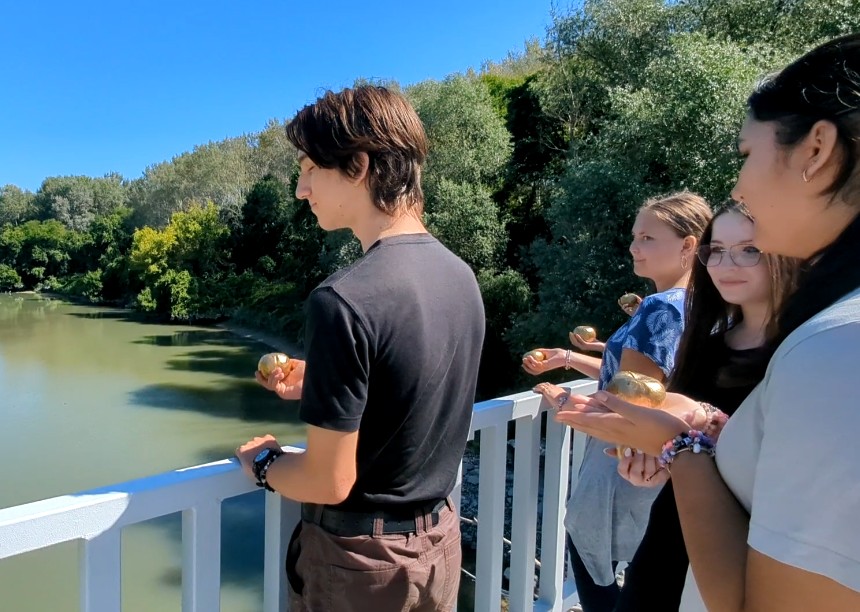
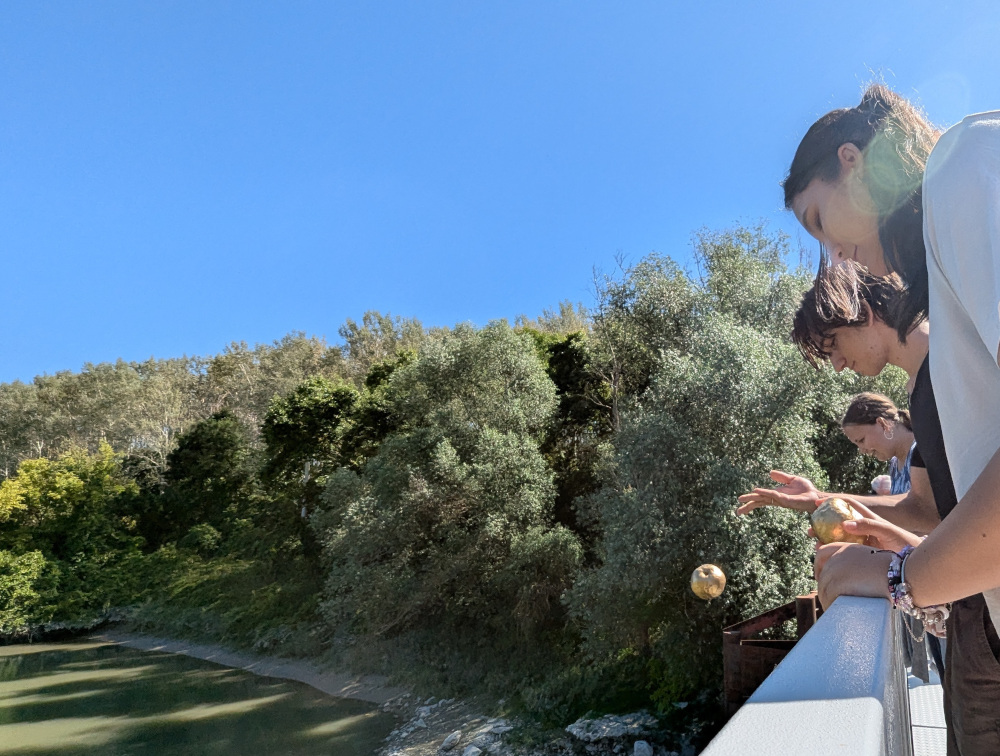
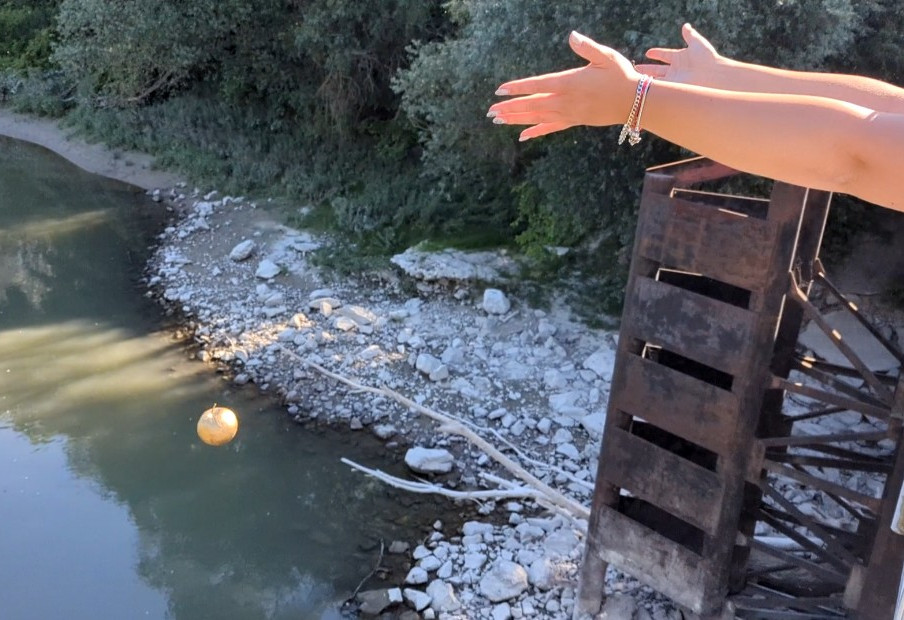
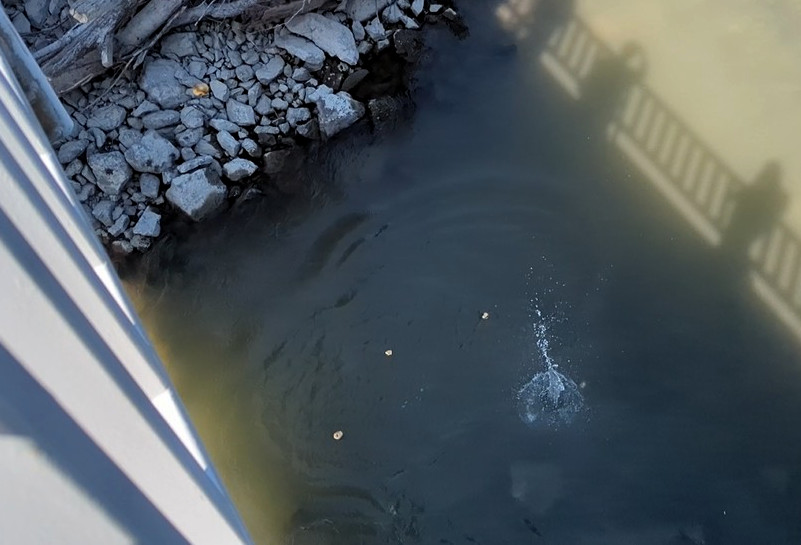
Episode 5. Híd álma – Hét alma / Dream of the Bridge – Seven Apples Seven golden apples are cast into the water from the bridge, drifting away like dreams released into the flow of life. Visitors witness the happening and the act of letting go.
Process
The project was created during August 12–19, 2025 in Rácalmás, Hungary, as part of the symposium dedicated to Sándor Márai’s The Herbalist and in homage to the work of Mária Bartuszová.
An artist book documents the visual poem and the process of the Golden Apples project.
Exhibited at
“Bridge” exhibition, 2025, Rácalmás, Hungary
“In the Footsteps of Time” exhibition, 2026, Várnegyed Galéria, Budapest, Hungary
Golden Apples is a series of site-specific projects exploring transformation, ritual, and perception. Through subtle gestures, objects, and photography, ordinary spaces are turned into stages for ephemeral interventions.
2025 The Golden Apple of Istanbul2025 Aranyalmás Rácalmás2024 An Offering to the Sphinx
The golden apple—symbol of desire, knowledge, and exchange—becomes a catalyst for attention and meaning. Each episode engages the environment, participants, and the artist, creating fleeting narratives that exist in memory and image.
The series works as a conceptual principle, allowing the idea of “golden apples” to unfold across locations and forms, while each episode remains unique.
The project, developed in collaboration with Dmitry Razev, is dedicated to exploring the phenomenon of deer stones — both ancient and contemporary, archaeological and symbolic, real and imagined. In our work, we combine artistic and scientific approaches: we research, document, interact with, and interpret these stones through the method of Revealed Realism.
What Are Deer Stones?
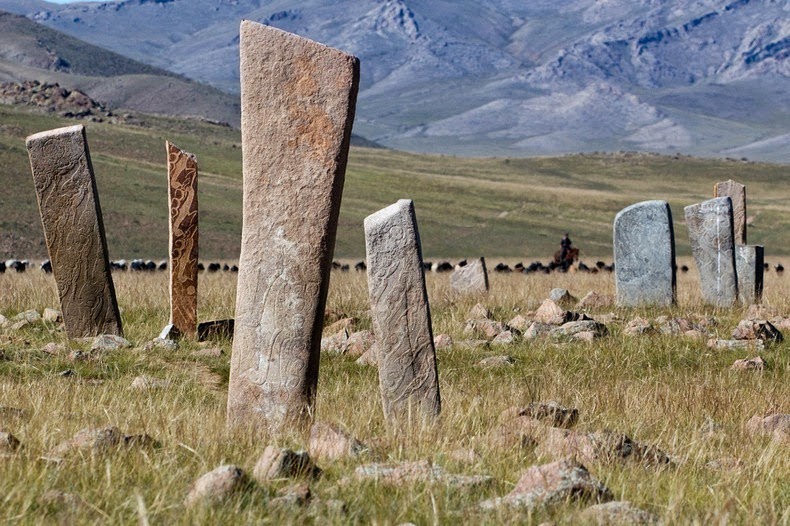
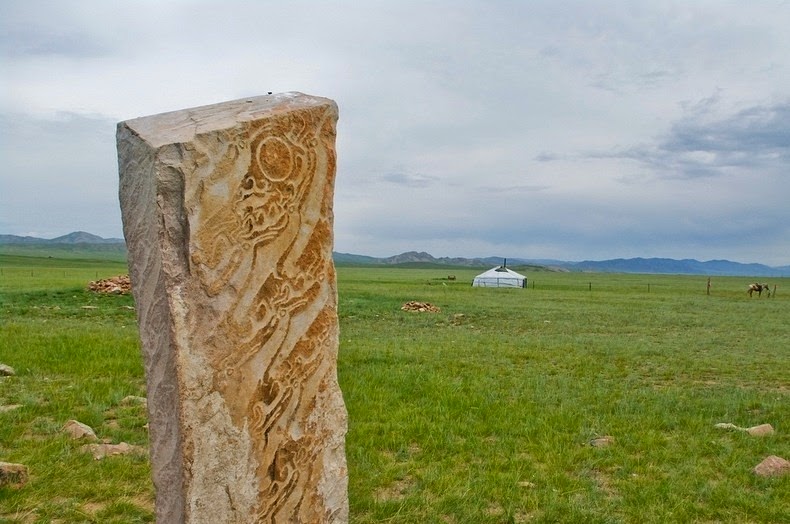
Deer Stones (Mongolian: Буган чулуун хөшөө) are stone stelae, often featuring anthropomorphic traits, with depictions of flying deer and other carvings. They range in height from 1 to 4.5 meters. These megaliths were created by ancient societies that existed between 1200 and 700 BCE in the territories of Mongolia and adjacent regions of Siberia.
Deer hold a prominent place on nearly all deer stones. The image is based on the Siberian subspecies of red deer (Cervus elaphus sibiricus). Early stones show very simple depictions of deer; over time, the drawings become more detailed. A gap of 500 years leads to the emergence of complex images of flying deer. The deer are depicted specifically as flying through the air, not merely running on the ground. Their antlers become elaborately decorated, featuring extensive spiral patterns that can cover the entire deer. Sometimes the antlers hold a solar disc or another sun-related symbol.
Deer stone, Khovsgol Province, Mongolia fromDeer stone complex at Uushgiin Uvur from
The tops of the stones are usually rounded or flat, often carved at an angle. Human faces appear much less frequently. When present, they are sometimes represented symbolically by a few neat diagonal strokes (//, ///).
Deer stones were part of the sacred rituals of ancient societies. Although the specific forms of megalith usage in rituals of these ancient cultures have not been fully established and may have varied across regions and throughout the 500-year period, there is no doubt that they played an important role in mediating the interaction between the human world and higher powers. The use of deer stones in religious ceremonies was known up until the early 20th century. [12]
Modern “Deer Stones” of Hungary
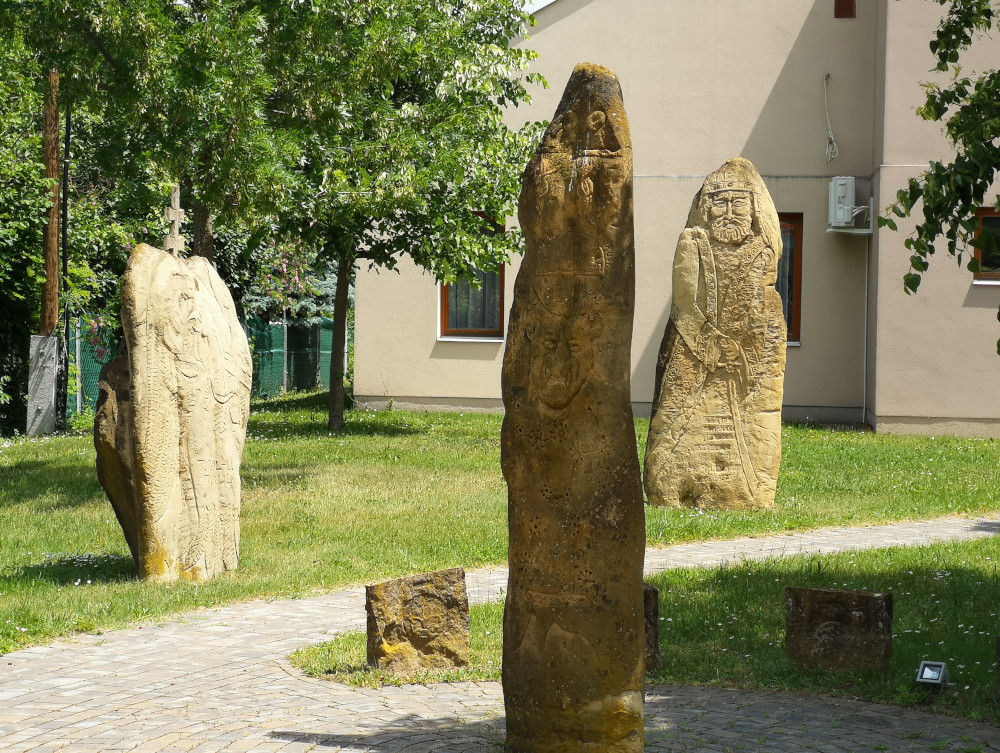
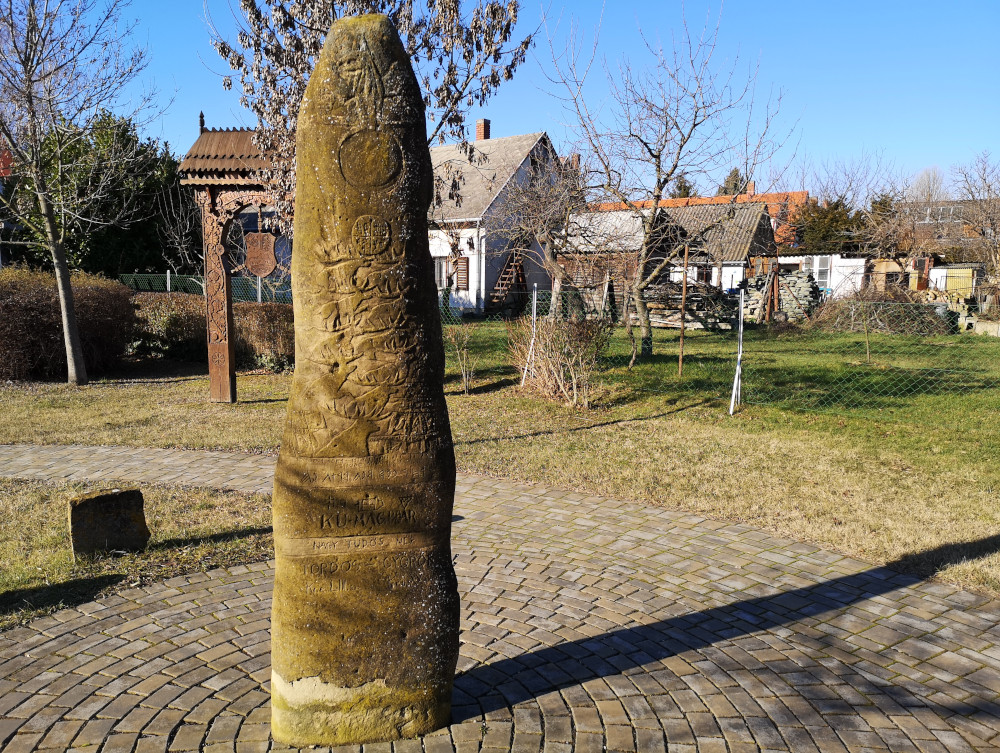
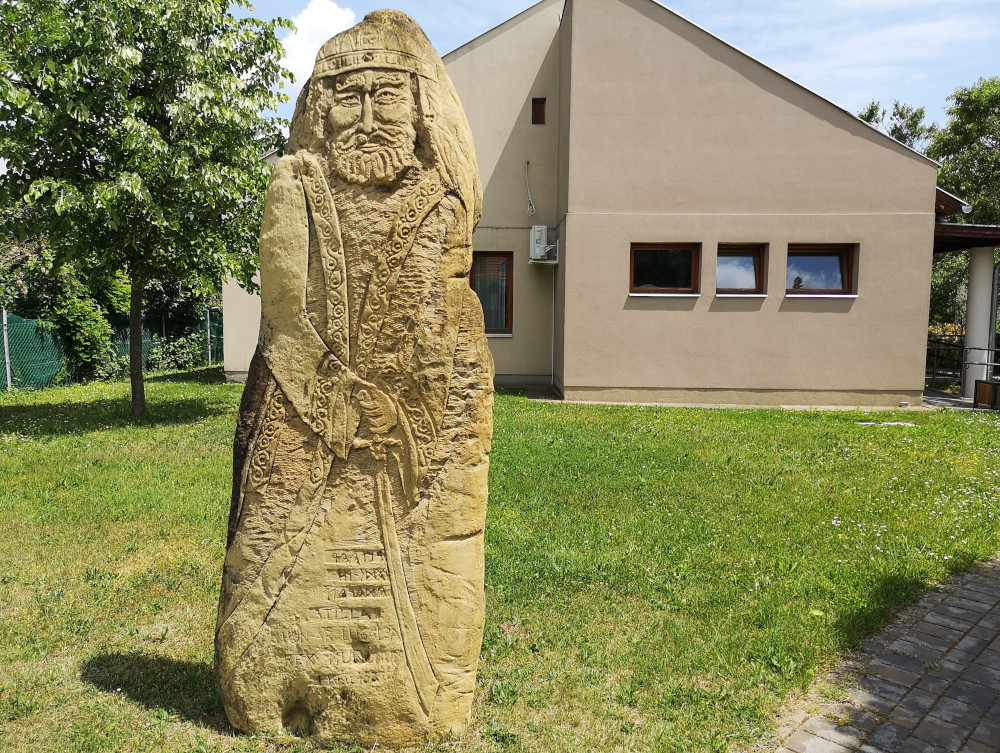
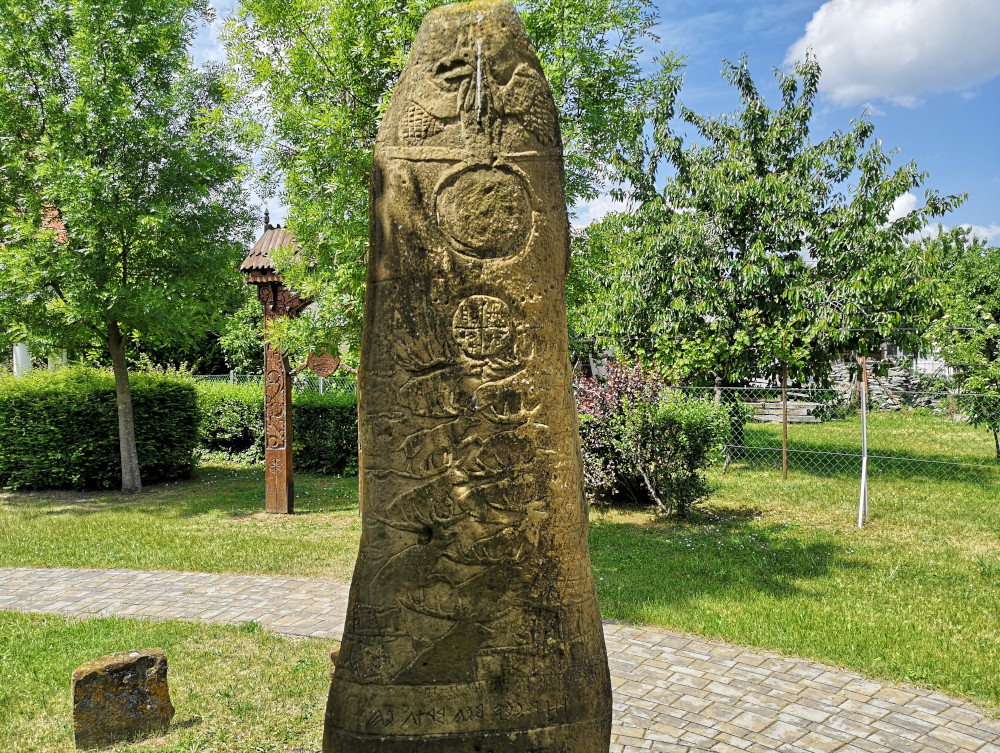
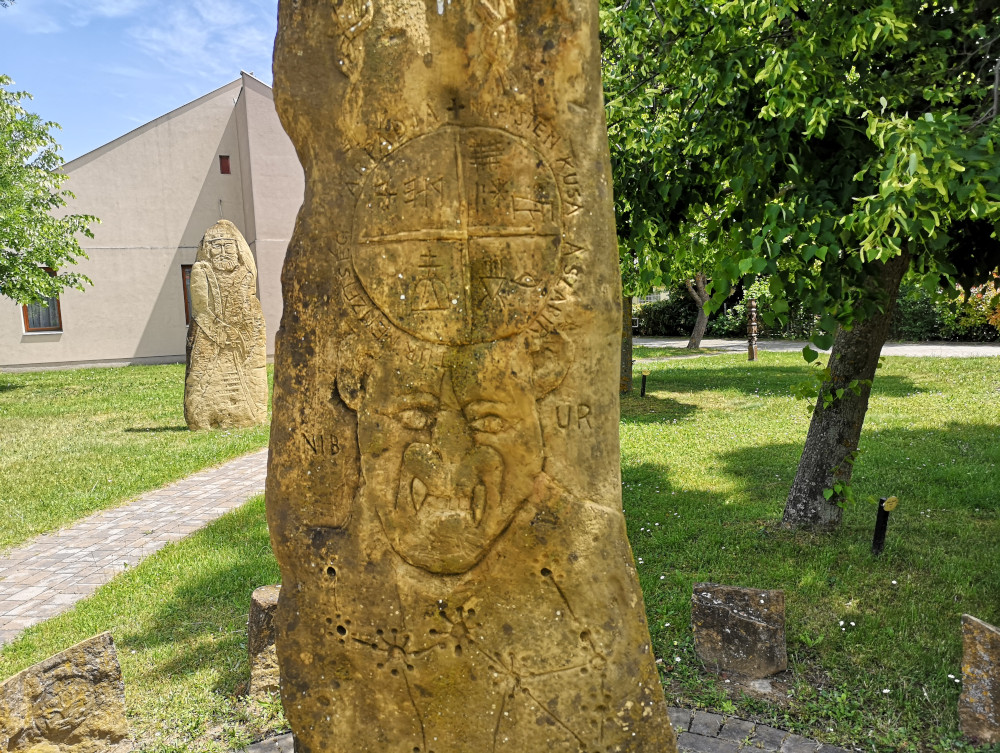
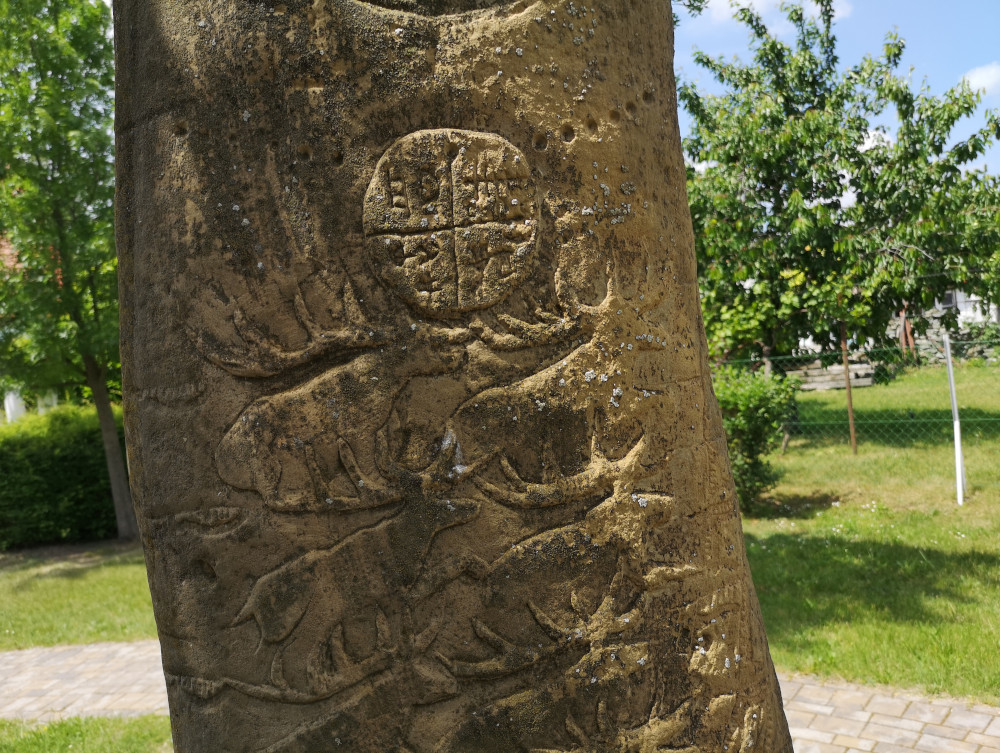
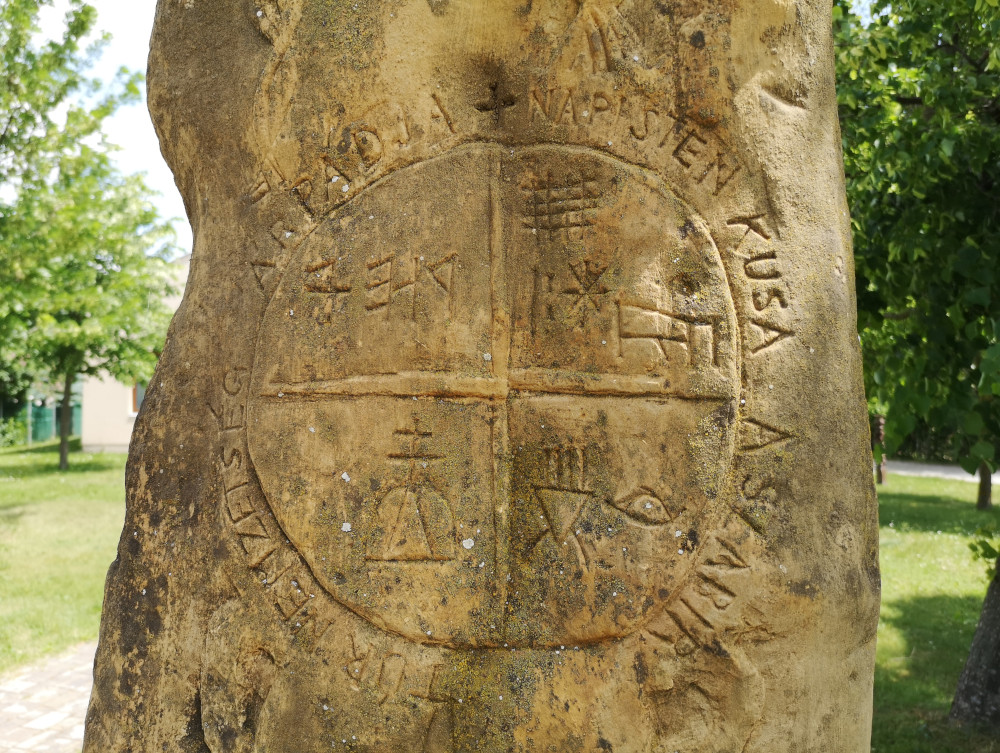
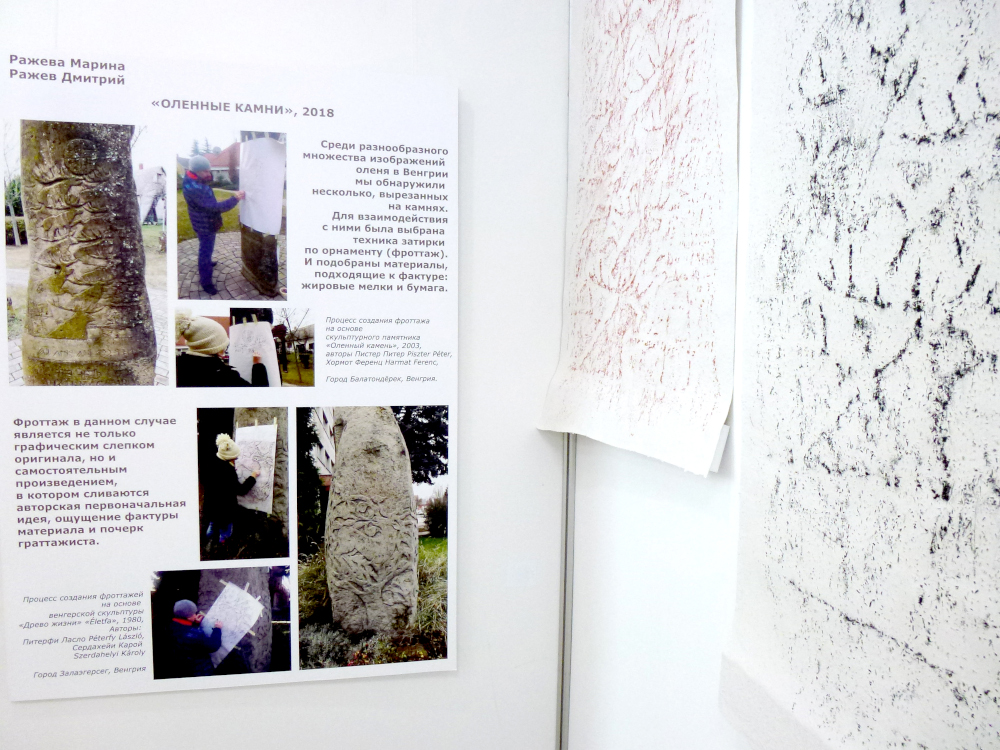
It is remarkable that Hungary is home to contemporary sculptures that closely resemble ancient deer stones in form, content, and symbolism. As part of our project, we explored several such monuments: photographing them, researching their creators, contacting local information services, documenting our findings, and engaging with the works on a creative level.
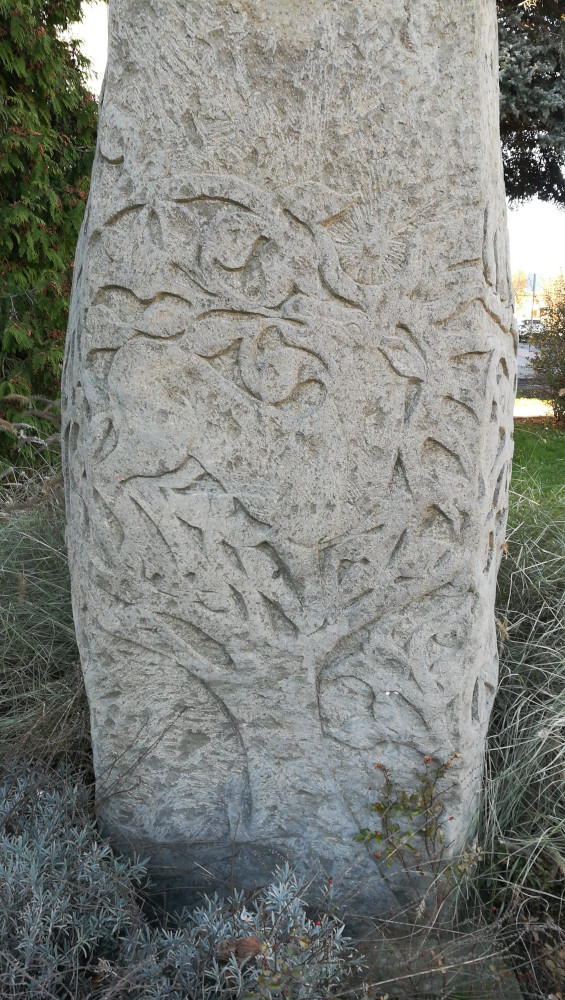
“Tree of Life” (Életfa)
Artist: Péterfy László, with the collaboration of Szerdahelyi Károly Year of Installation: 1980 Location: Zalaegerszeg, Petőfi utca 39.
The sculpture was originally installed in 1980 in the square in front of the Zalaegerszeg Town Hall. In 1989, with the placement of the equestrian statue of Zrínyi in that same square, the Életfa was relocated to a small park at the corner of Ady Endre and Kisfaludy Sándor Streets. However, this would not be its final site. On May 5, 2022, the sculpture was moved once again—this time to its current location at Petőfi utca 39, in the courtyard of the Zala County Regional Organization of the National Hungarian Hunting Chamber and the Zala County Association of Hunters and Hunting Enterprises. After restoration, it is once again open to the public.
Description: Carved from an 8-ton sandstone block that tapers toward the top, the sculpture is covered with animated scenes of life. Mythical and folkloric figures of humans and animals intertwine with gently swaying plants and trees. On the front side, a stag is depicted with a solar disk between its antlers. [12 ]
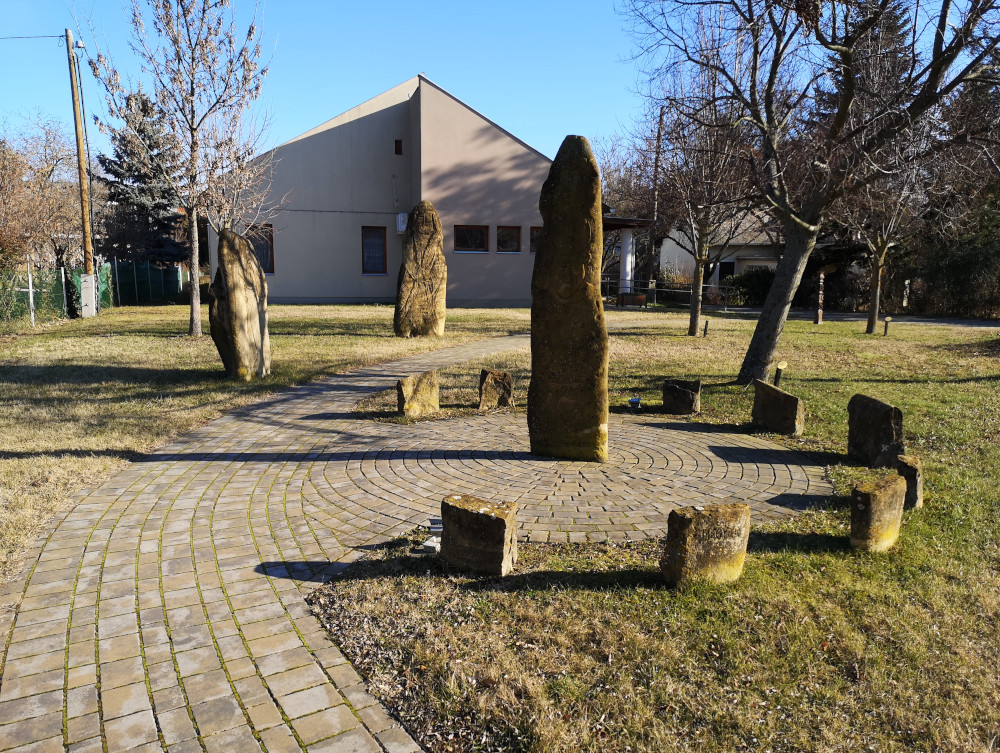
“The Conquest of the Homeland” (Honfoglalás)
(Also known as: “Deer Stone” (Szarvaskő))
Artist: Harmat Ferenc, with the participation of Piszter Péter Year of Installation: 2003 Location: Balatongyörök, Kossuth Lajos u. 29
This sculptural group is situated in a small park within the courtyard of the municipal building complex.
Description:
The sculptural ensemble consists of three large engraved sandstone monoliths arranged in a semicircle. The eastern stele features a depiction of a warrior in the style of the steppe balbal stone statues. The central figure bears the image of the mythical Turul bird. The western stele is surrounded by small stone plaques inscribed with the names of legendary chieftains of the Hungarian tribes. One side of this stele displays the Orion–Nimrud constellation. On the other, rows of deer are engraved, ascending upward in a dynamic, ritual procession.
Frottage as a Form of Artistic Interaction
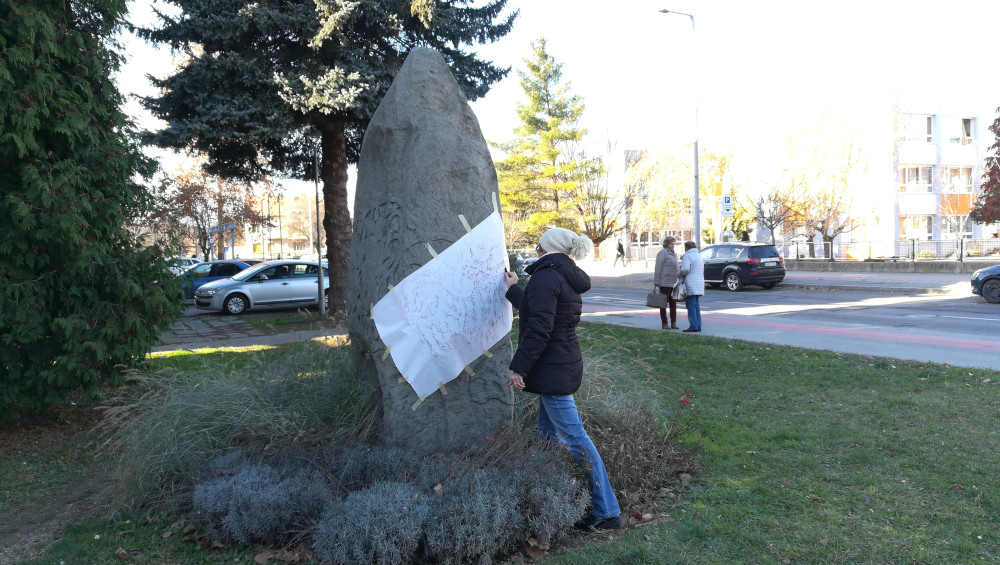
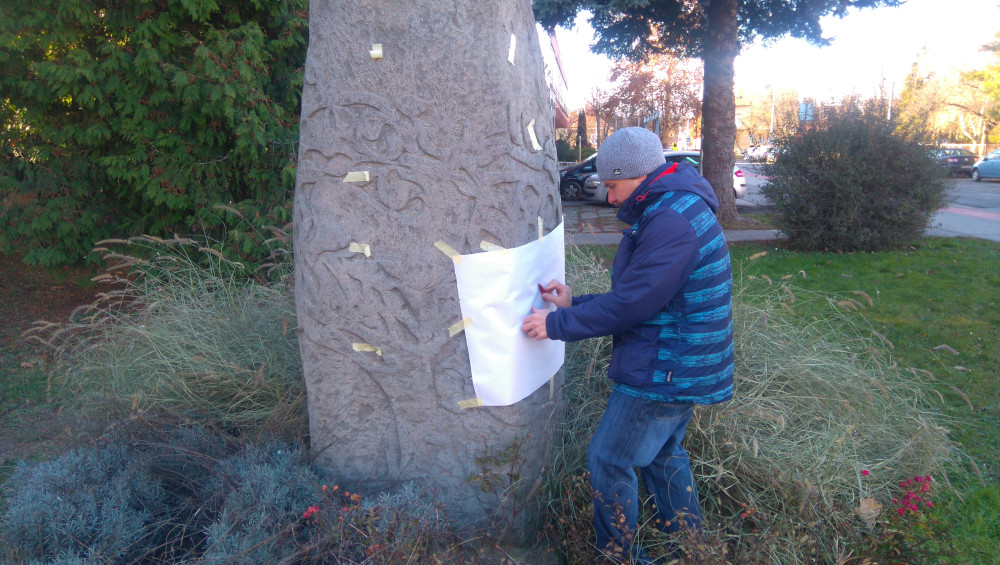
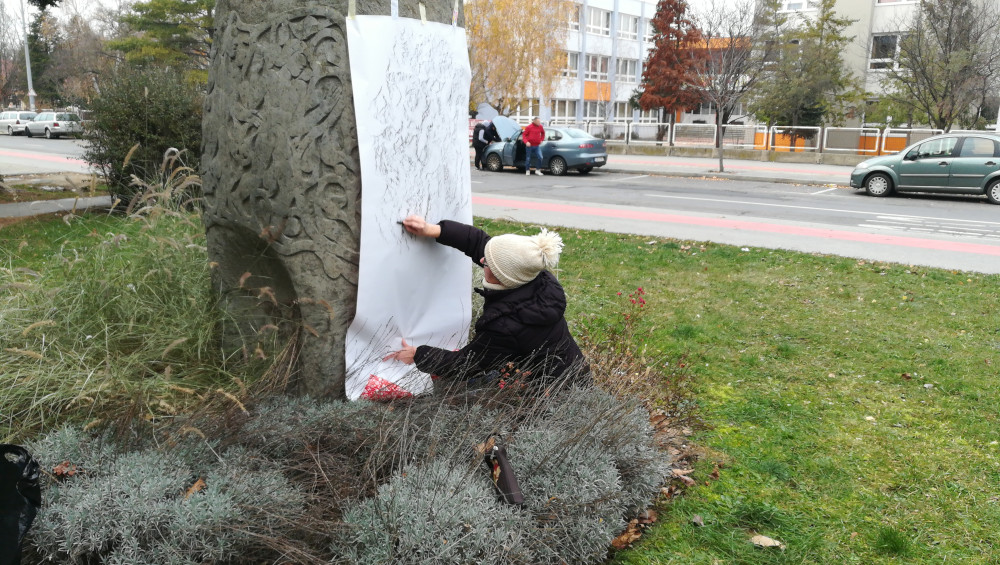
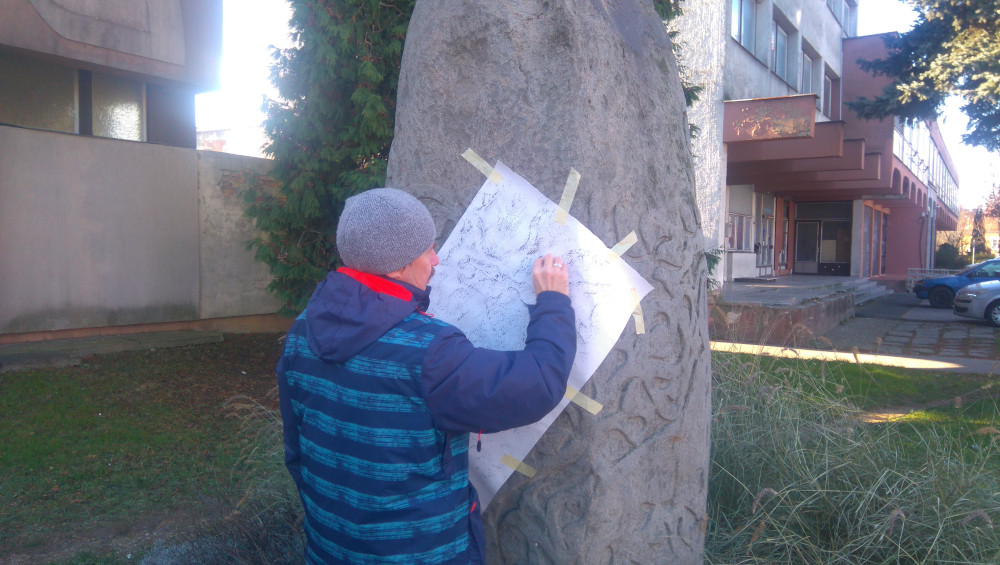
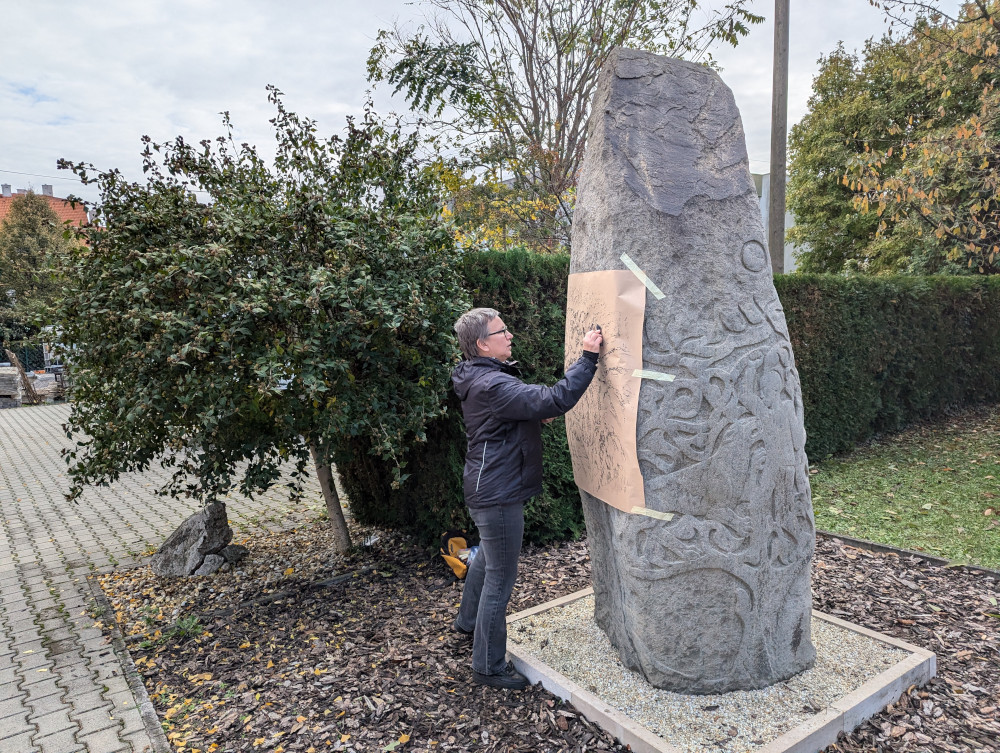
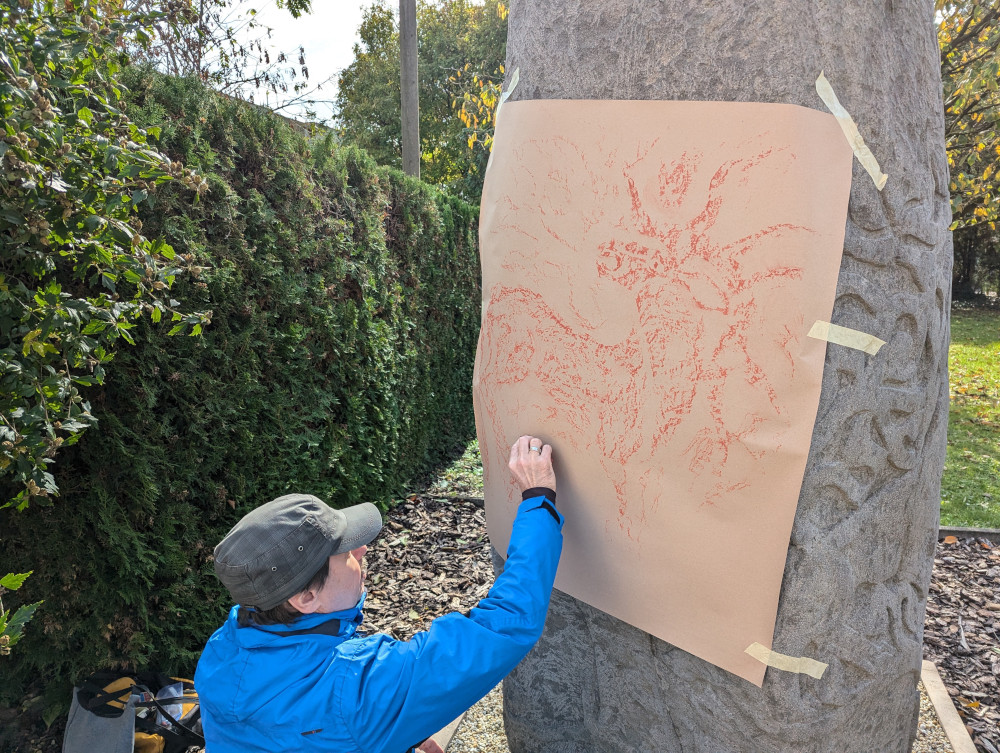
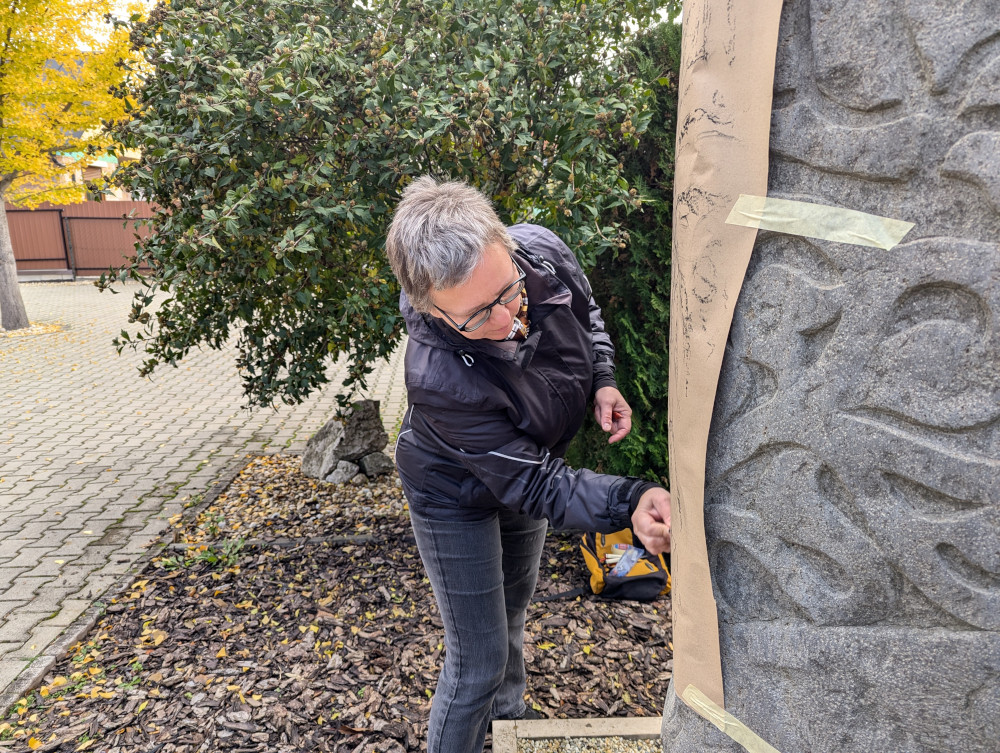
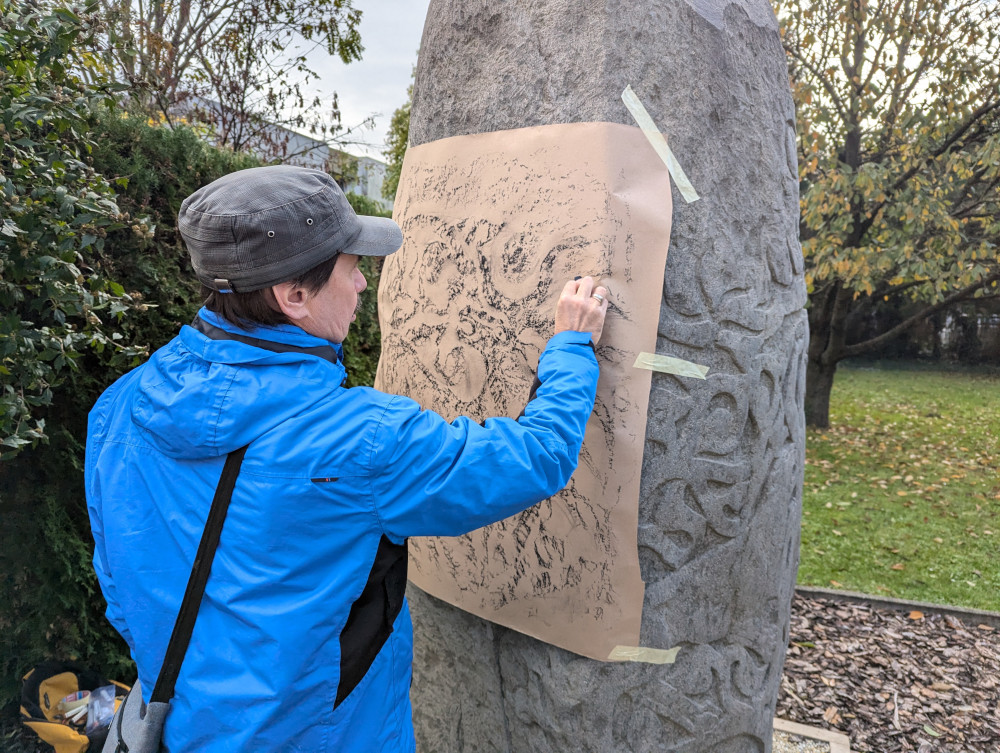
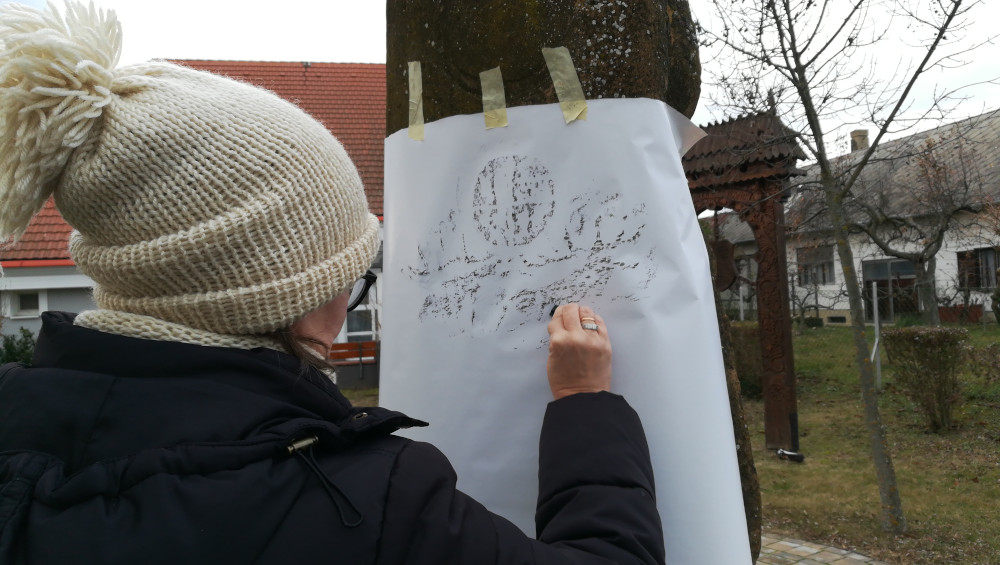
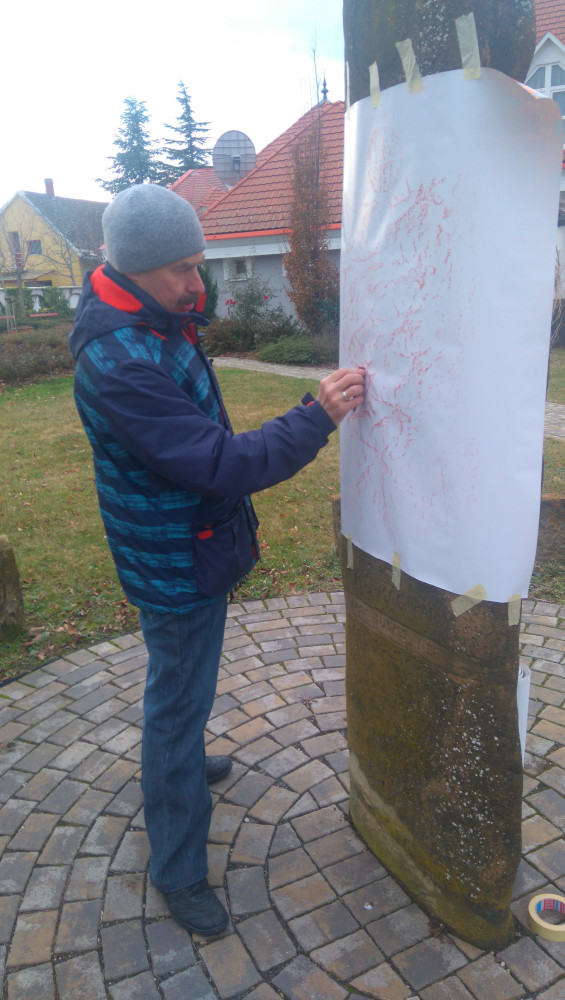
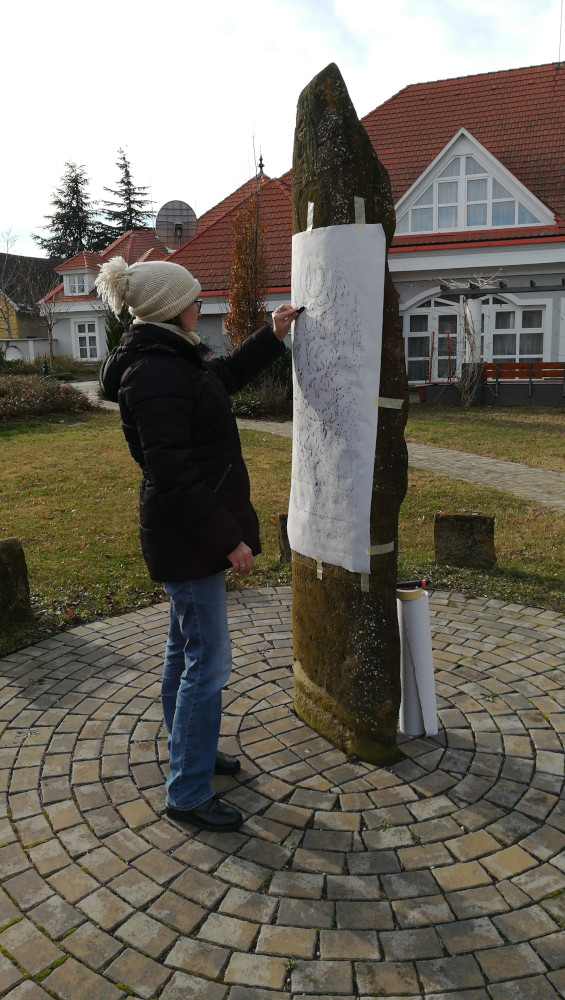
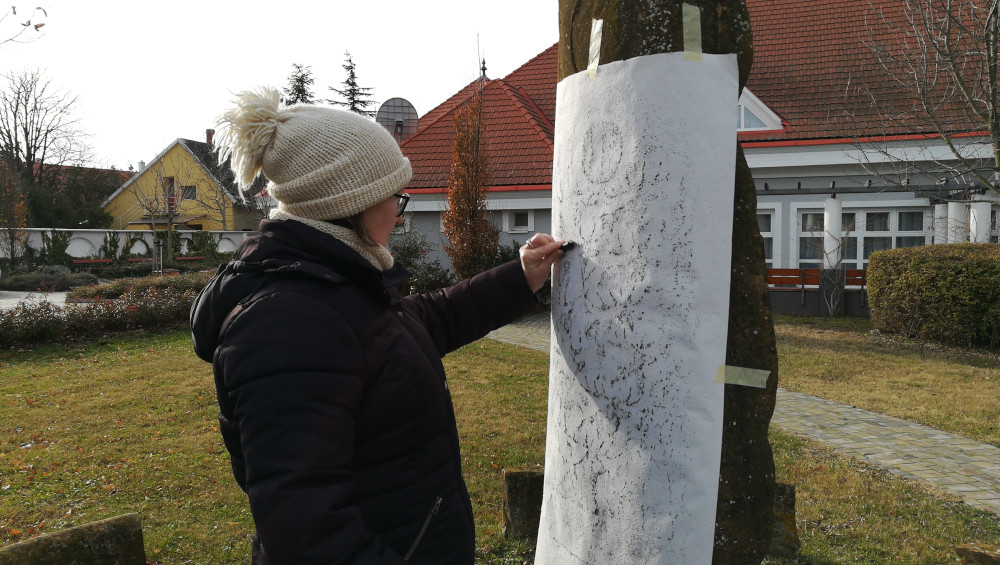
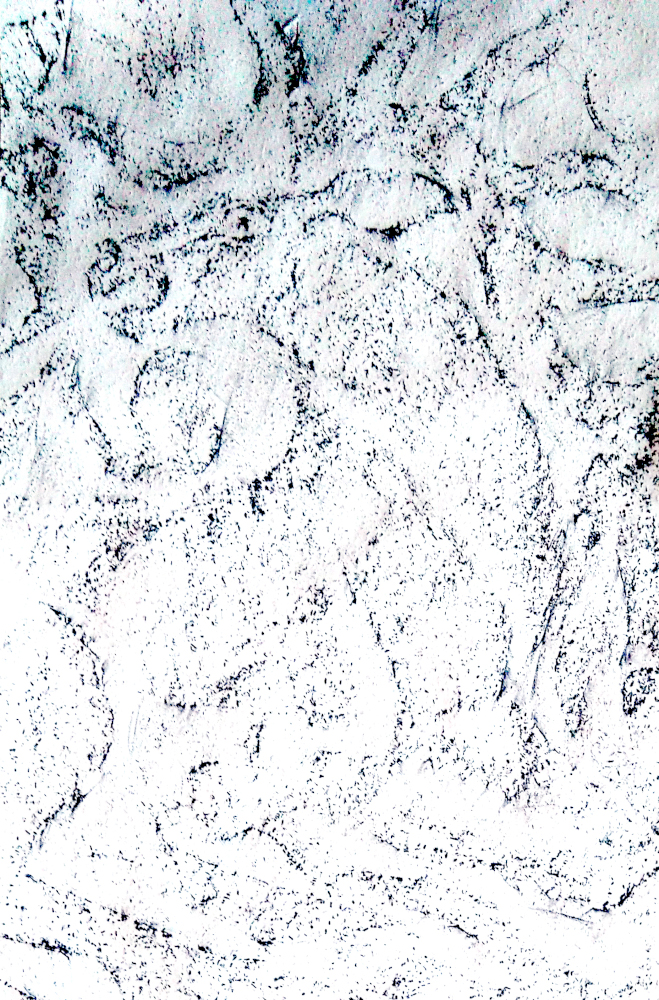
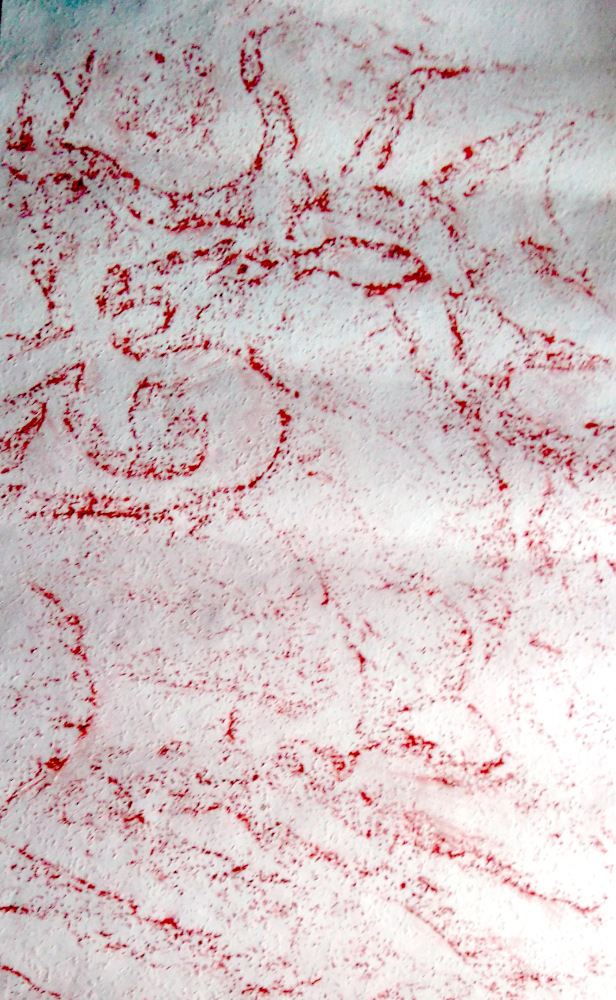
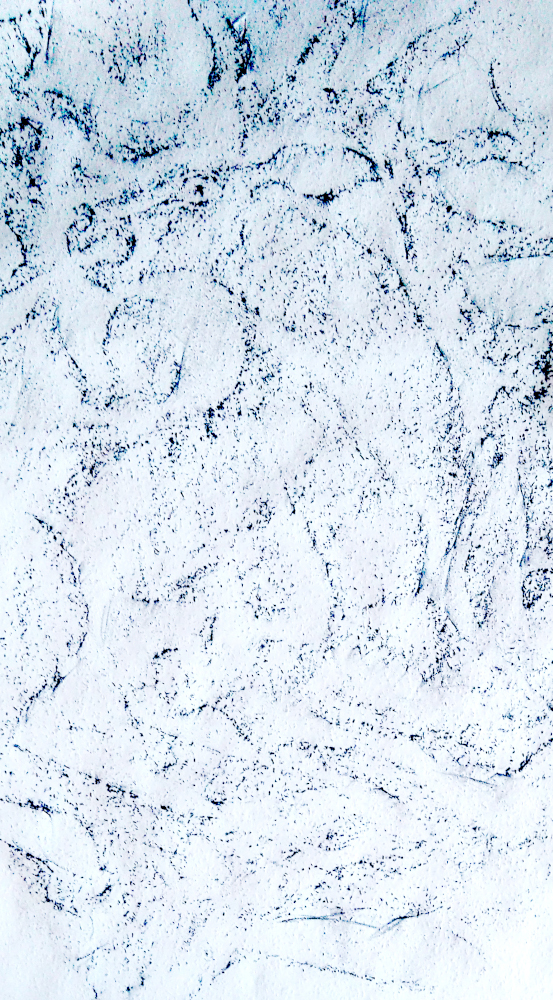
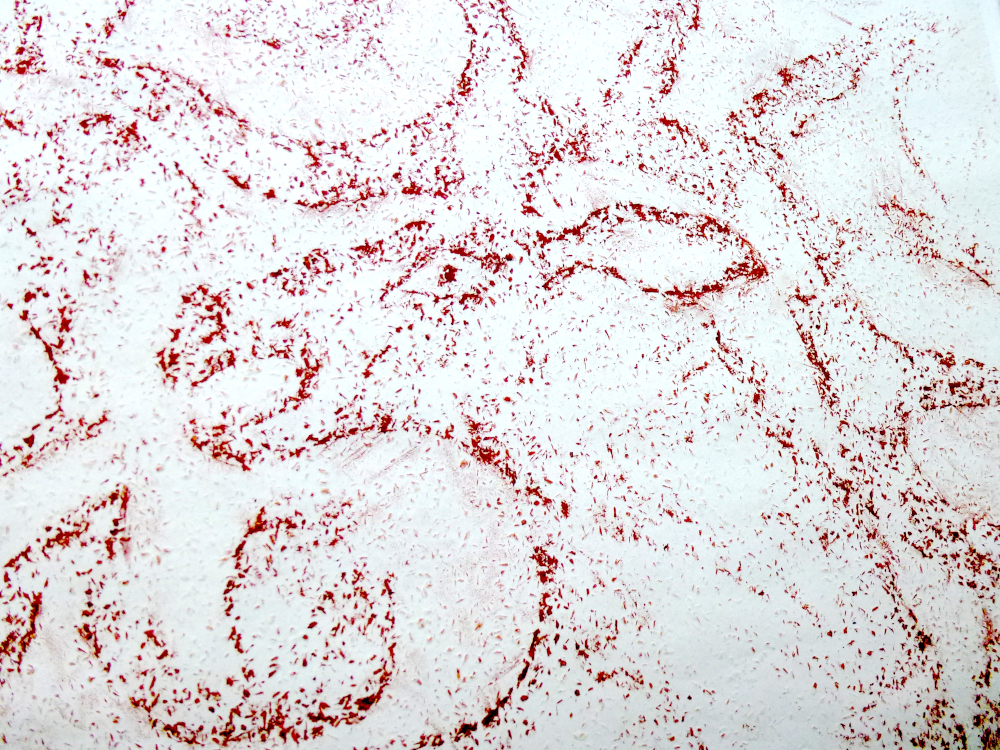
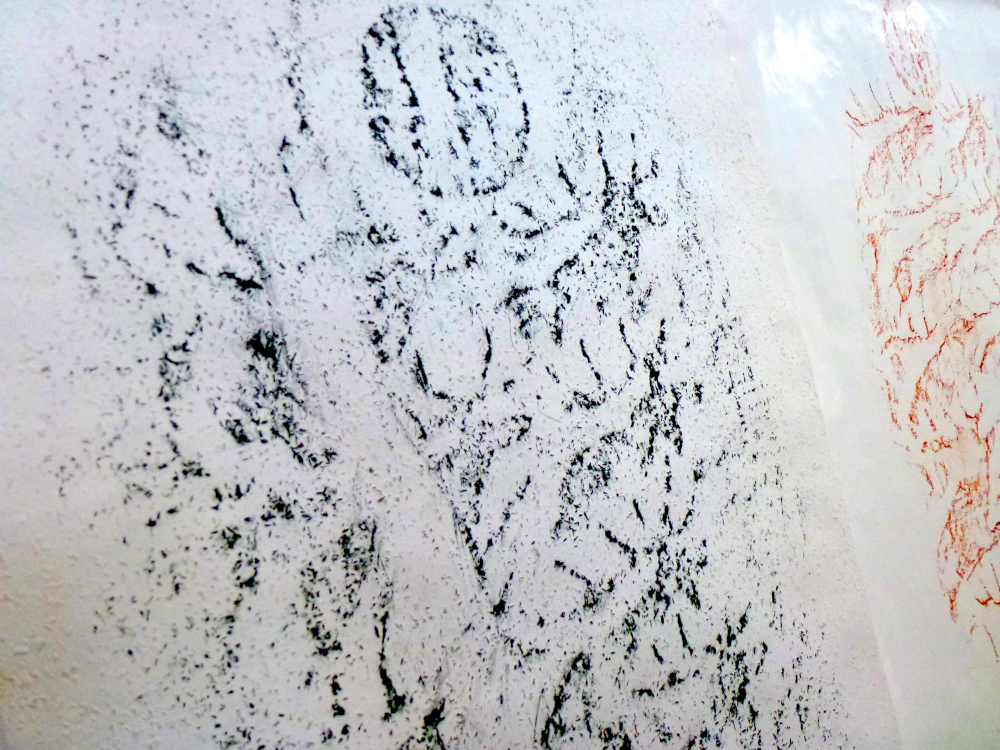
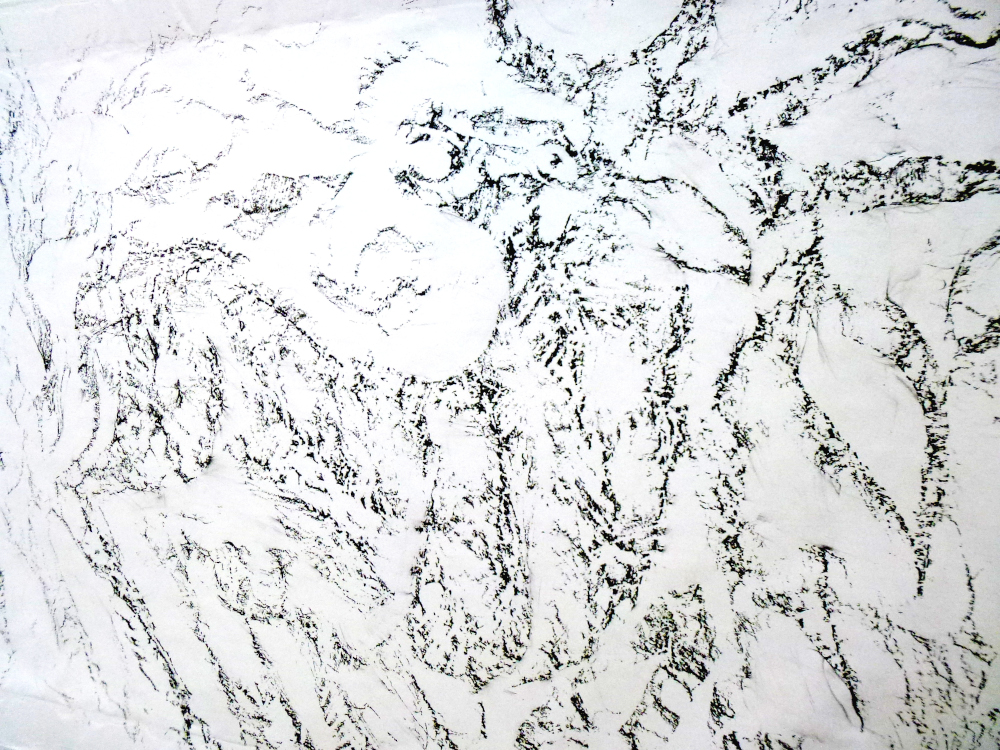
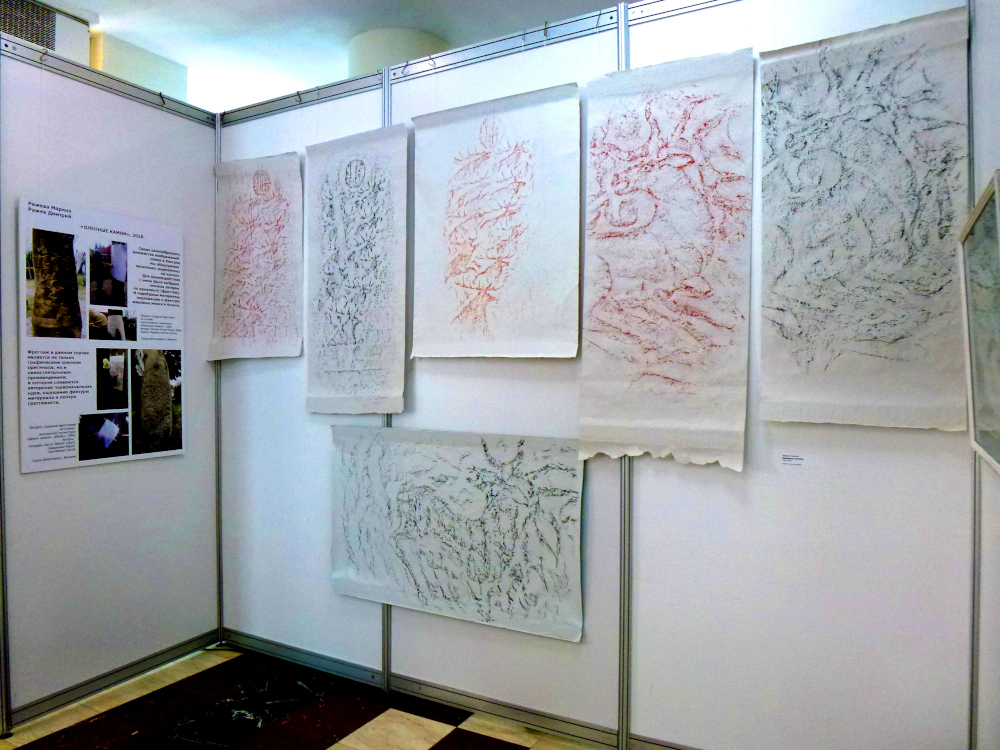
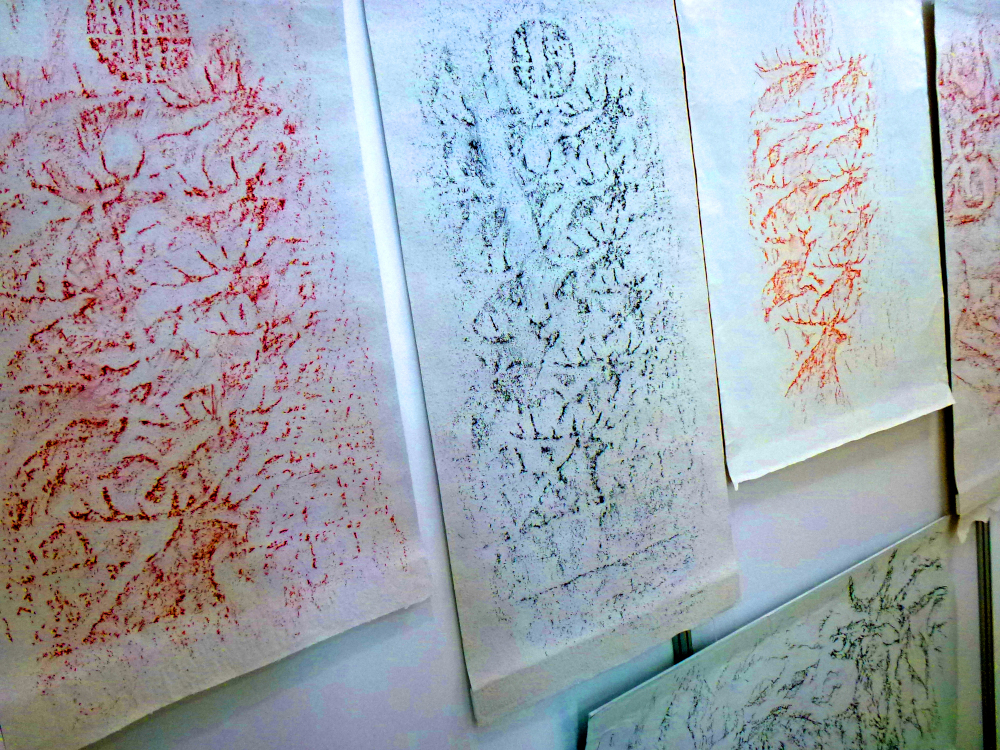
We conducted a series of frottages from these monuments in 2018, 2020, 2021 and 2024. Materials: paper and wax crayons.
In this context, frottage is not only a method of capturing texture — it becomes an independent artistic act. The original sculptural idea merges with the material and gesture of the artist. The relief, surface, and traces of time enter into dialogue with the drawn line and the hand of the one making the imprint. [Instagram 12] [youtube]
These works were exhibited as part of the international art and educational exhibition project “DeerLand“ [Instagram 123]
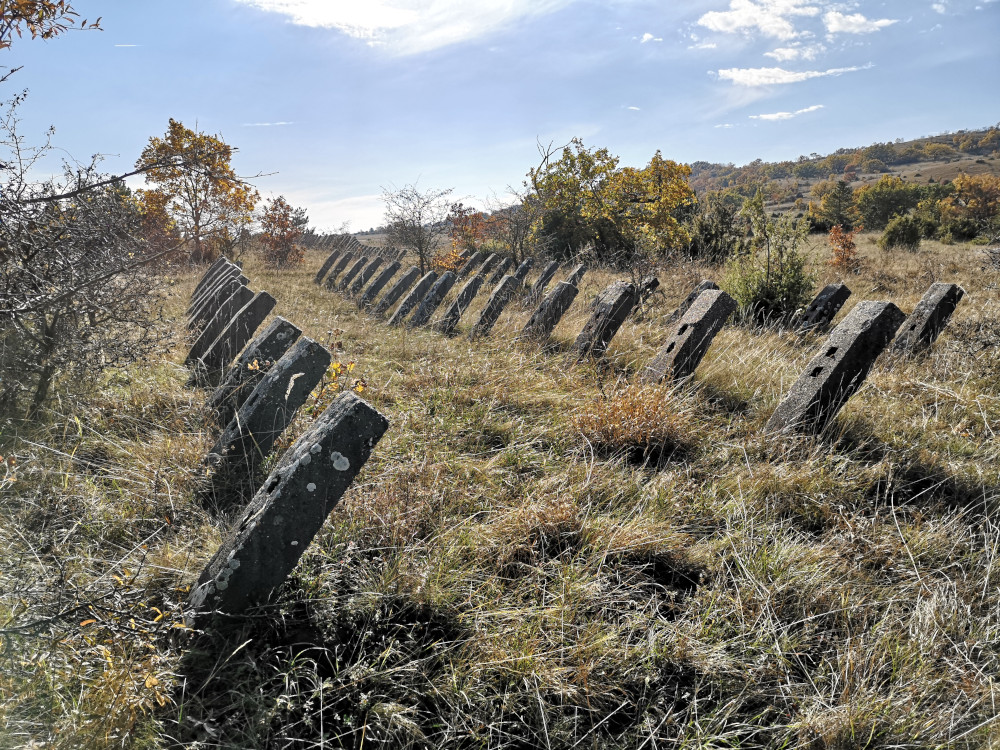
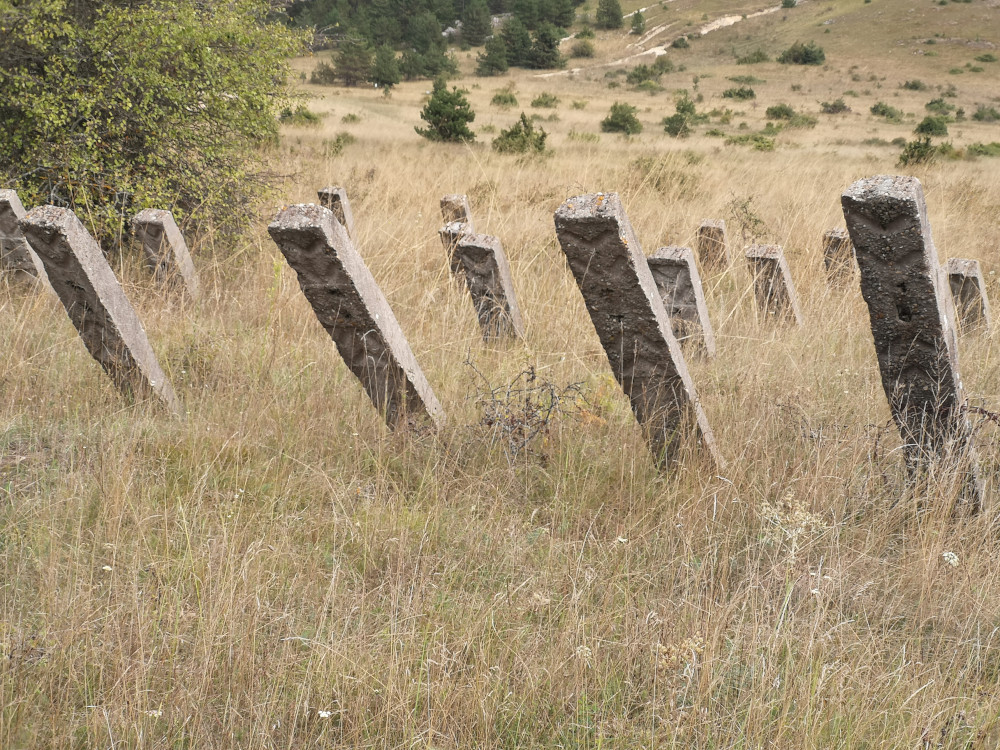
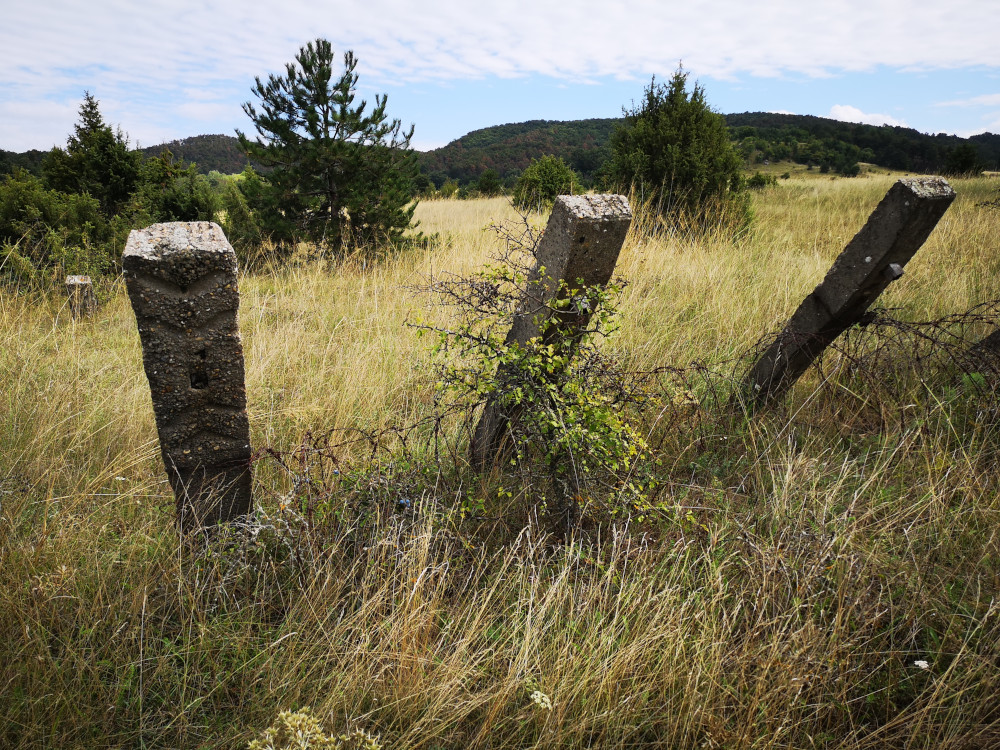
“Field of Deer Stones”
Location: Approximately 5 km south-southeast of Nyirád, in a forest-steppe landscape on the grounds of a long-abandoned military installation.
Author & Date: Created by time, people, and nature.
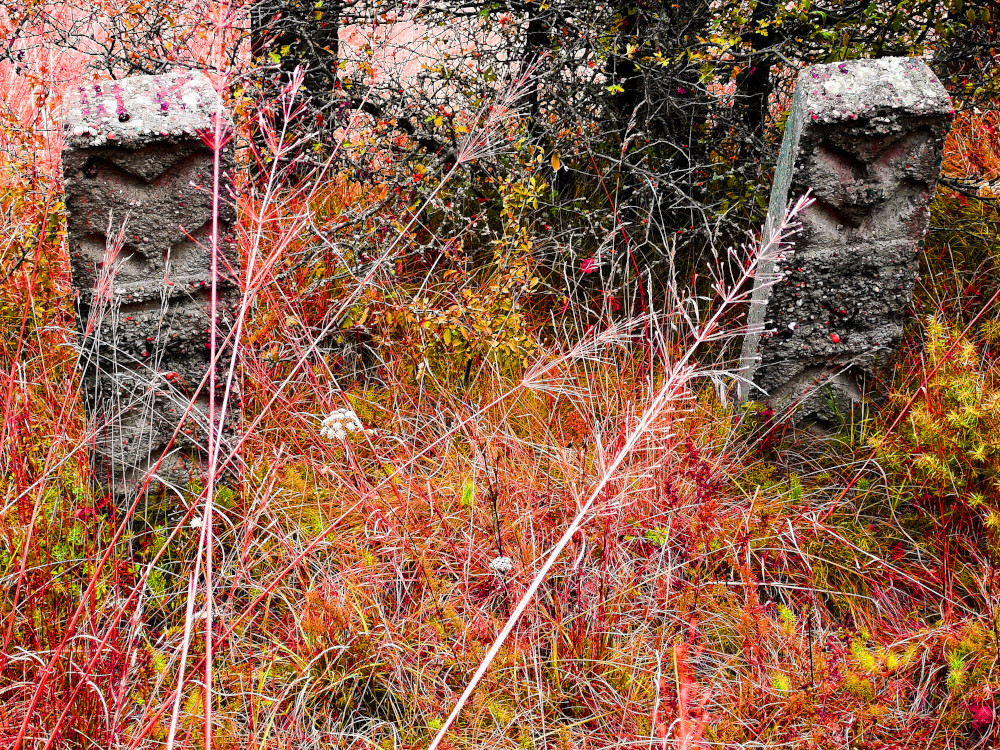
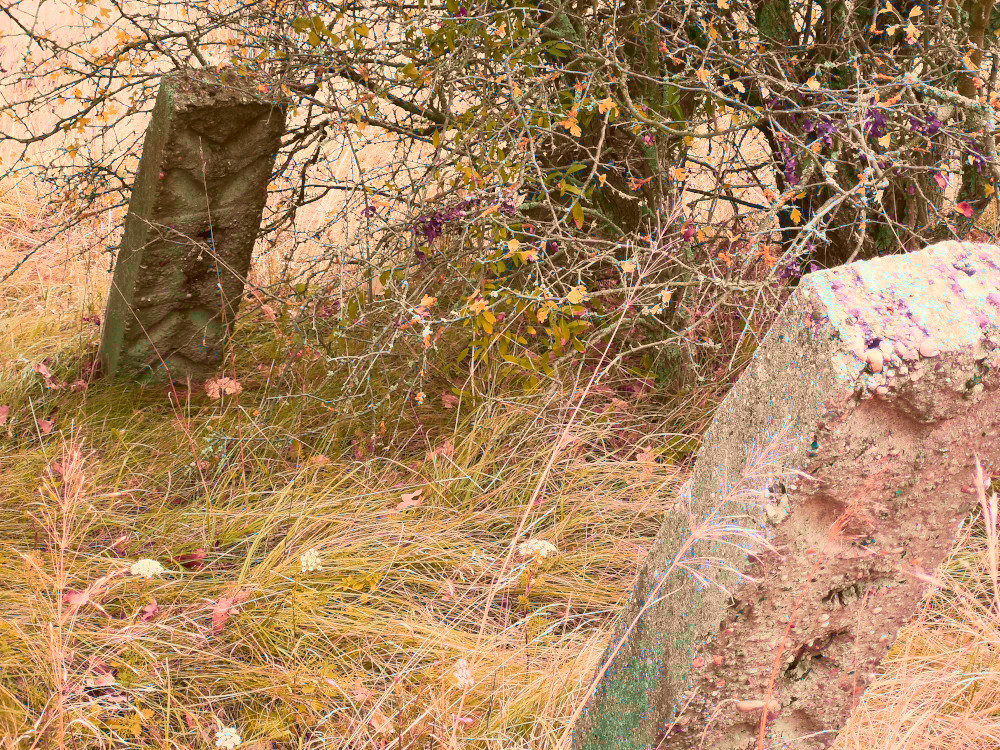
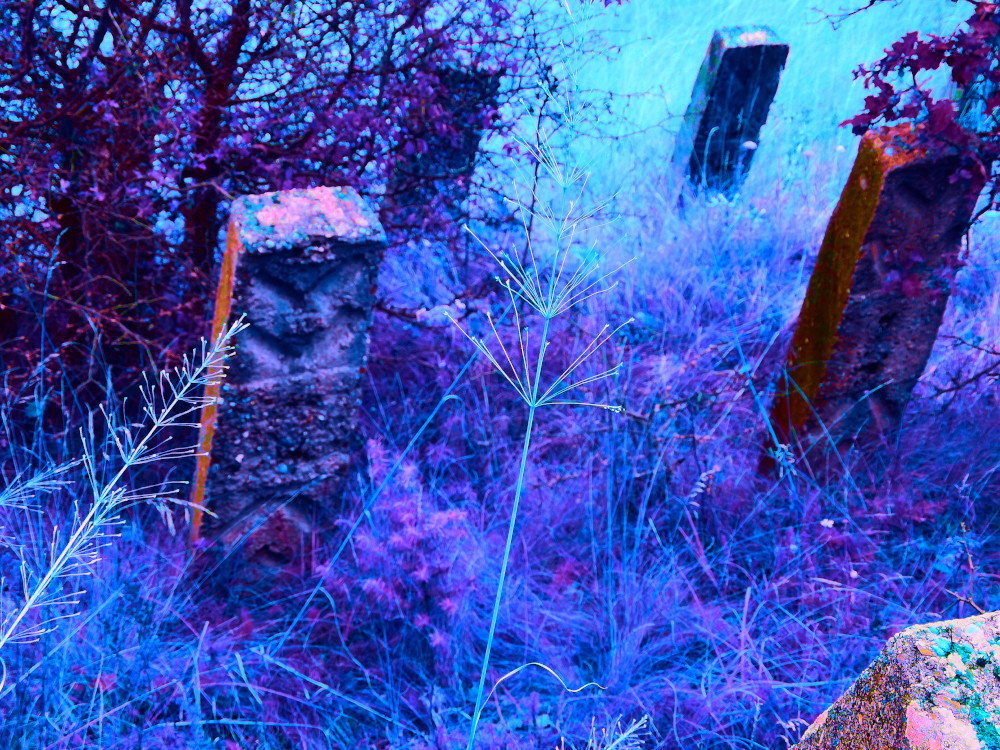
On a gentle hillside, we discovered rows of concrete posts embedded in the ground at an angle. While their original function is unclear, they are likely remnants of military engineering — possibly barriers or training obstacles from a former late-20th-century training ground.
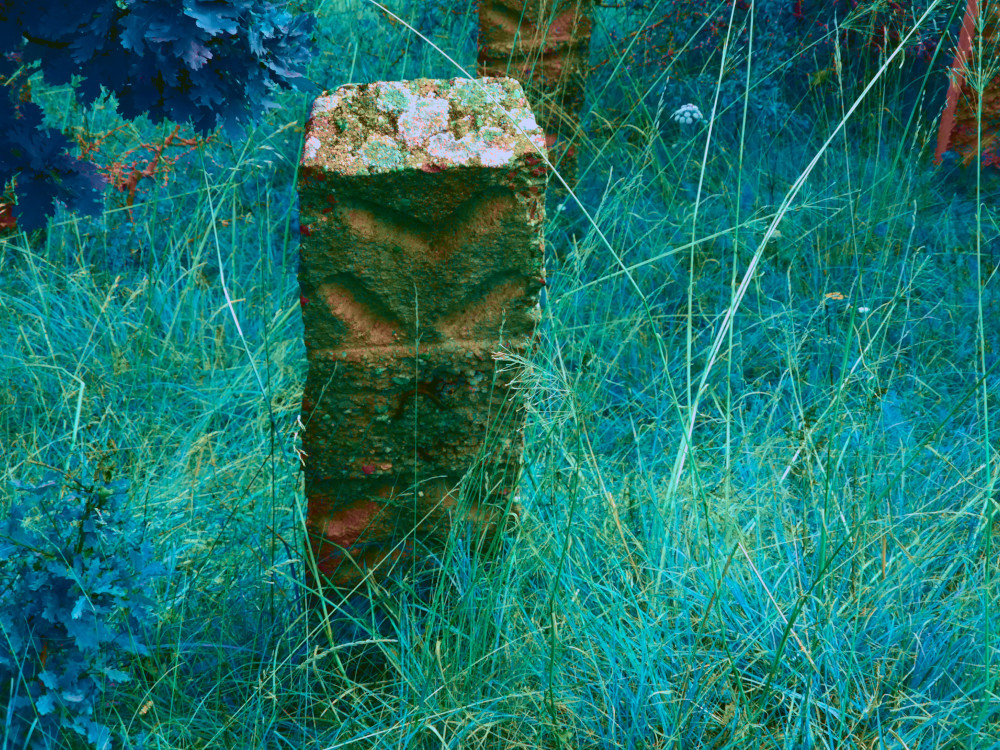
The layout and shape of these structures may be accidental. Yet visually, they evoke strong associations with megalithic alignments — menhirs, deer stones, and ancient stelae. This resonance becomes even more pronounced through artistic processing.
We documented these forms as “found artifacts” and digitally enhanced the images to emphasize their resemblance to ancient monuments. Thus emerged the Field of Reindeer Stones — a visual reconstruction of a myth arising from the intersection of nature, forgetting, and incidental form.
The project draws on the traditions of Siberian and Ural-Altaic deer stones — ancient burial markers carved with weapons, antlers, and symbols connecting different realms. Here, in the Hungarian landscape, a modern echo appears — perhaps unconsciously, perhaps by chance. Yet in this field of frozen forms, the ancient motif of the mediator between worlds seems to reawaken.
This is a powerful example of the “archaeology of the present”: utilitarian structures with lost meaning come to be seen as new archetypes, generating myth.
The series reflects the aesthetic of Revealed Realism: the object is found, but the meaning is overlaid. This corner of the Hungarian cultural landscape became a naturally found site for reinterpreting history, memory, and form — perfectly aligned with our method.
Conclusion
By tracing the echoes of ancient deer stones across time and geography — from Bronze Age Mongolia to the Hungarian cultural landscape — our project reveals how symbols survive, resurface, and transform. Through the lens of Revealed Realism, we seek not only to document but to awaken dormant layers of meaning in the world around us. Whether carved in granite or cast in concrete, the image of the deer continues to mediate between the visible and the invisible, the historical and the mythic, the past and the present.
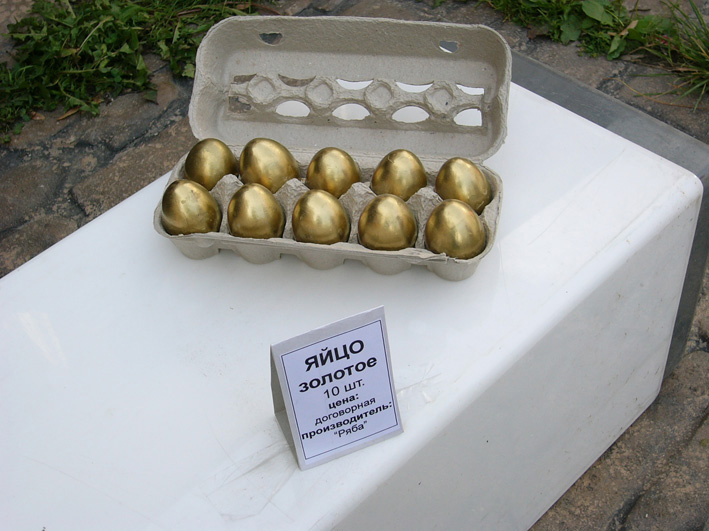
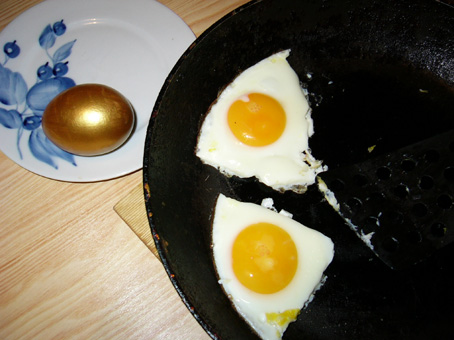
What is the sacred meaning of an old fairy tale about the golden hen known to everyone from early childhood? What was lost and what was gained when the egg broke?
The same questions are raised in many myths of the old and new worlds: about the original egg, the creation of the world, the legend of the golden age. Ideas of good and evil and what is being done on time.
This myth is relevant at all times and at each new moment acquires new semantic shades.
2002200420052024
Exhibition history :
2002 — Living the Simplest Thing, Art-Novosibirsk Gallery Festival, Novosibirsk, Russia
2002 — Shakespeare’s Testament, Ural Museum of Youth, Yekaterinburg, Russia
2004 — Tasting Ball, Pushkin House, Yekaterinburg, Russia
2004 — New Mythology, International Exhibition of Contemporary Art, Karaganda, Kazakhstan
2005 — High-Five, Elovoy House, Yekaterinburg, Russia
2013 — Art Objects on a Book Theme, Belinsky Library, Yekaterinburg, Russia
2024 — JELEN — JELENÉS — JELEN|ÉS, 4th International Land Art Symposium, Rácalmás, Hungary
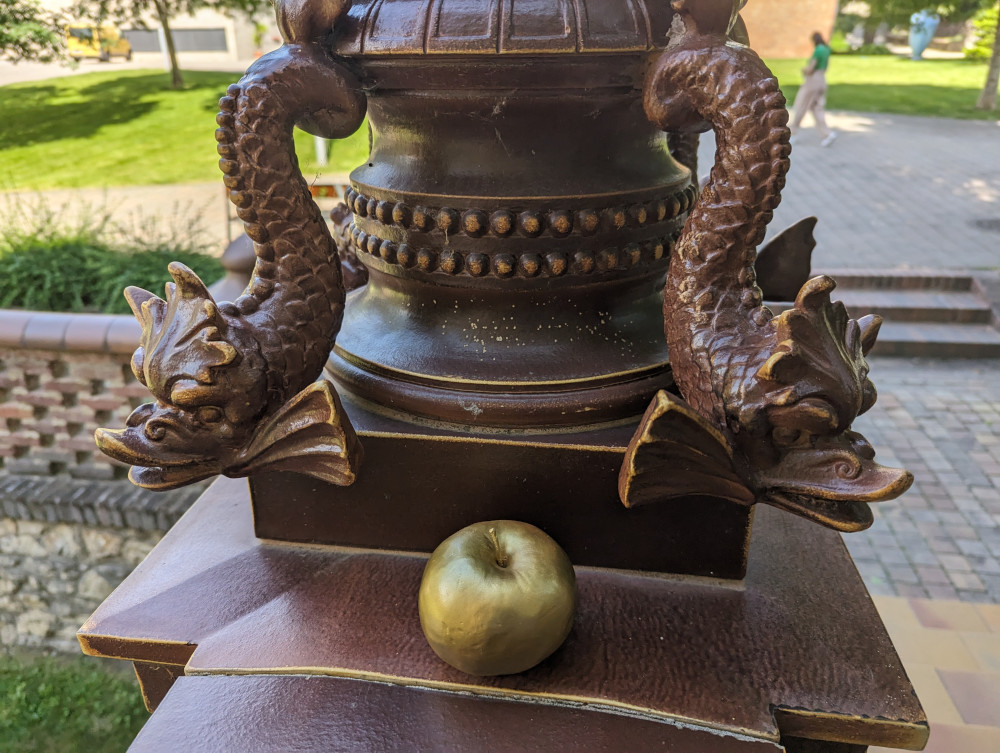
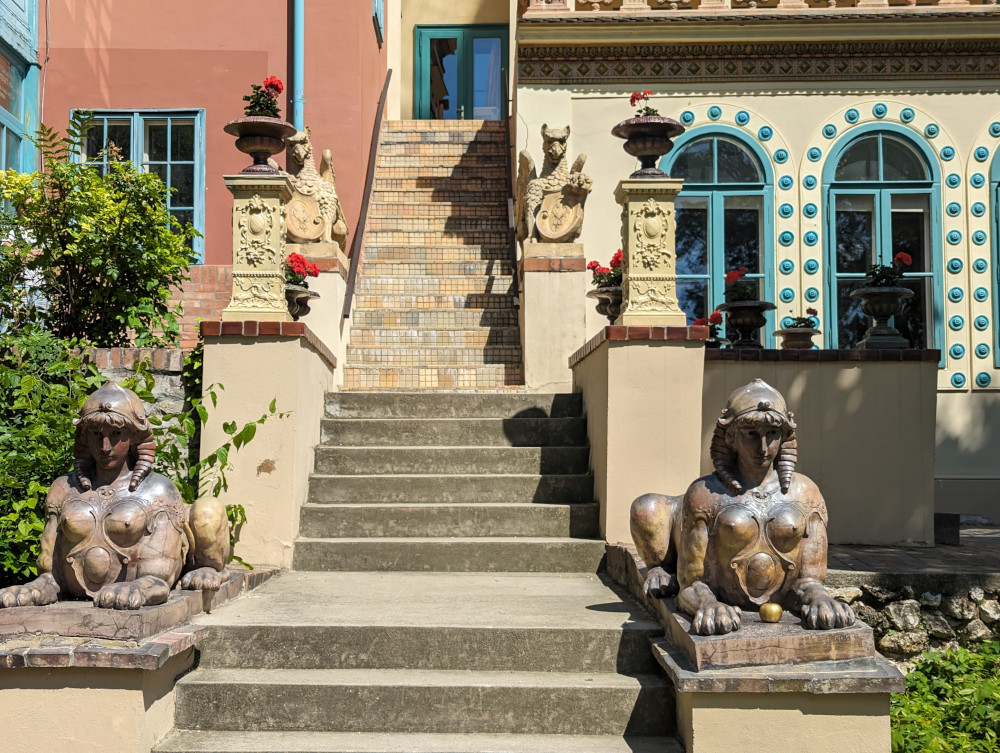
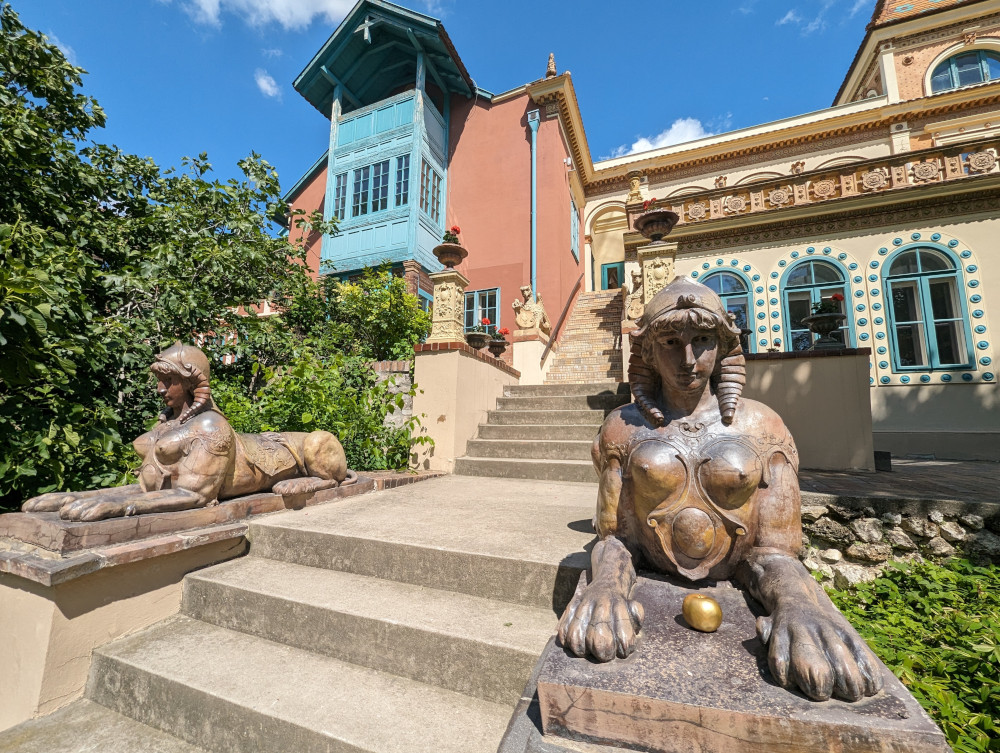
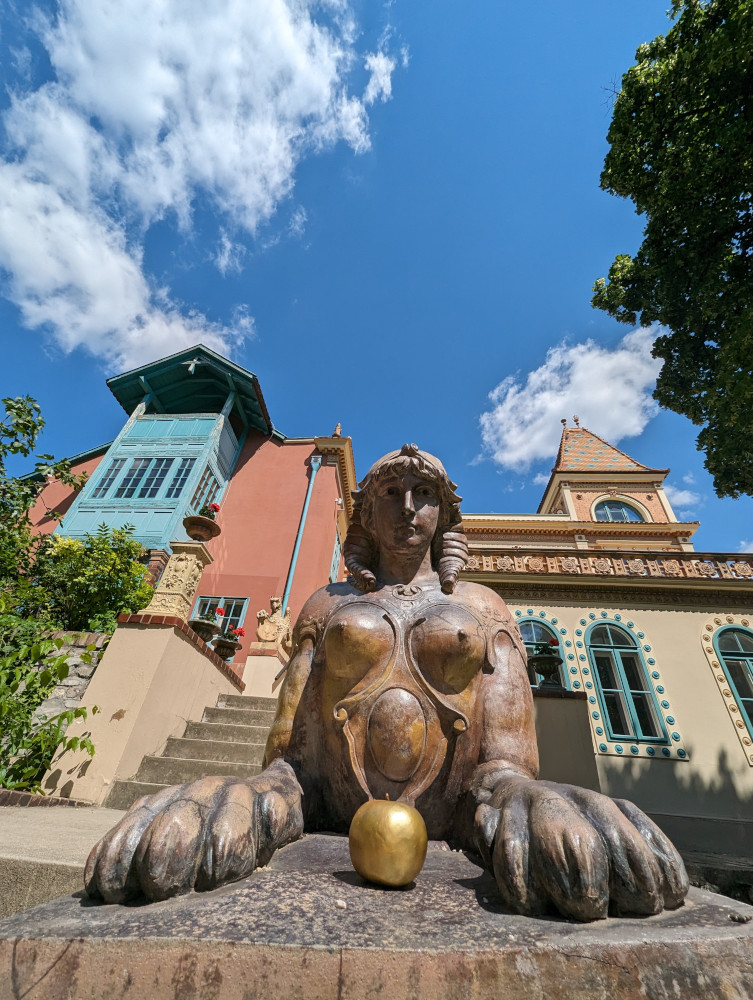
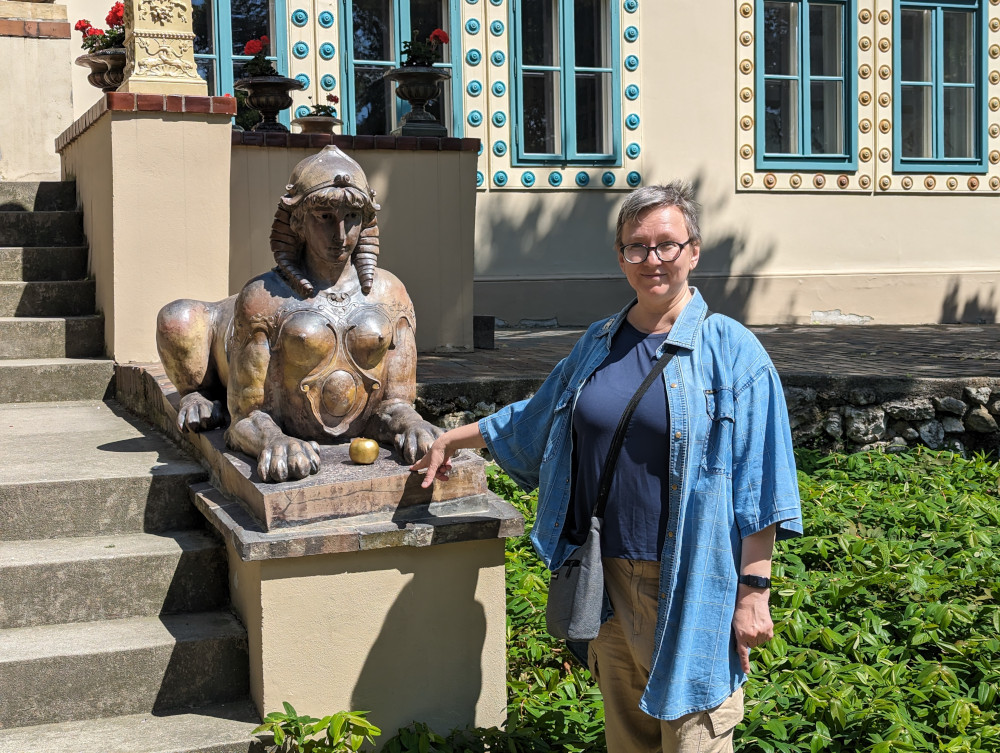
The golden apple embarked on a journey through the historical labyrinth of the Zsolnay Quarter — between time and space, history and modernity, art and the street, matter and reflection.
The apple entered the exhibition space for a moment, becoming part of the “official” history of the Zsolnay Golden Age, then stepped beyond its boundaries, dissolving into the real environment.
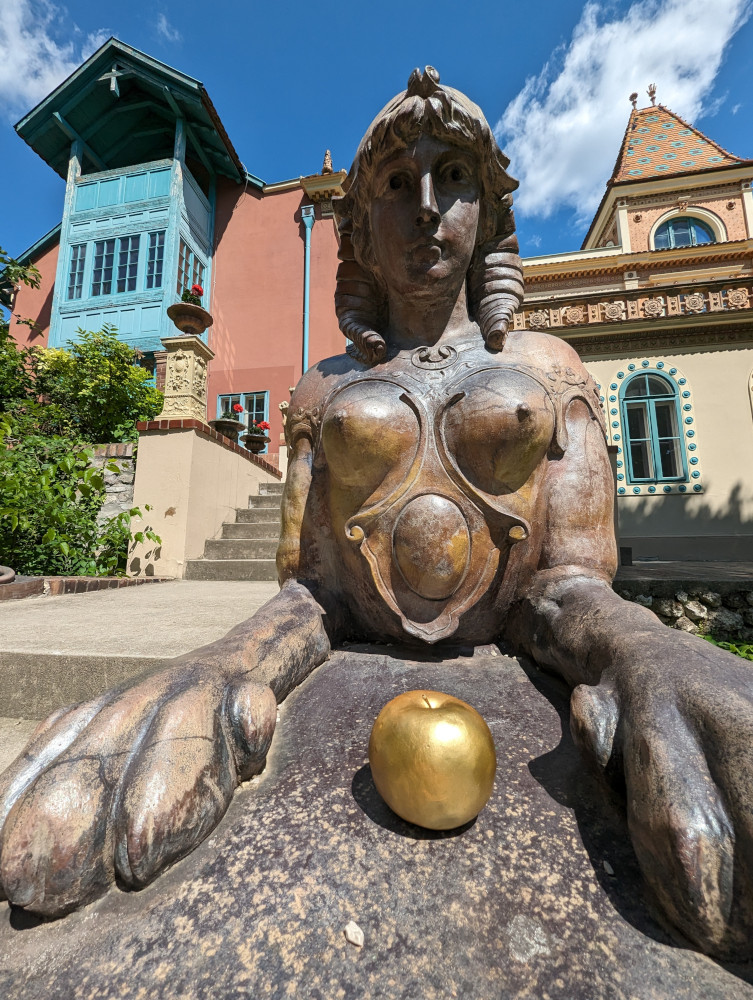
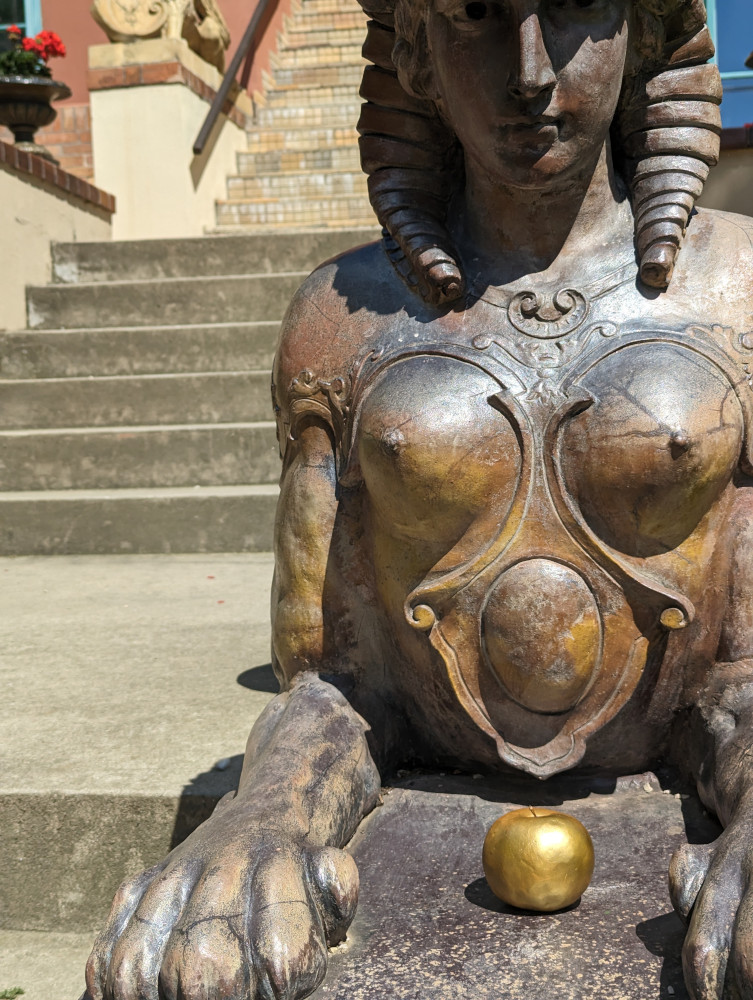
Its journey was documented in a series of photographs: the apple reflected the sun, glided across textures, tasting the matter of time. Each frame captures a moment of choice between motion and stillness, disappearance and presence.
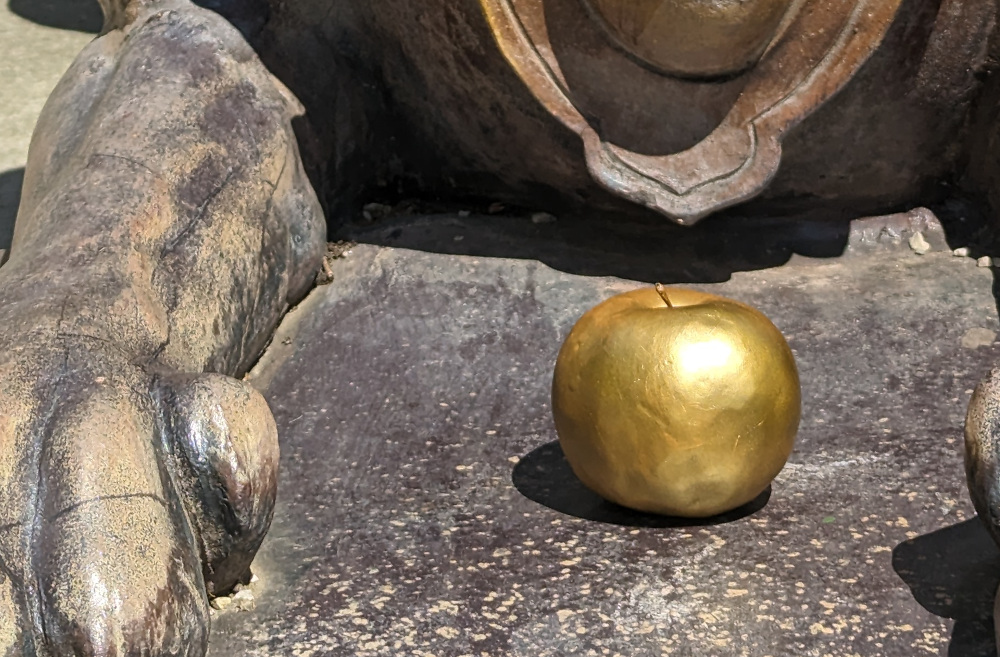
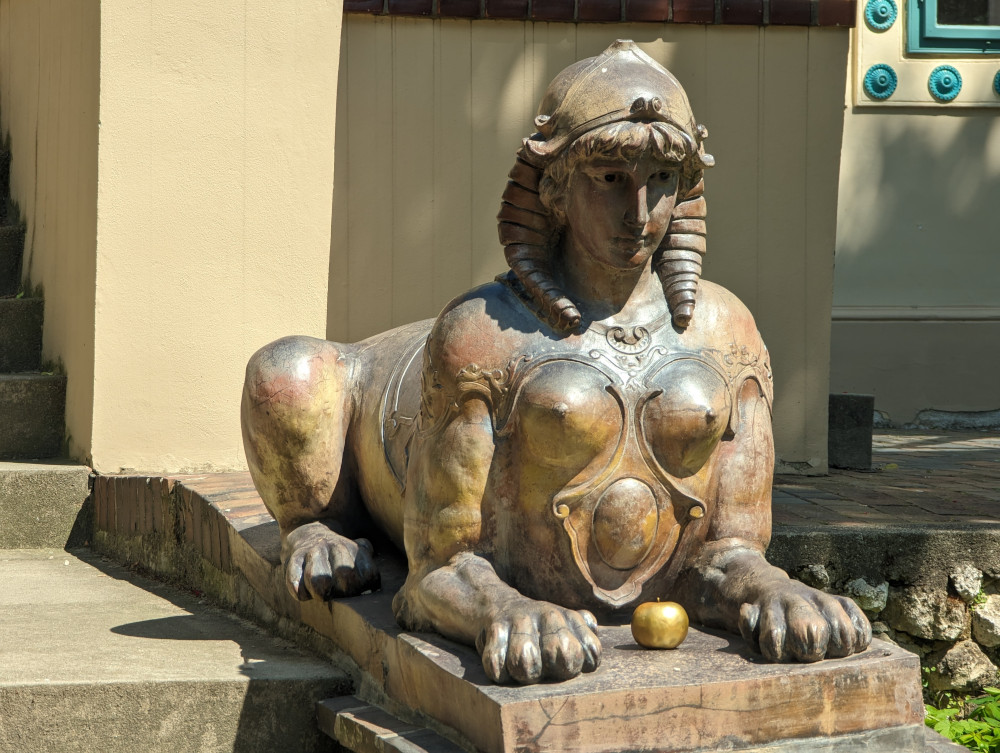
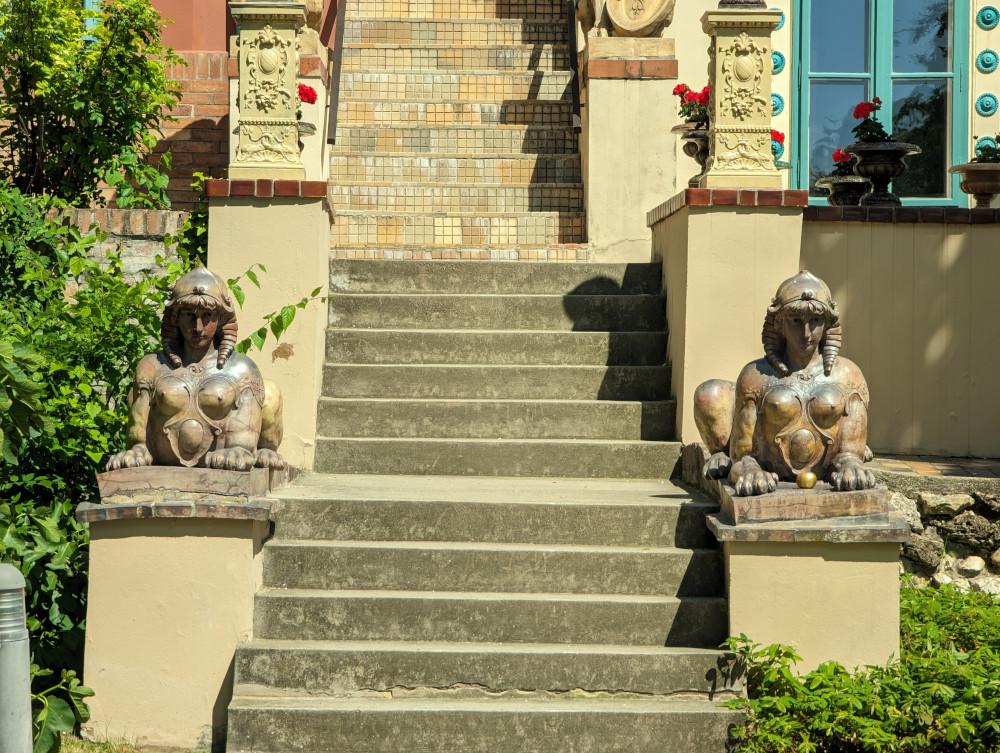
The offering took place beside one of the two ceramic Sphinx sculptures guarding the staircase. The reflection from the golden surface altered the expression on the Sphinx’s face. Was it an illusion, a play of light, or the past come to life, accepting the gift?
The project invites reflection on how values, both material and immaterial, move through time, transforming meanings and leaving a trace in our perception.
From the authors: “We left the apple there, by the Sphinx. What happened next? We don’t know, but we can imagine several scenarios.
Perhaps the Apple disappeared—someone took it. Maybe it was a passerby who saw value or mystery in it. Maybe a tourist took it as a souvenir, or a child believed they’d found a magical artifact.
Or the Apple remained in place but changed—rain and wind began to wash away the gold, revealing the living matter beneath the surface. It began to decay, becoming part of the urban environment, vanishing somewhere between art and nature.
Perhaps the Apple became part of the Quarter—someone moved it elsewhere, continuing its journey. Maybe it appeared by another sculpture, or ended up inside one of the Zsolnay ceramic workshops.
We like to believe the Apple turned into a legend—even if it disappeared physically, its story remains. Someone will tell it again, someone will search for its traces, and someone might catch a fleeting glint on the Sphinx’s face and remember this moment.
In this context, the Apple is a temporary guerrilla sculpture—installed without permission, yet altering the perception of the space. It intervened in the environment of the Zsolnay Quarter, entered into a dialogue with the Sphinx, and disappeared, leaving behind only memory and photographic trace.
This offering was a fleeting gesture, but it sharpened the boundary between presence and disappearance, art and everyday life, the material and the symbolic.”
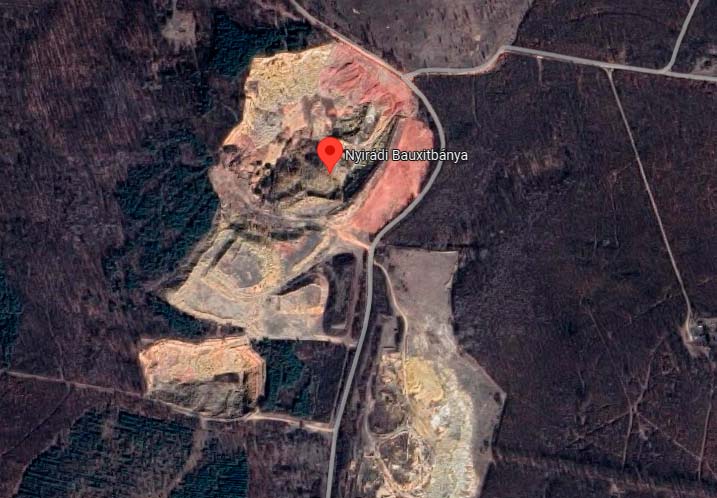
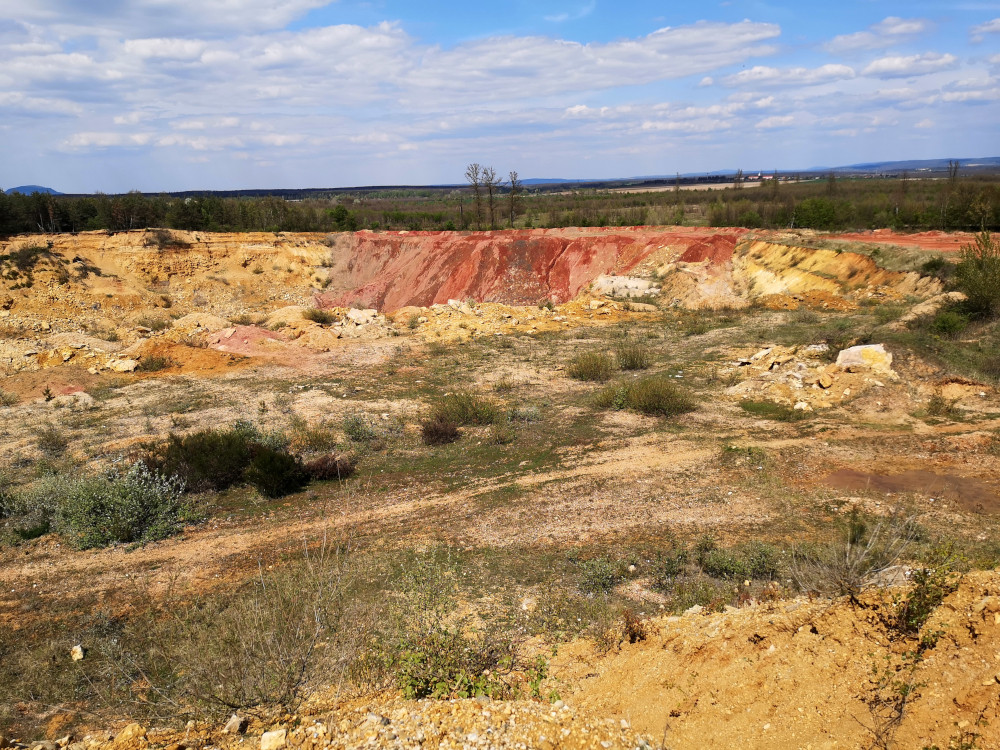
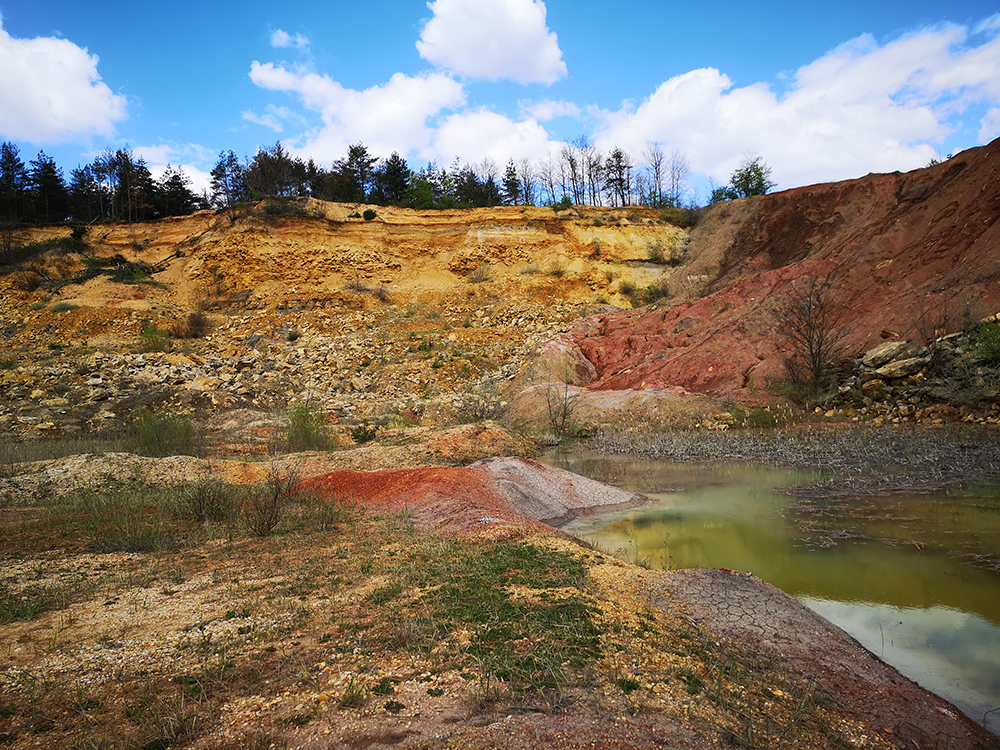
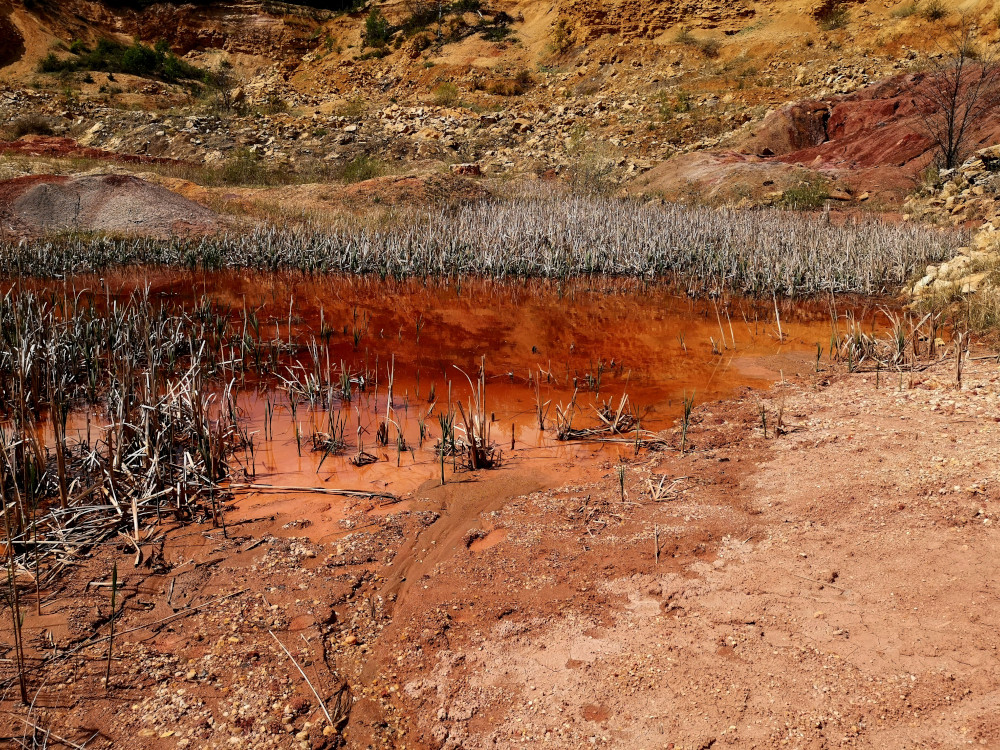
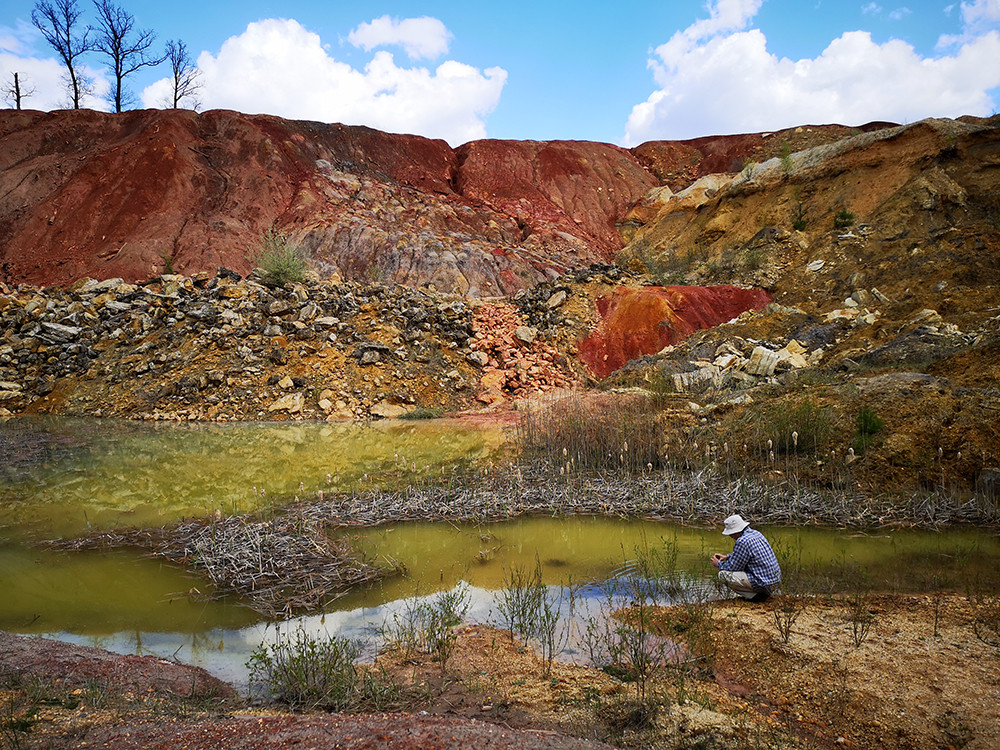
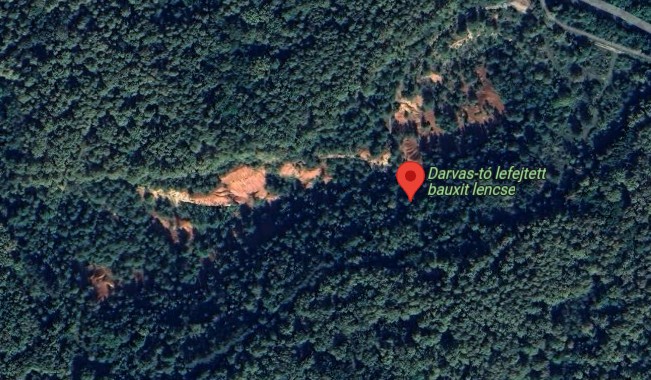
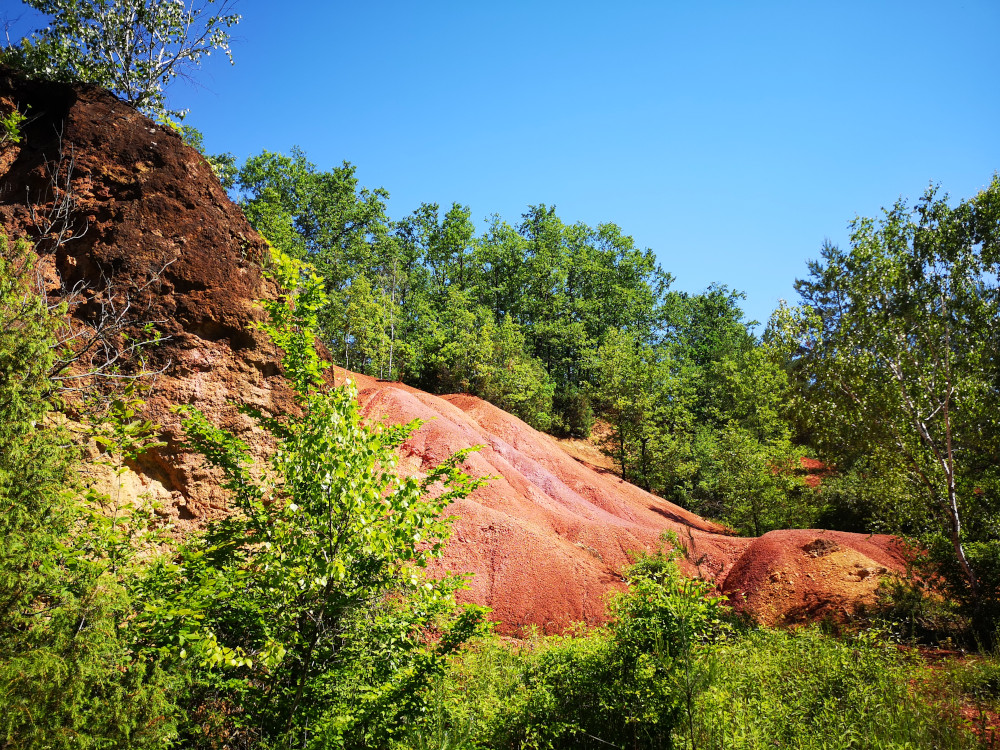
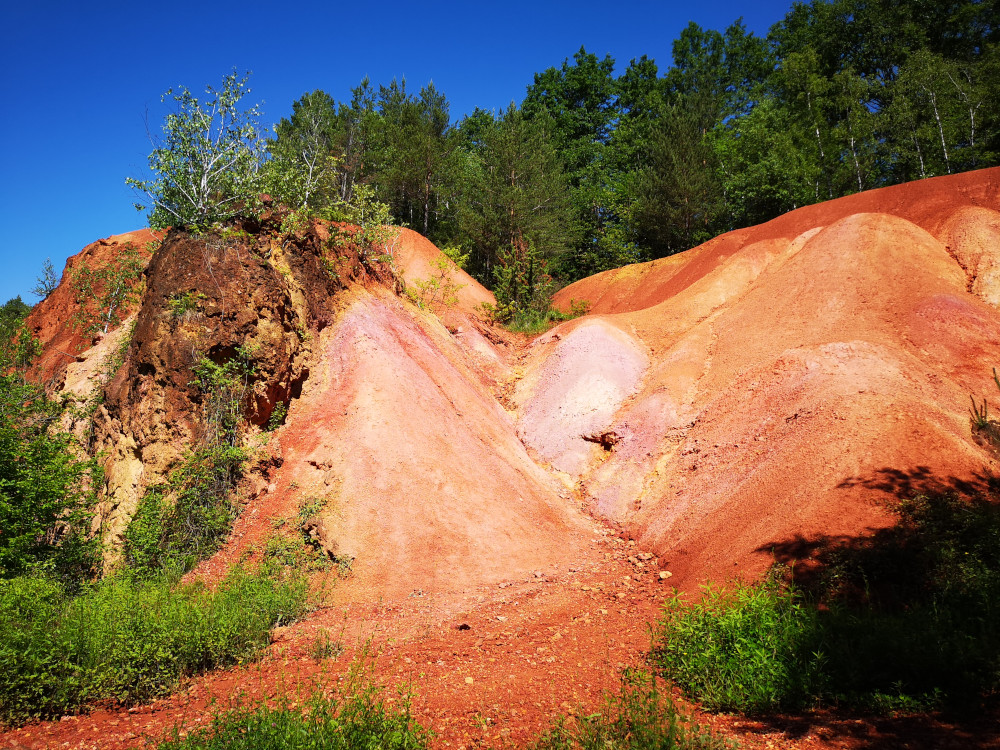
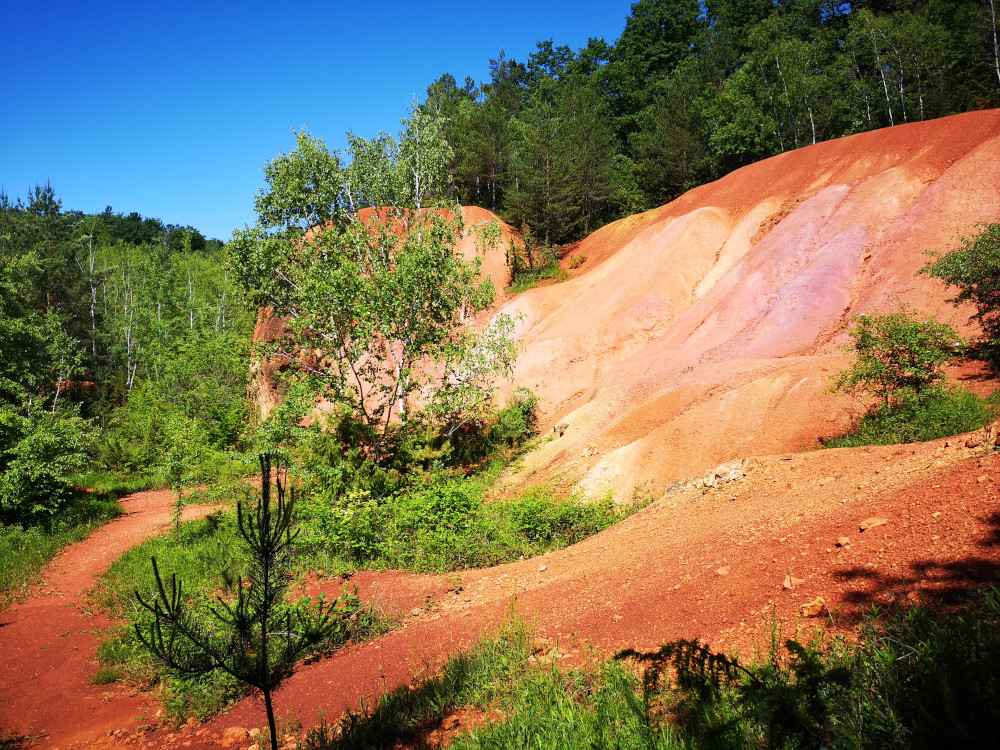
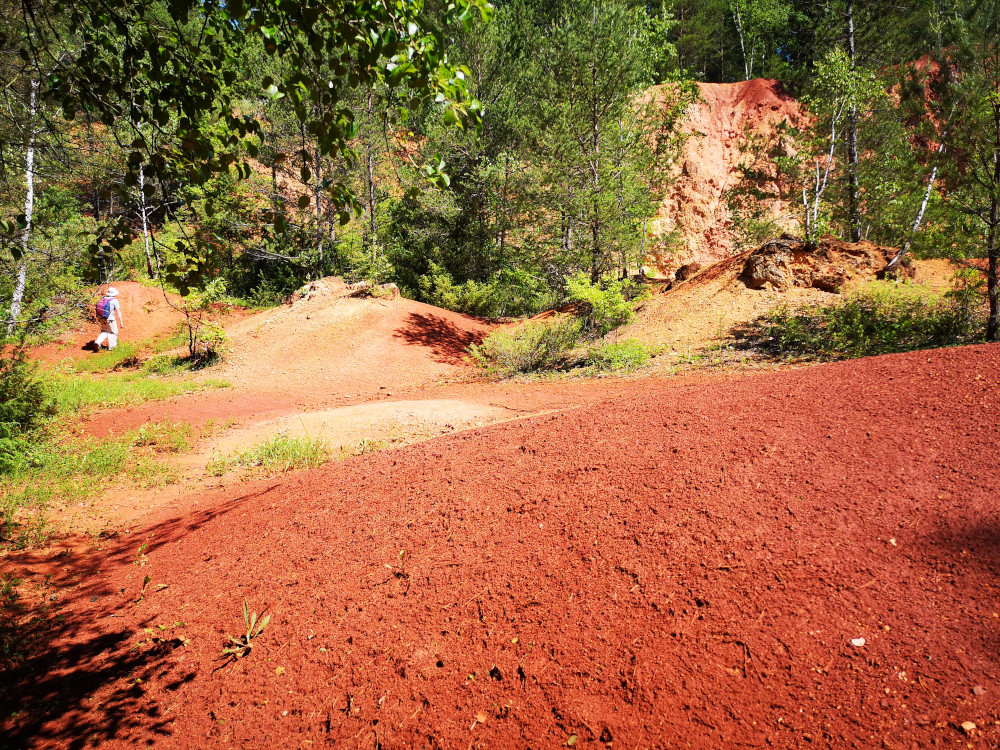
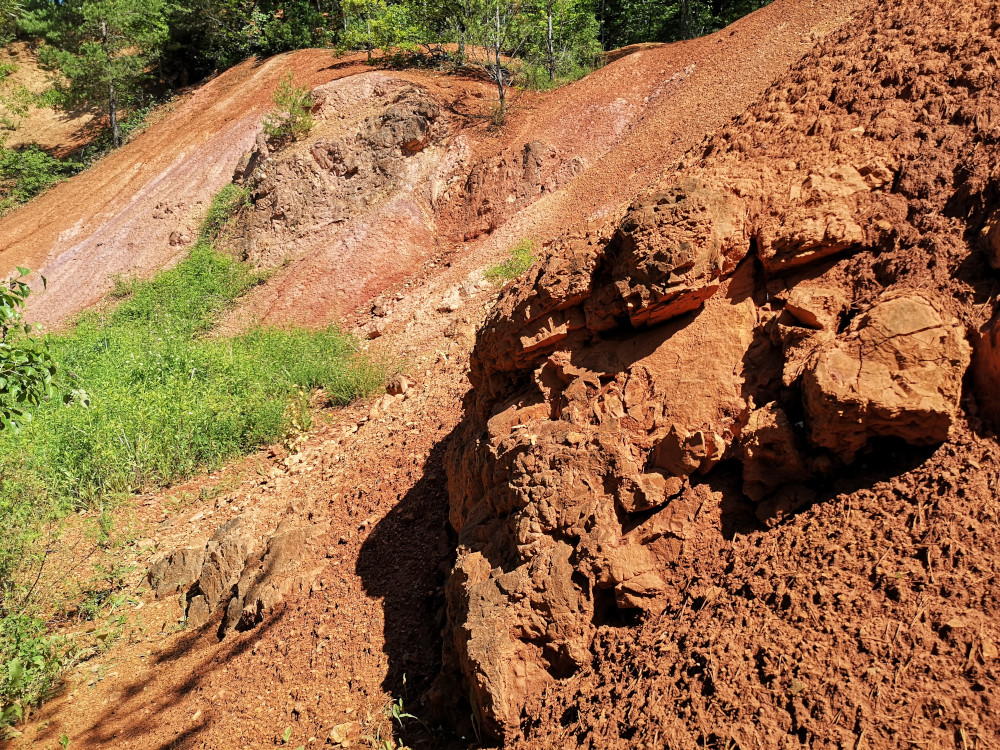
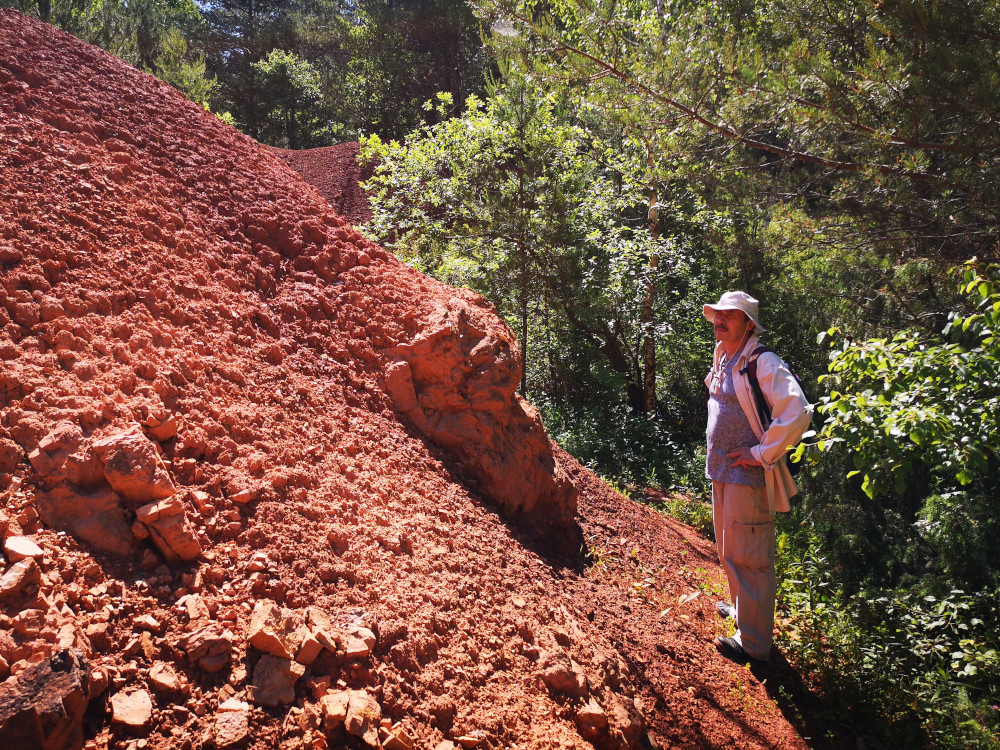
The Nyirád Bauxite Quarry is a place where geology, industry, and art meet. Once a site of intense bauxite mining, it now reveals colorful slopes, water-filled basins, and layers of natural and human history. Through performance, pigment collection, and immersive artistic practice, we bring this landscape’s memory to life.
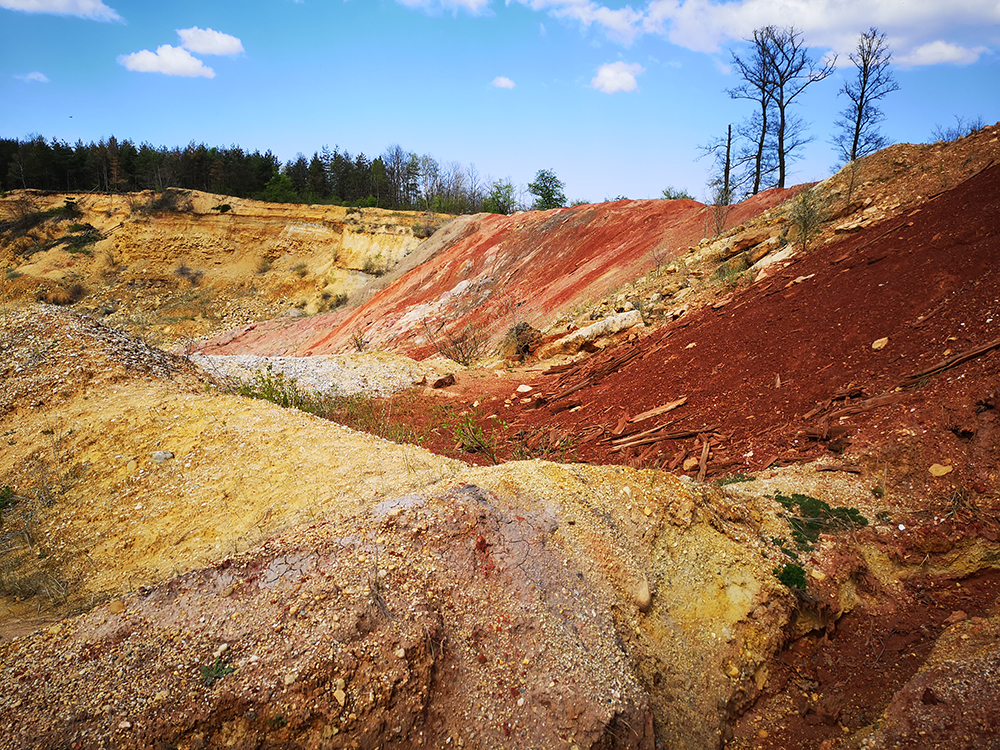
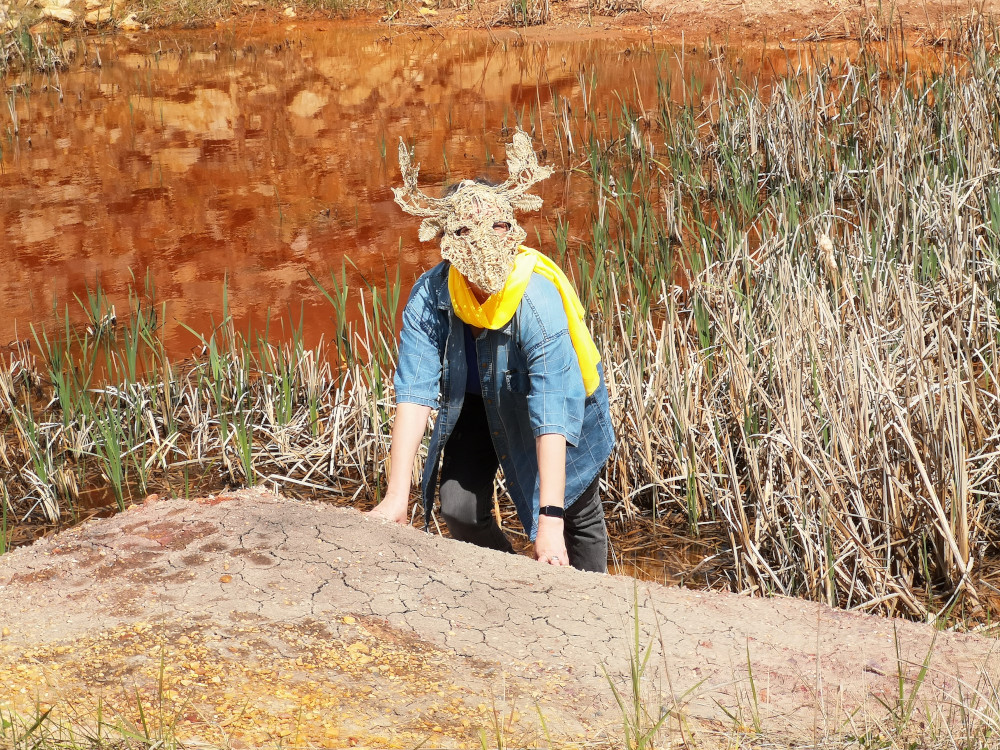
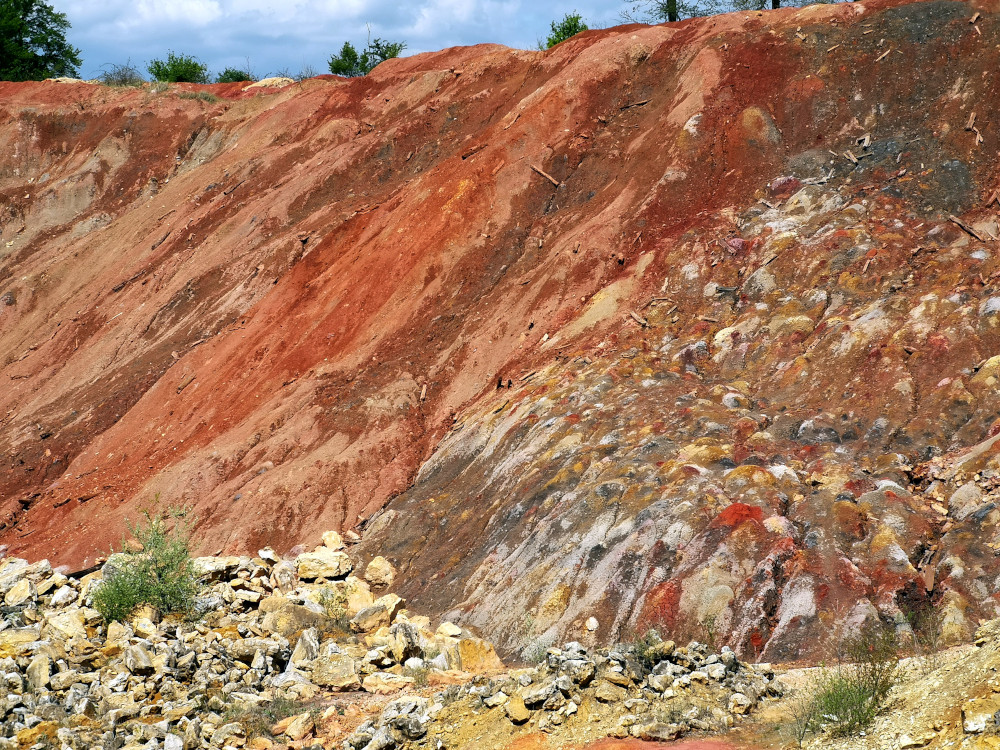
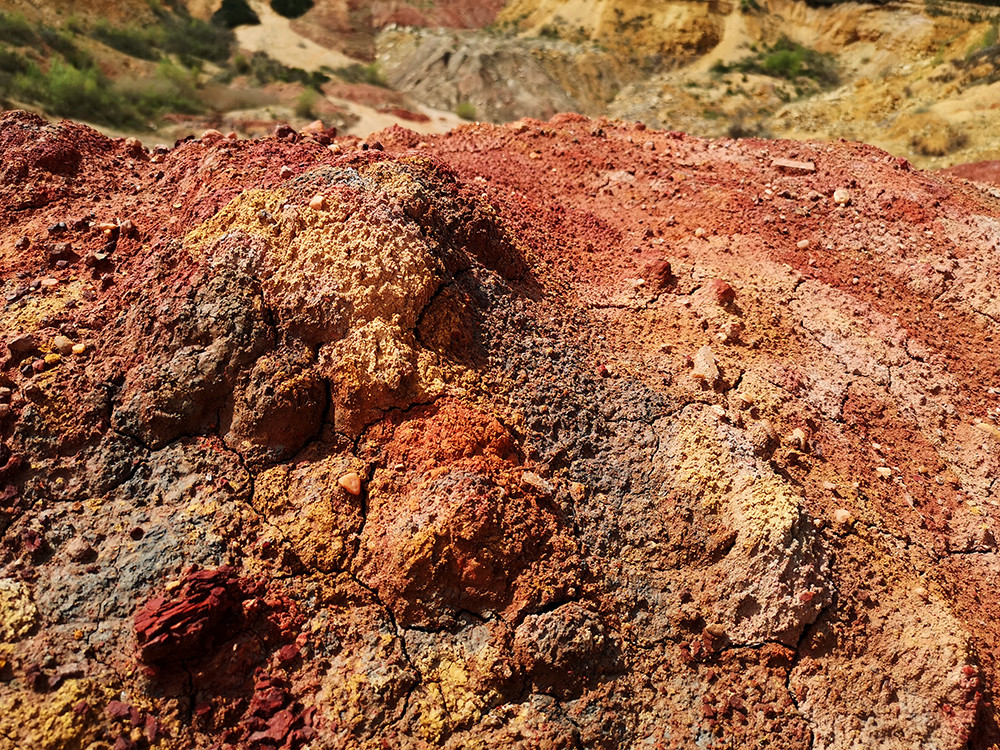
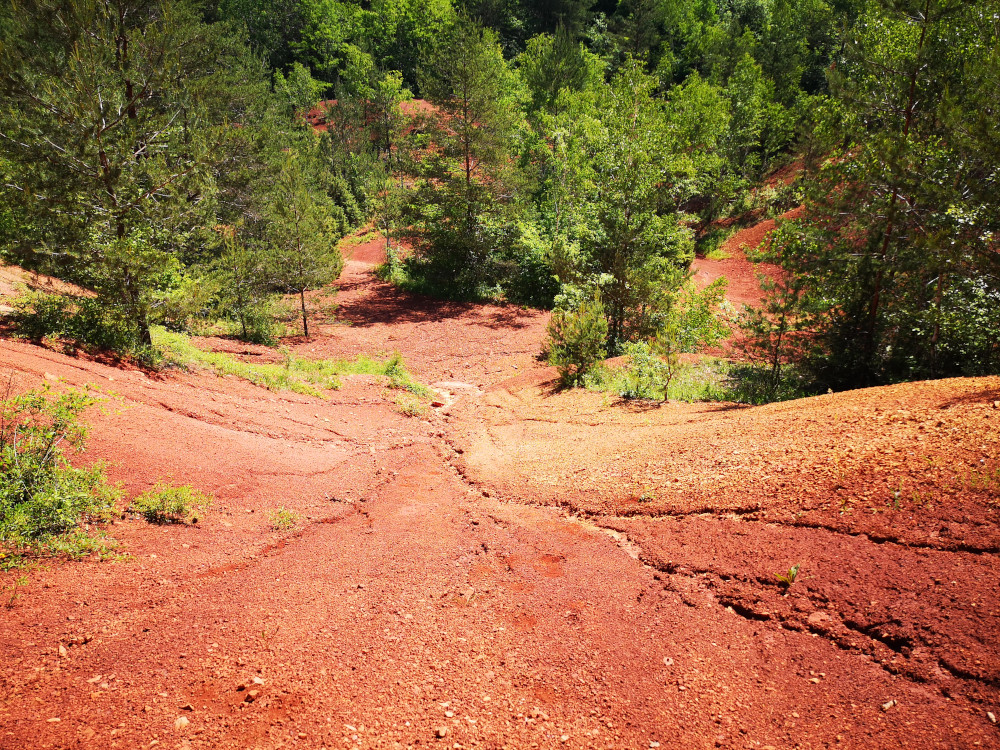
Geological and Historical Context The bauxite quarry is located approximately 4 km south-southwest of the town of Nyirád. It consists of several interconnected basins, covering an area of about 1100 by 700 meters. All mining operations have since been halted. Today, the southern basin features a racetrack, while the northern basin is recognized as a geological natural monument. It showcases exposed multicolored slopes and a partially water-filled floor, measuring around 300 by 400 meters. The quarry is known for its vivid and varied coloration.
The primary material extracted from the site was bauxite — an aluminum ore. Bauxite forms in tropical climates through the intense weathering of igneous rocks. Under hot and rainy conditions, rock components break down and are carried by water, settling where the flow slows. The quarry’s bedrock consists of Upper Triassic dolomite (227–205 million years old). During the Cretaceous period (approximately 143–113 million years ago), a bay formed in a depression in the dolomite layer. Sediments rich in bauxite minerals accumulated there, creating a bauxite lens.
Aluminum derived from bauxite is widely used in the aviation and aerospace industries. After the construction sector and packaging production (such as cans and foil), one of the largest consumers of aluminum is the energy industry. Mining in this area began in the 1940s. In the 1960s, to prevent flooding of the quarry, a gradual lowering of the regional karst water table was initiated. The ore was extracted through deep mining combined with continuous pumping of underground water. This process disrupted the natural water balance of the Transdanubian Mountains. Major river systems were damaged, and springs—including the Tapolca cave spring and the thermal sources of Lake Hévíz—were depleted. Water inflow into the lake was reduced by half. Although the environmental consequences were known to experts, the political climate at the time did not permit halting mining operations. Extraction was only stopped in the 1990s due to public pressure. Since then, groundwater levels have slowly begun to recover. [1]
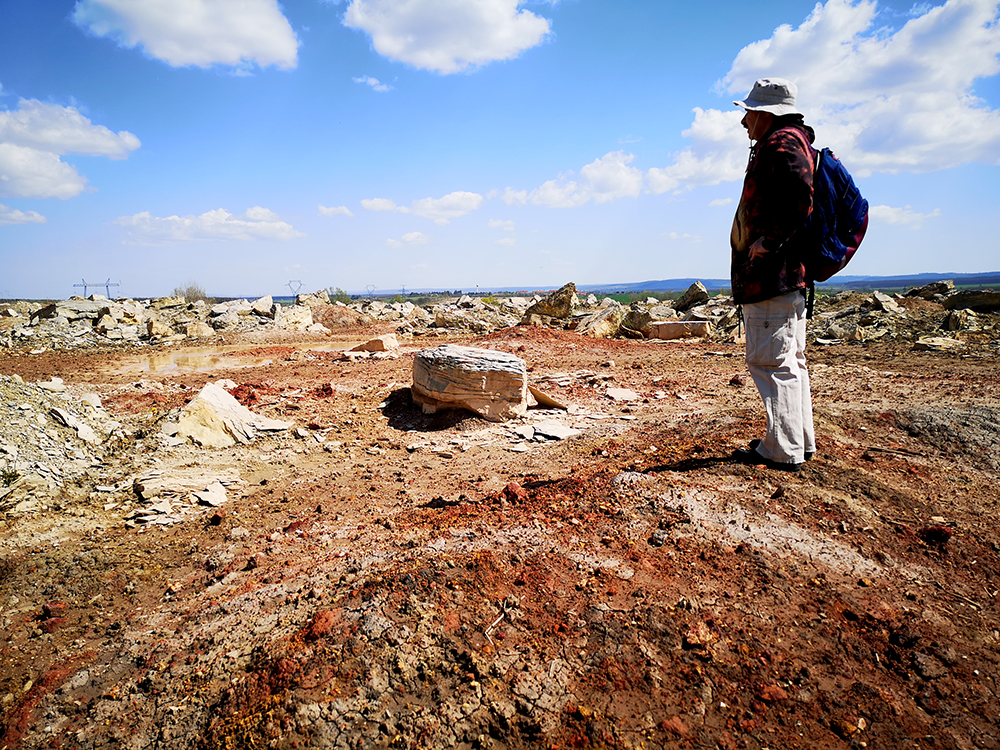
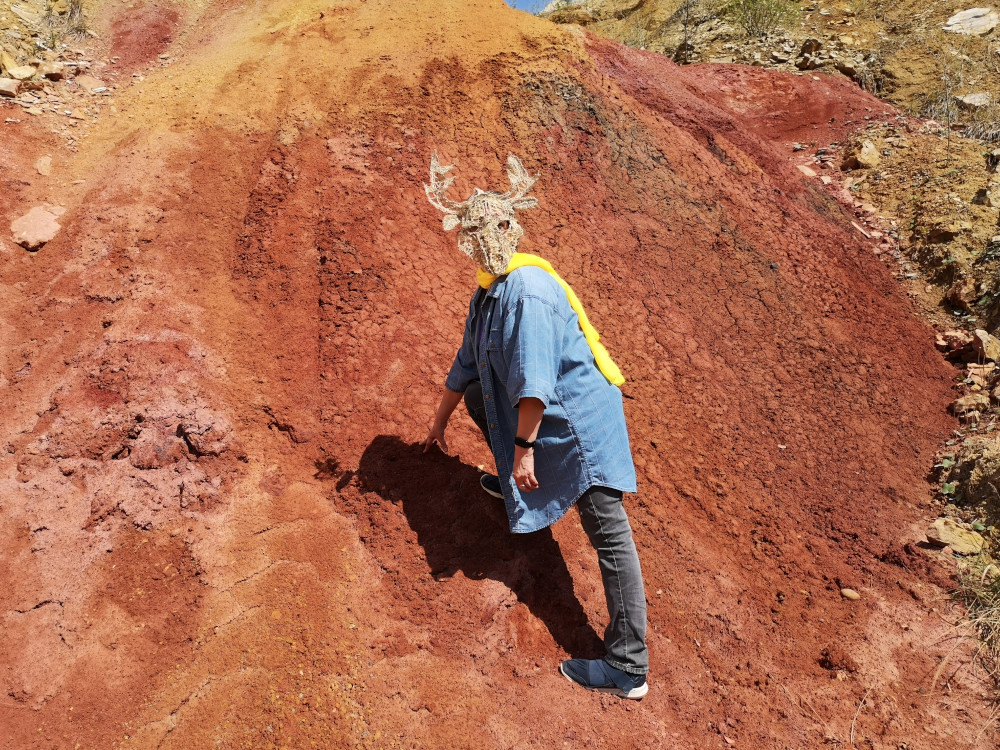
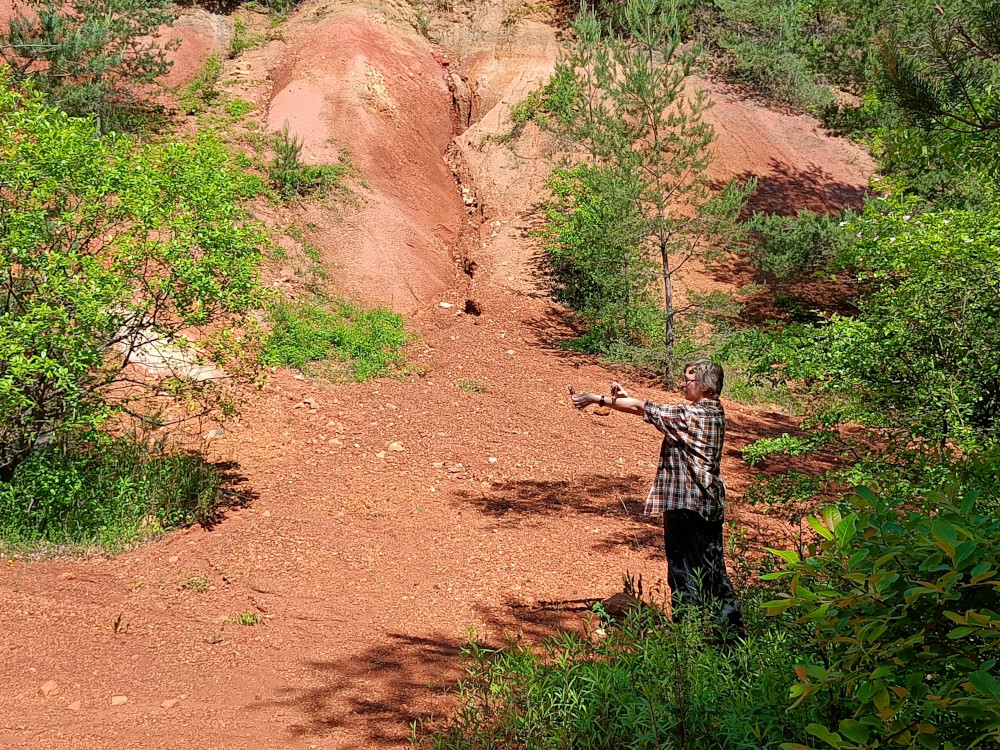
Performance and Artistic Intervention We first visited the Nyirád Quarry in 2022. The site looked almost otherworldly — people often say such landscapes resemble Mars, the planet named after the god of war. In some places, the terrain appeared like a dried, bloody wound. Mining left physical and ecological scars, but also cultural and emotional ones.
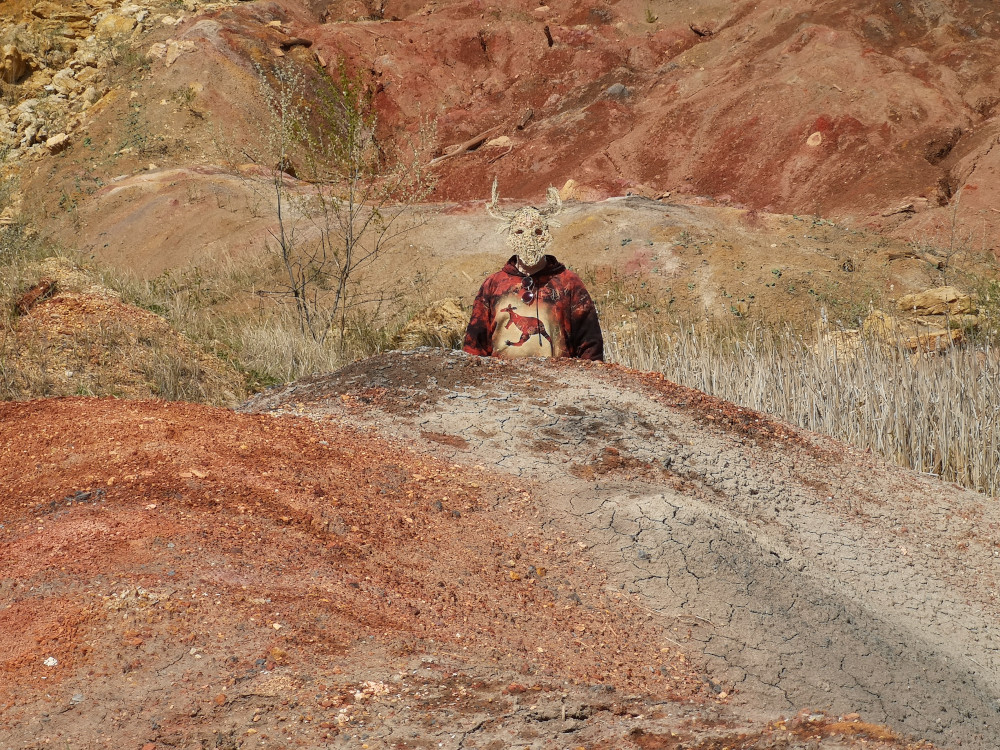
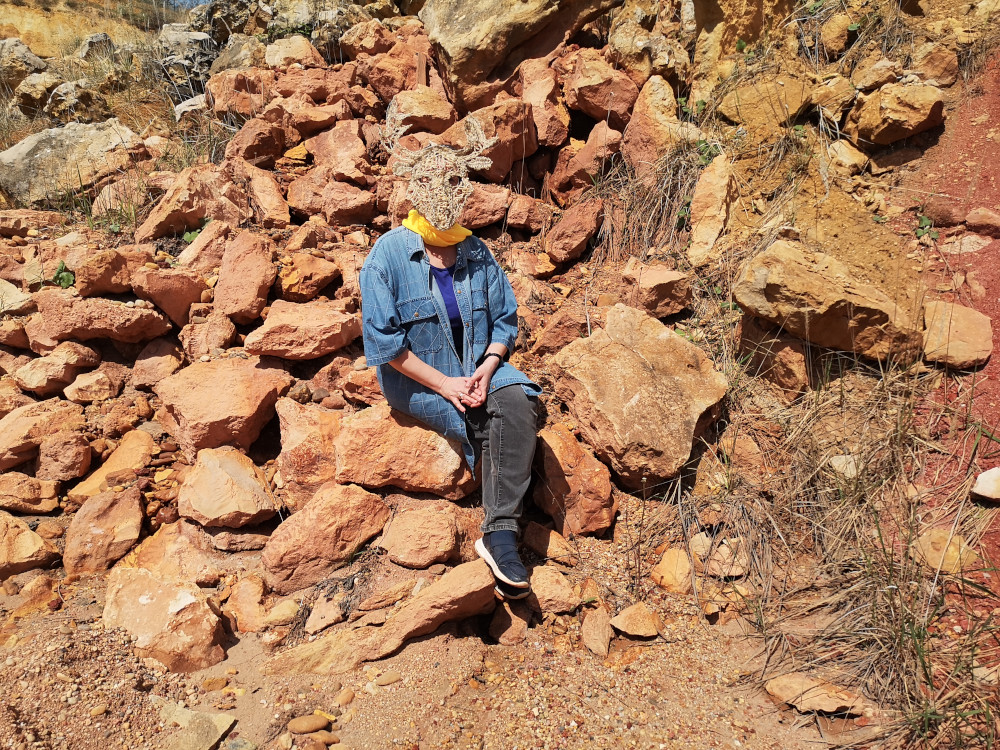
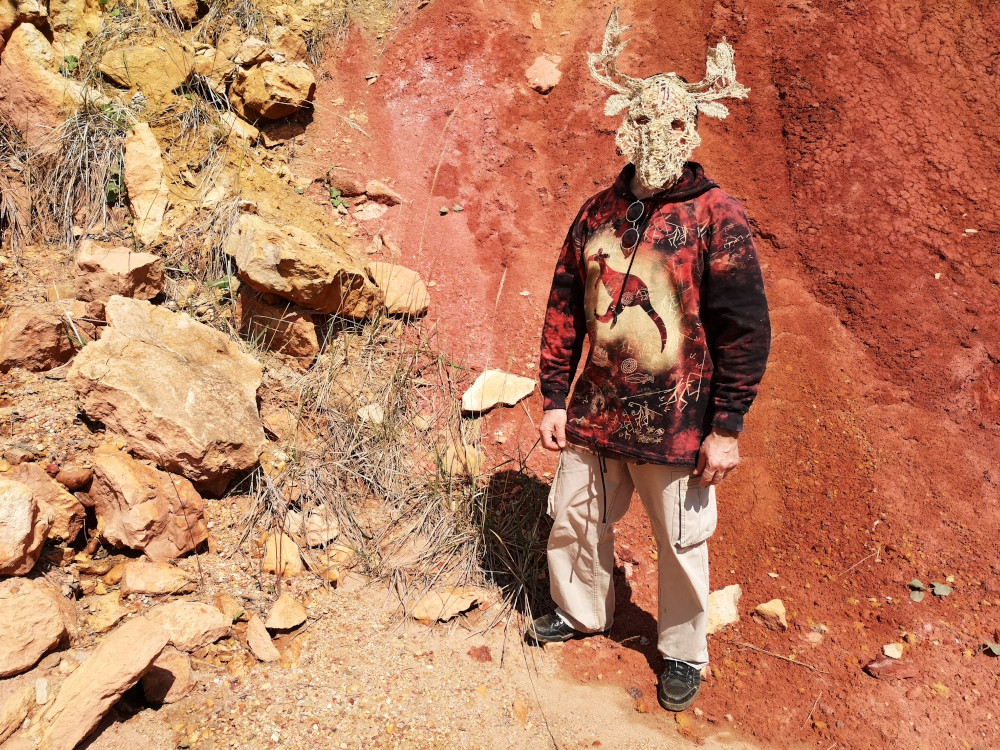
In many cultures, the deer symbolizes a mediator and healer of the earth. Our performances with deer masks embody this role, invoking the idea that art itself can heal landscape wounds. So we performed an artistic ritual in deer masks — a gesture of connection, care, and transformation.
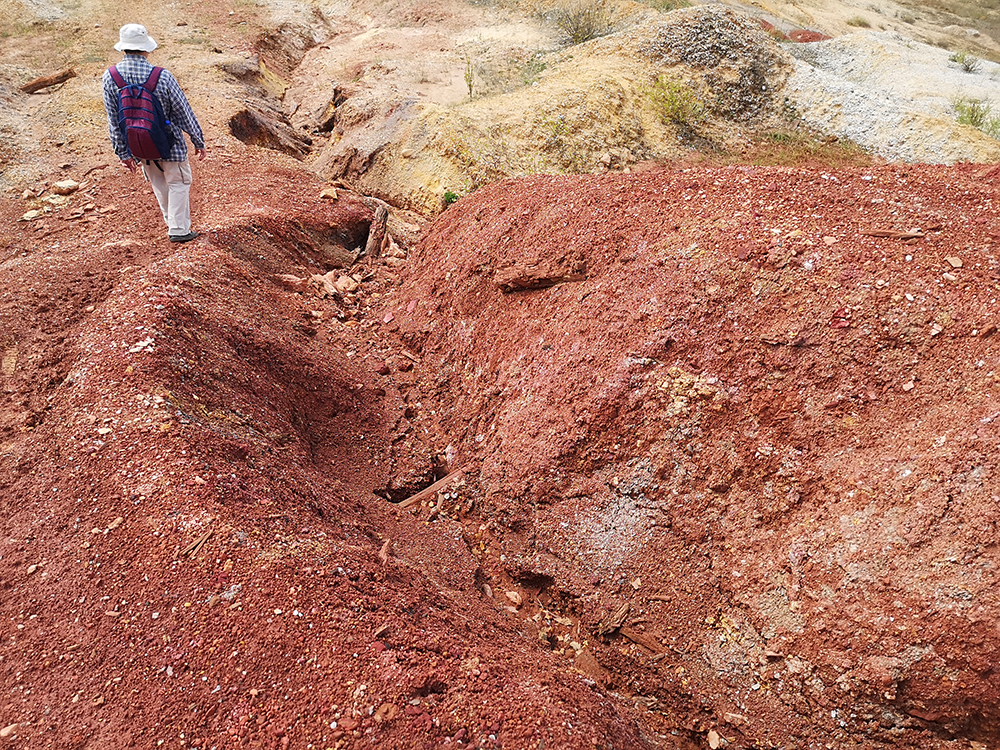
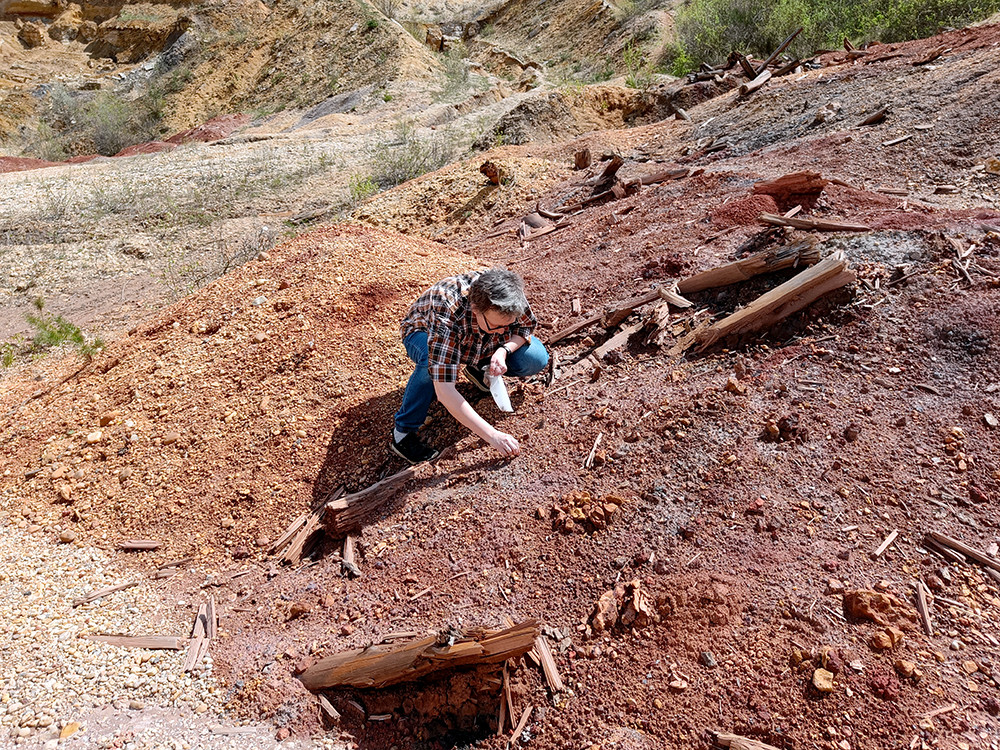
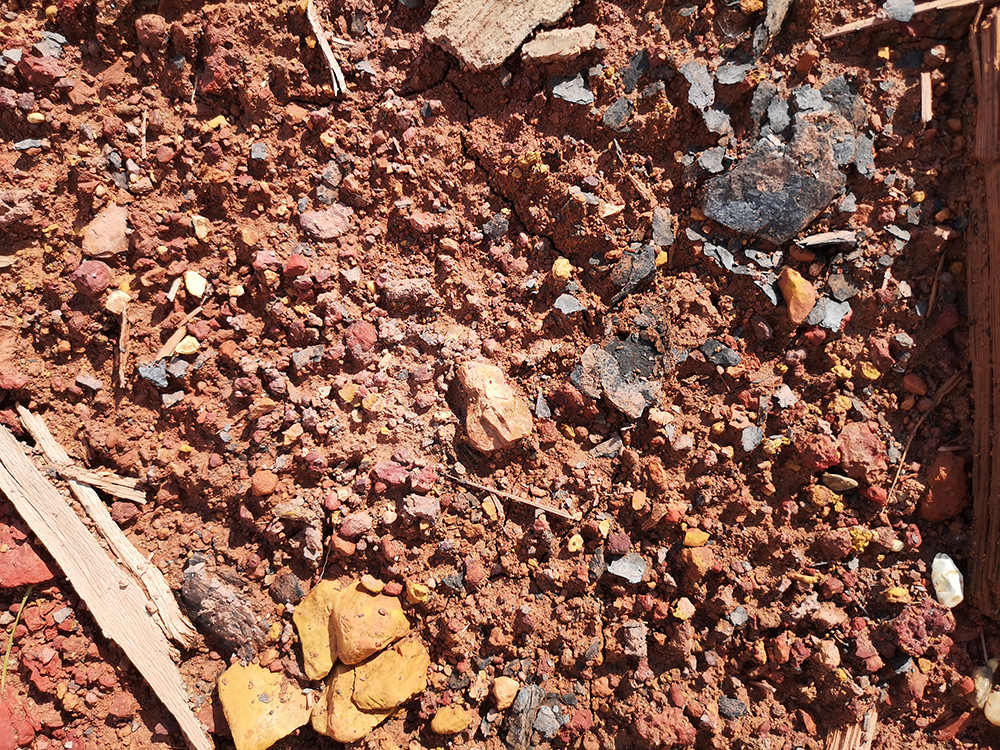
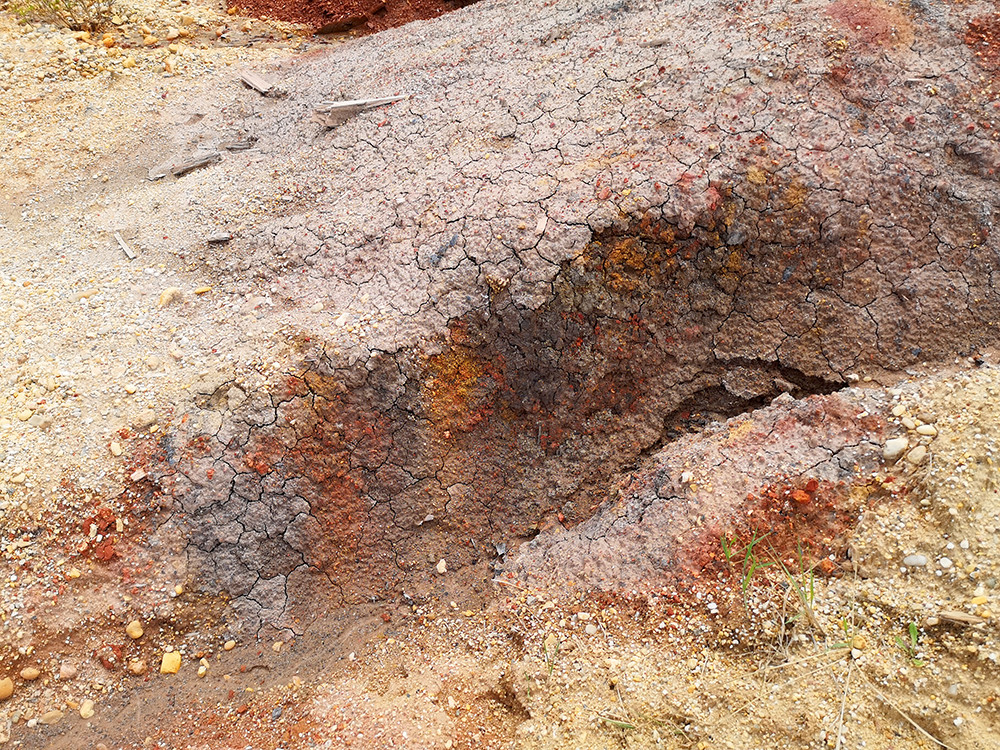
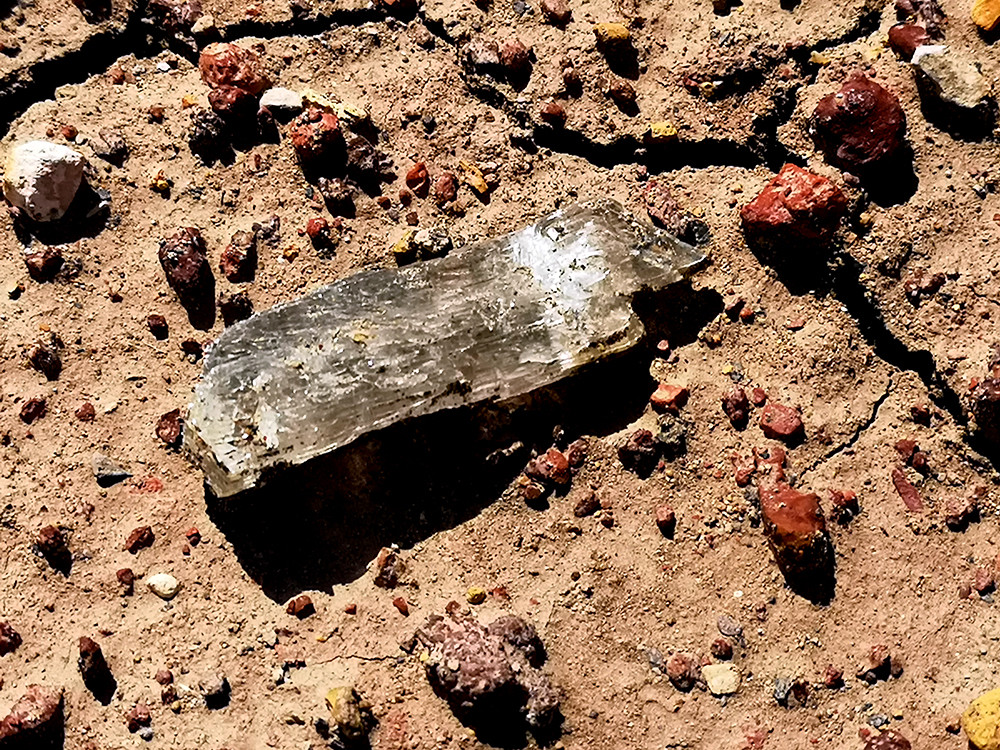
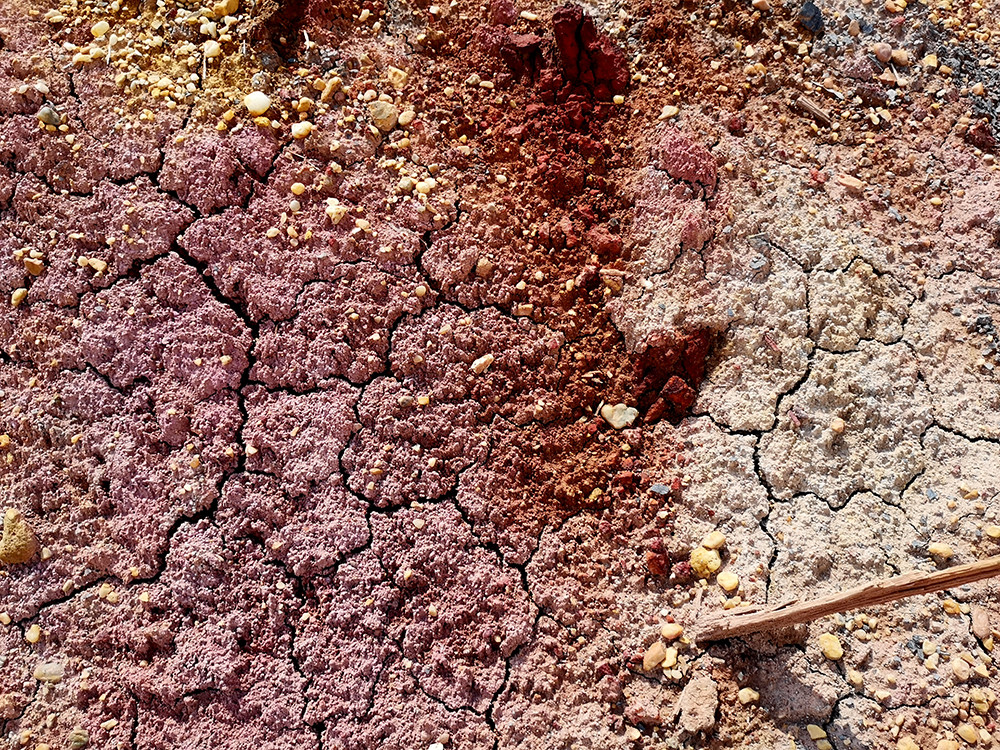
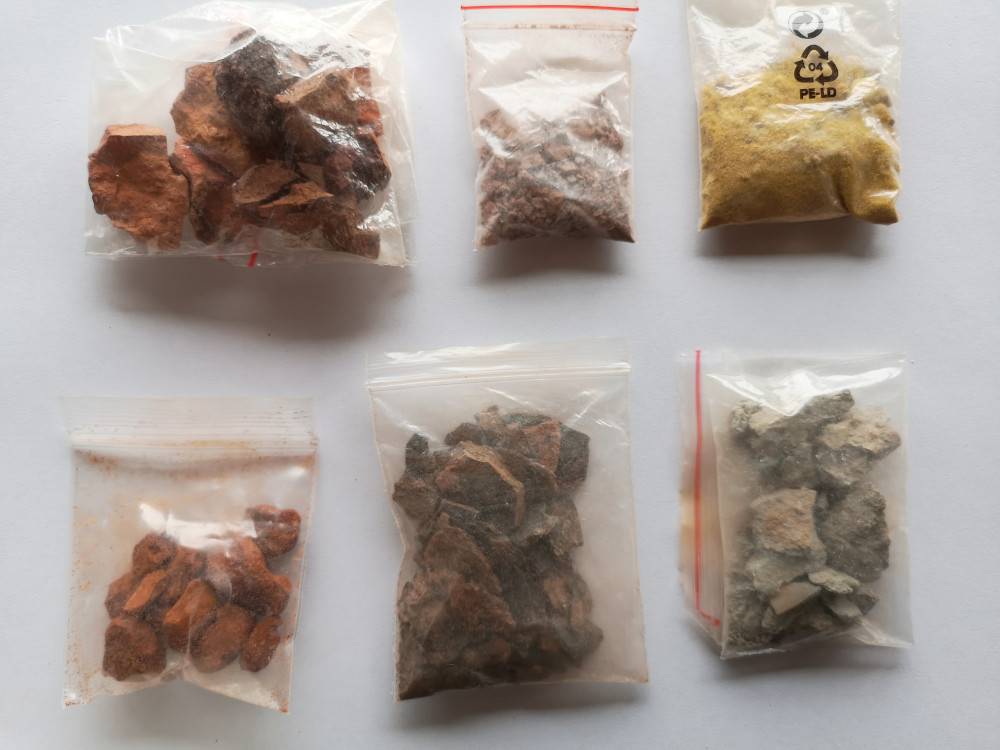
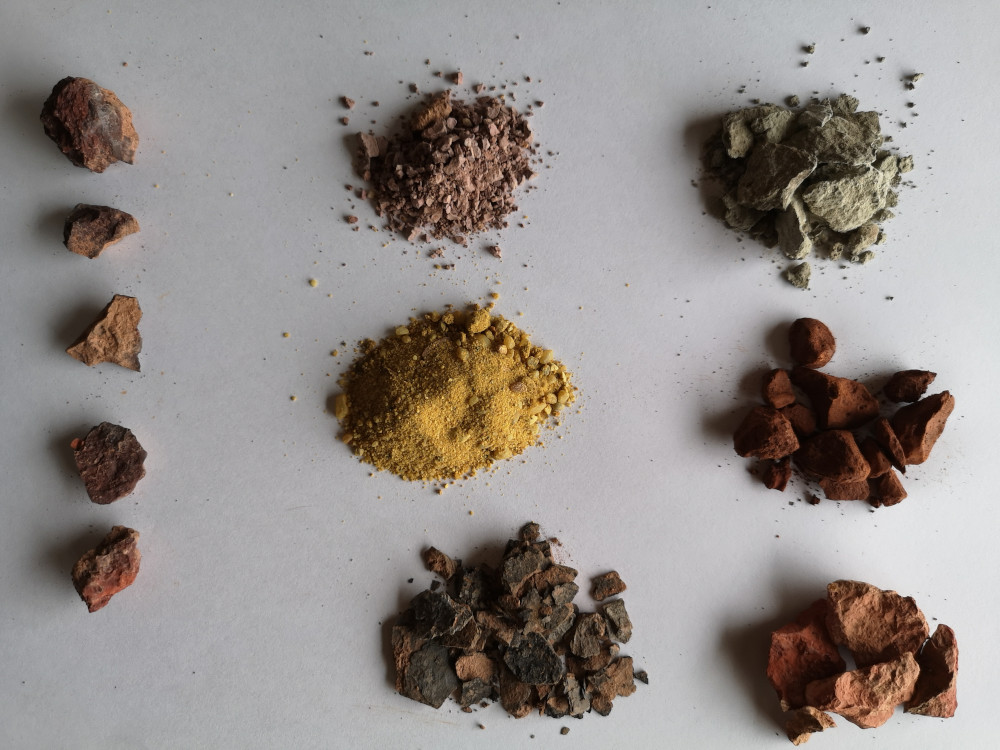
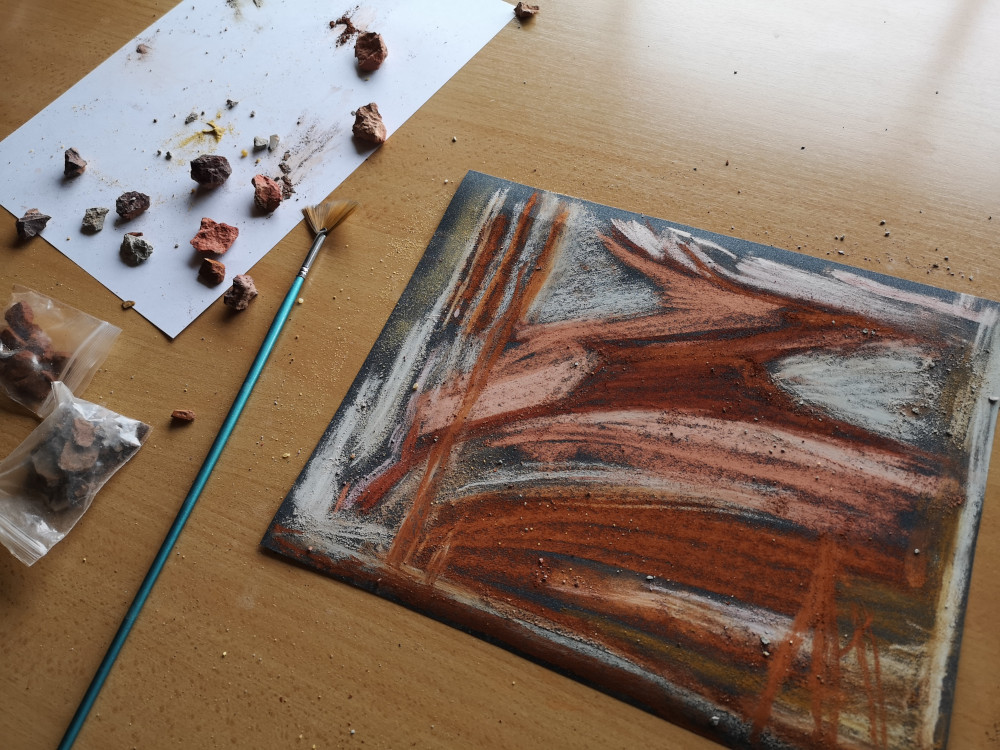
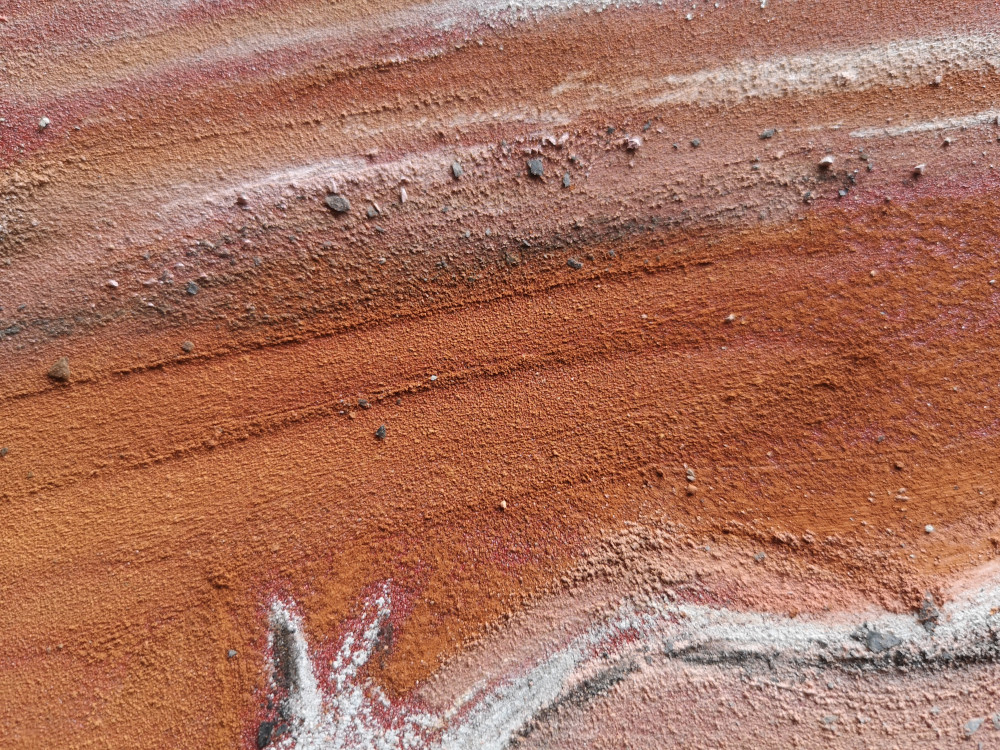
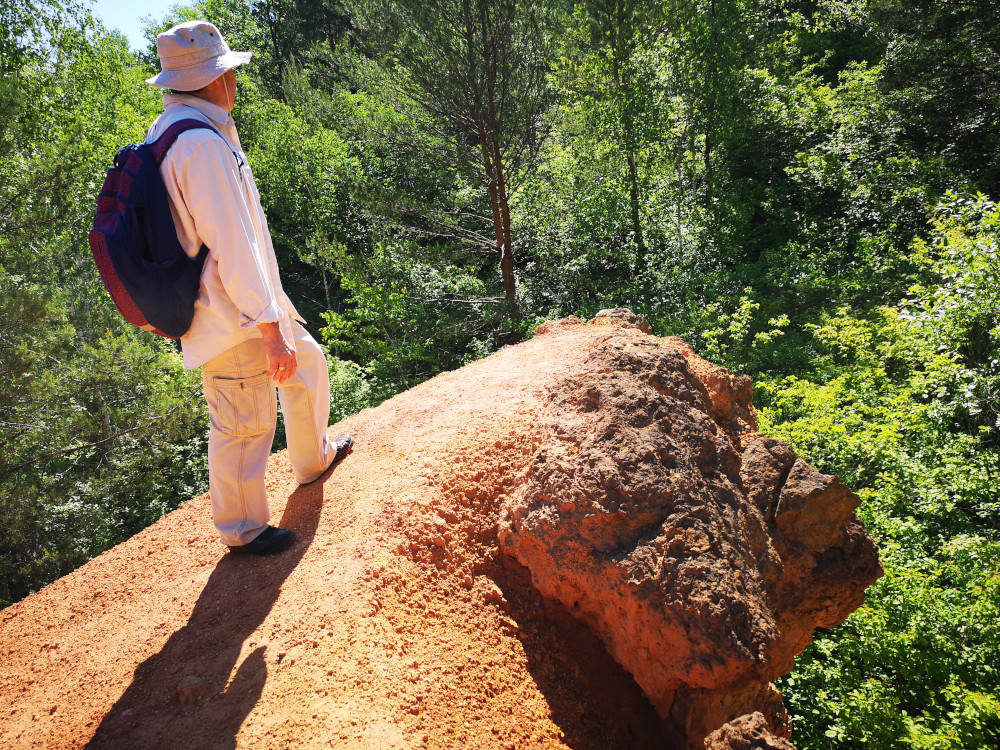
We returned in 2023. This time, in the multicolored part of the quarry, we gathered natural pigments from the vibrant mineral layers.
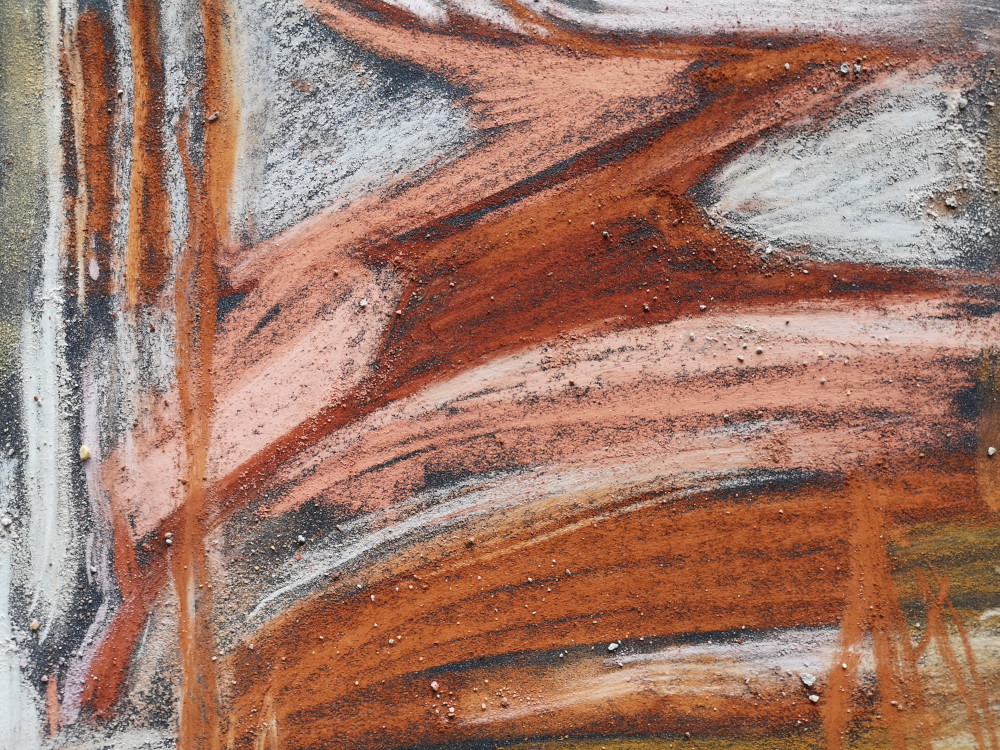
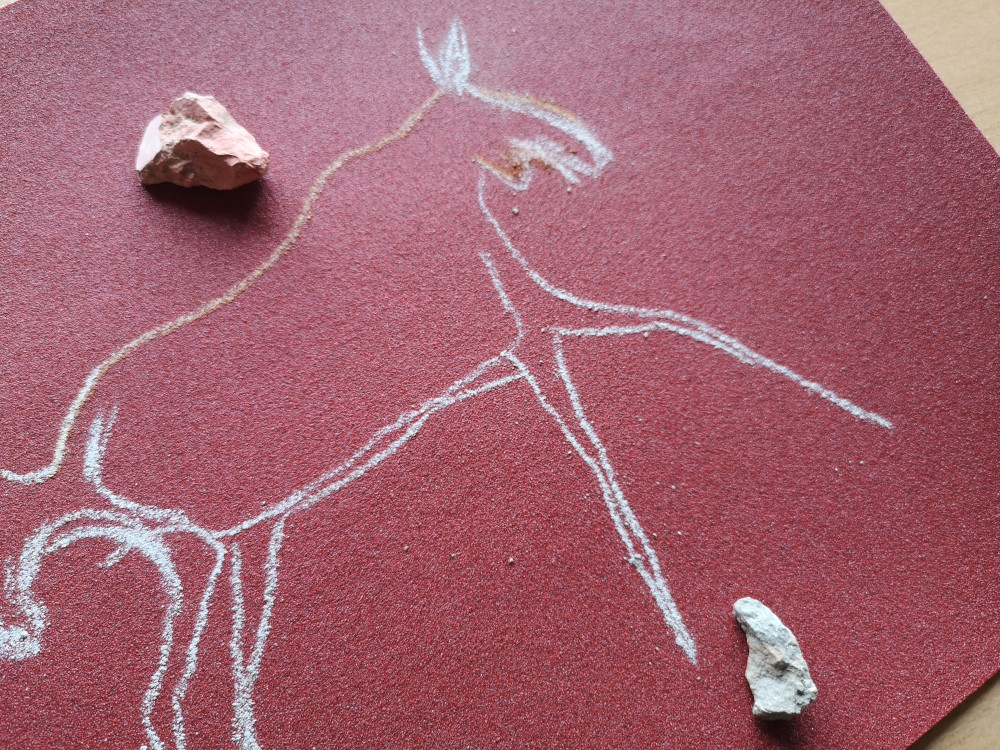
These were later tested on sandpaper – combining touch, memory and matter into images.
Revealed RealismMethod Our artistic approach does not impose new narratives but reveals and amplifies existing realities. By engaging physically with the site—through touch, movement, and material sampling—we deepen the perception of the quarry’s layered history and present condition.
This method bridges science and art, combining geological knowledge with sensory experience to create a multidimensional understanding of place.
The scientist reveals the quarry’s geological past and industrial impacts, preserving knowledge as a form of memory. The artist animates this knowledge, transforming it into lived experience and emotional connection. Together, science and art restore the quarry’s voice, enabling dialogue with its scars and stories.
Materials used: cotton wool, earth pigments from Darvastó, thread, time.
About the Place: The quarry is located approximately 7 km southwest of the town of Nyirád. It is characterized by its red coloration and is currently inactive. The quarry measures approximately 700 meters in length, 250–400 meters in width, and 15–20 meters in depth.
The extracted material was aluminum ore — bauxite. Bauxite forms as a result of the weathering of igneous rocks in tropical climates. Under extremely hot and rainy conditions, the rocks disintegrate, and their components are transported in solution to areas of sedimentation where the flow of water slows down. The bedrock of the quarry is Upper Triassic dolomite (dating from 227 to 205 million years ago). During the Cretaceous period (143 to 113 million years ago), bauxite-bearing particles accumulated in a bay formed by a depression in the dolomite layer, eventually forming the bauxite lens. Bauxite mining in the Nyirád area began in the 1940s. Ore from the lens was extracted through deep mining and the pumping of karst water. The quarry was closed in 1977. [1, 2, 3]
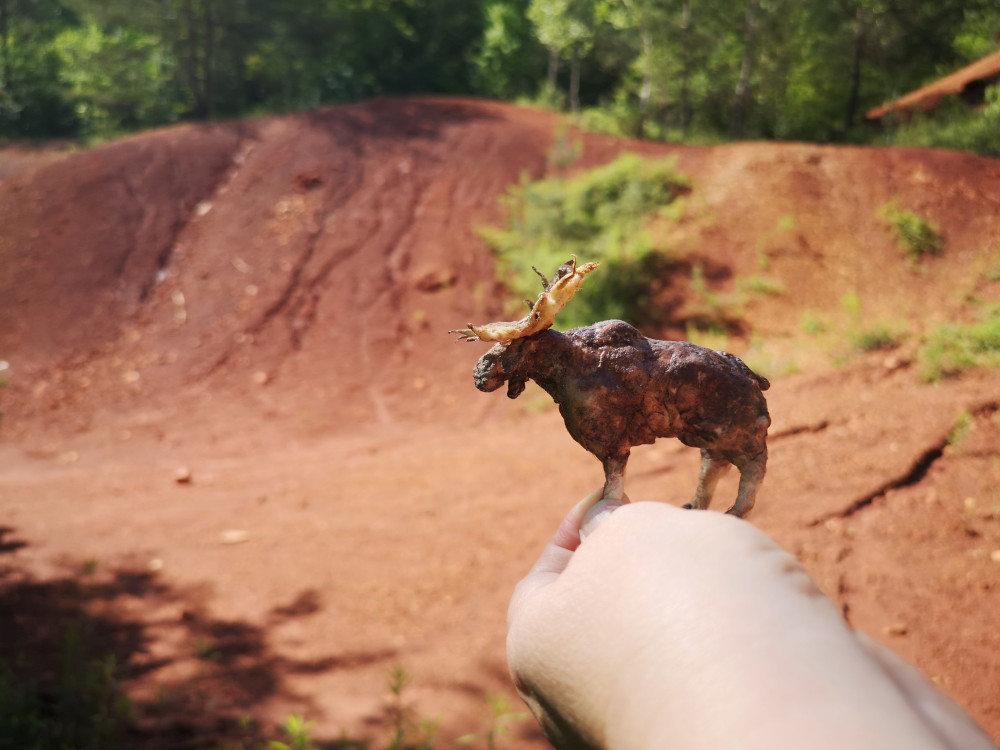
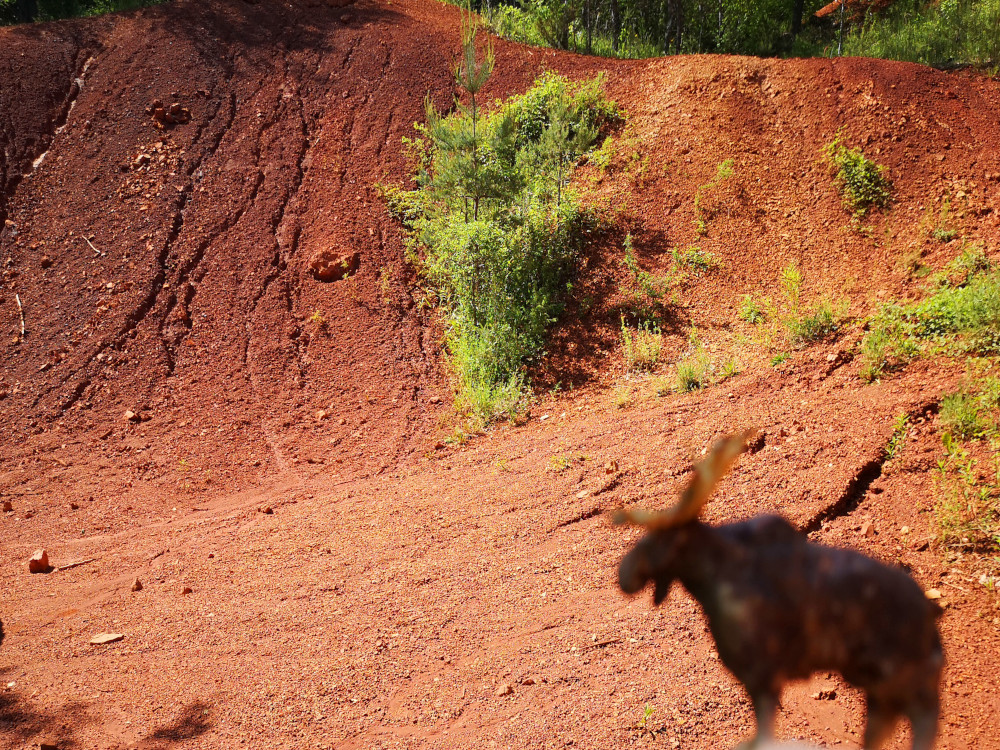
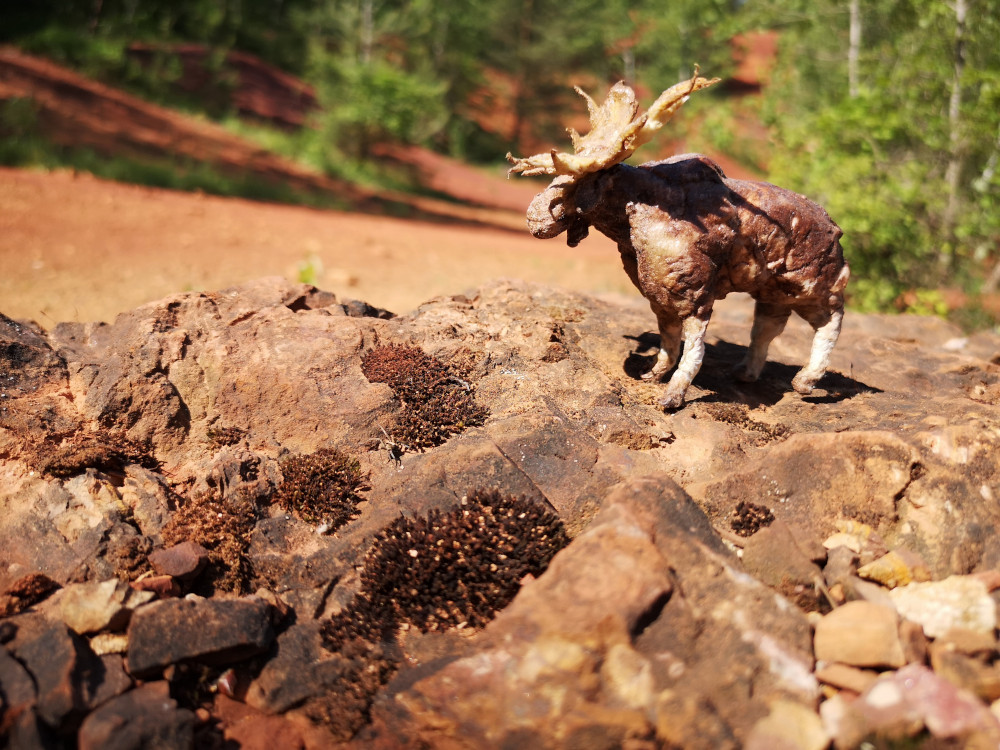
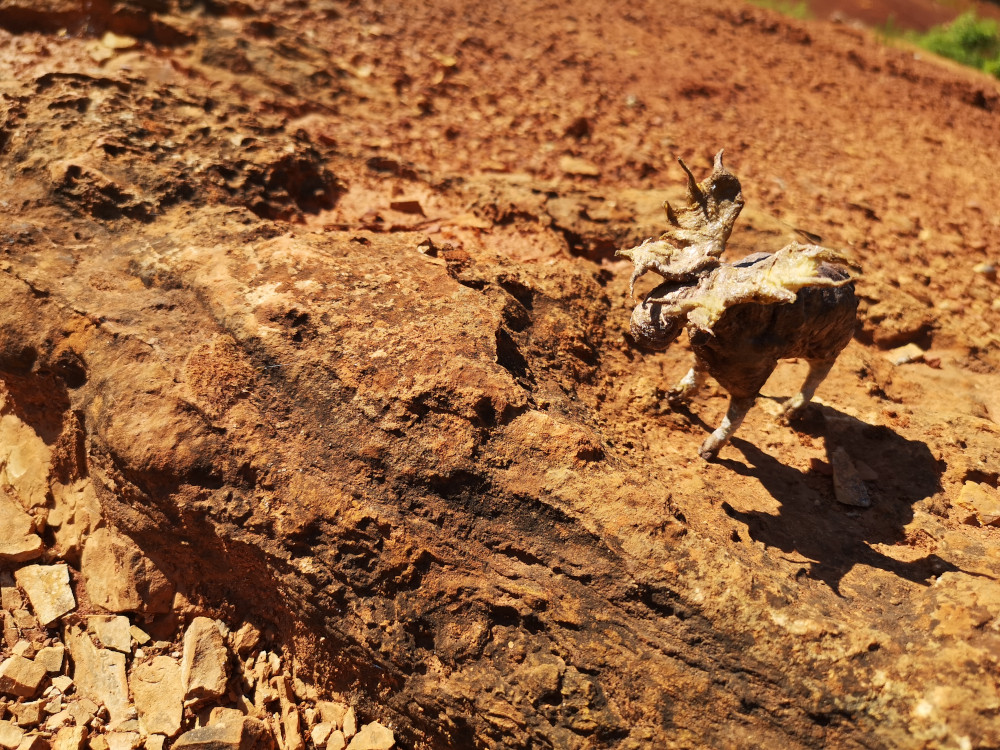
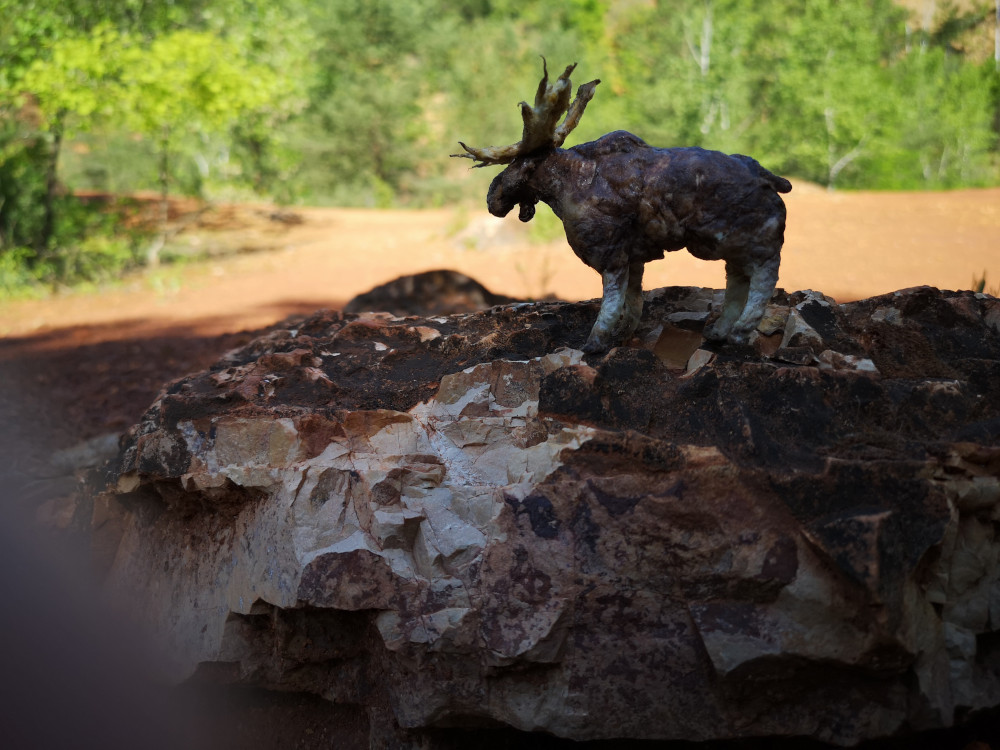
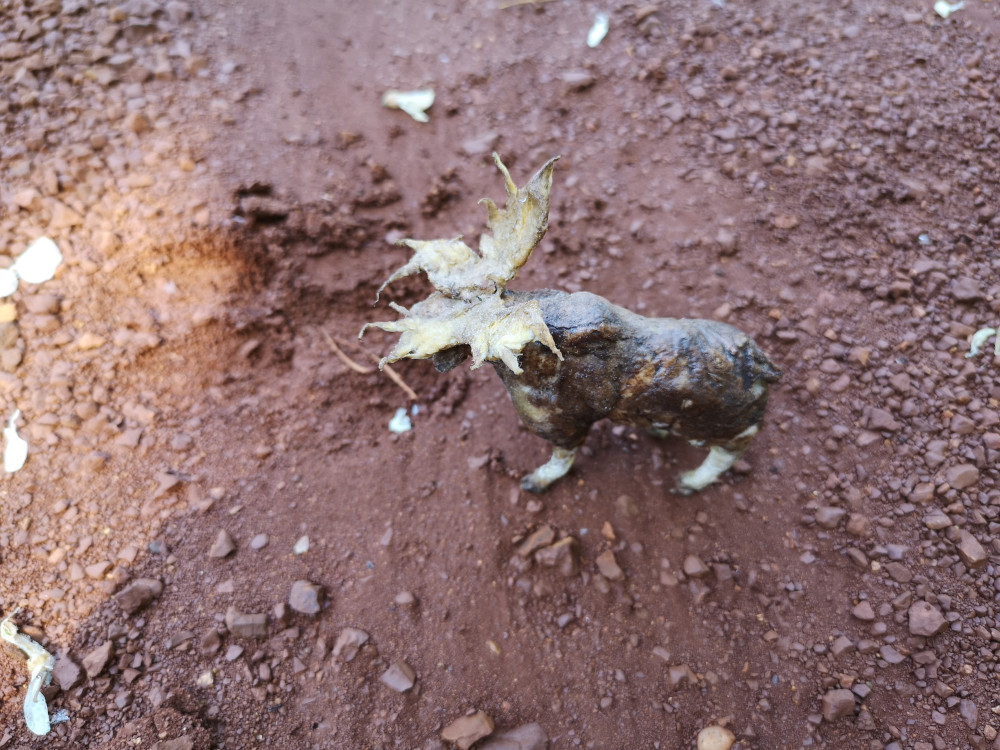
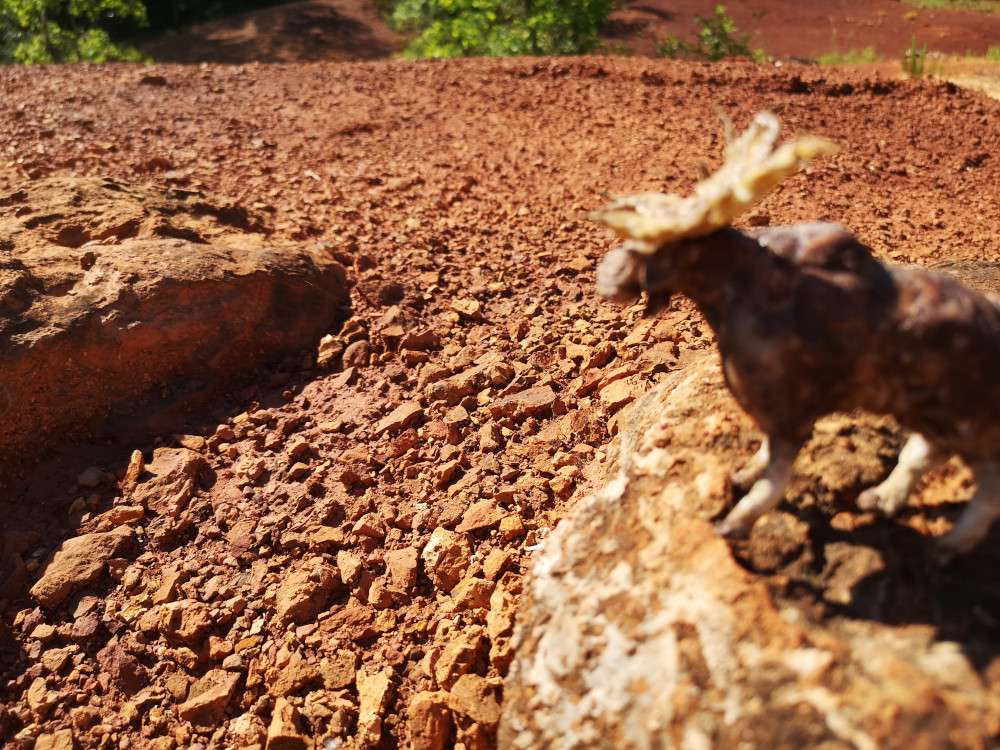
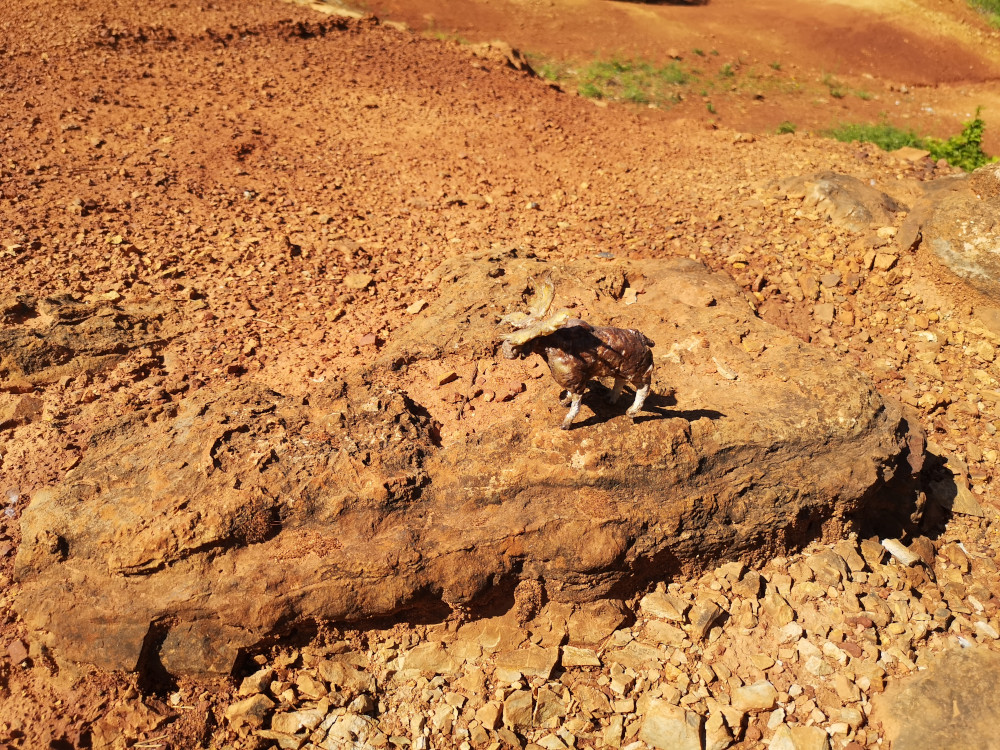
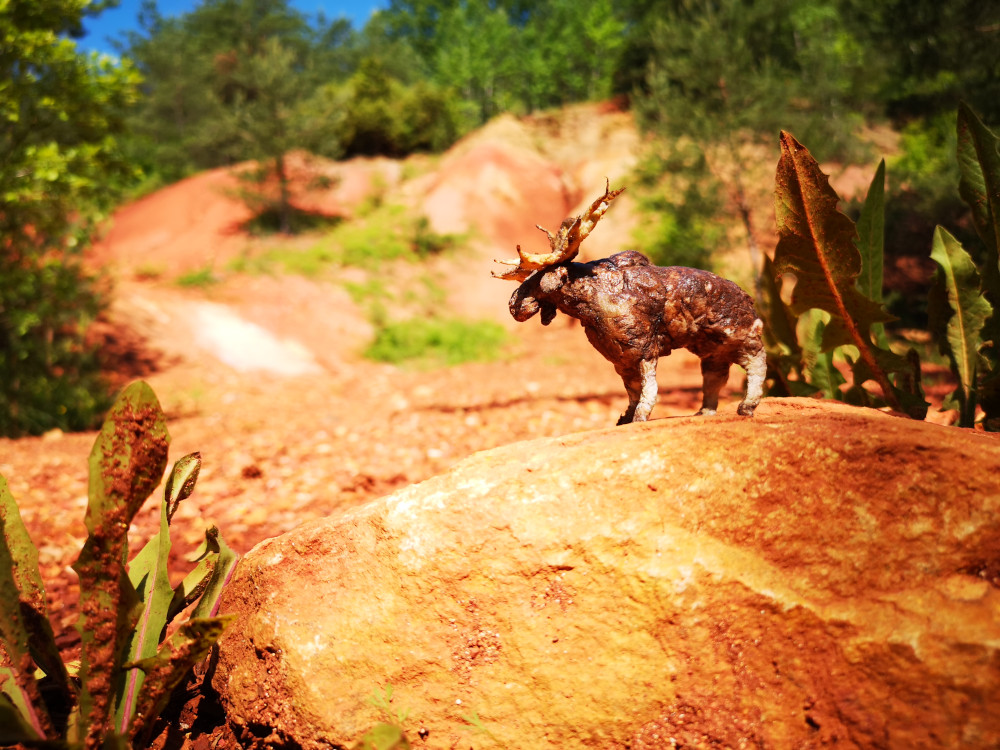
Artistic Intervention In 2022, we visited the quarry and brought an artistic presence into its landscape. A small stag figurine, handcrafted from cotton wool and tinted with natural pigments taken directly from the site, was photographed by us in the quarry. Then we left it there — an unauthorized miniature monument. It bore no label, no explanation, no protection. It simply remained — vulnerable, visible, and quietly appropriate.
The red stag in the red earth became a silent ritual of return. A handmade creature, infused with the color of the land itself, placed into the wounded earth like a stitch.
In many mythologies, the stag is a messenger between worlds — between the visible and the hidden, the natural and the artificial, trauma and regeneration.
We see it as a soft footprint on hard ground. A gesture of remembrance, healing, and care.
This action was created by our team as part of a growing series of works exploring the memory of the land, ecological trauma, and myth through Revealed Realism (RR) — a method of subtle intervention, documentation, and co-presence with altered landscapes.
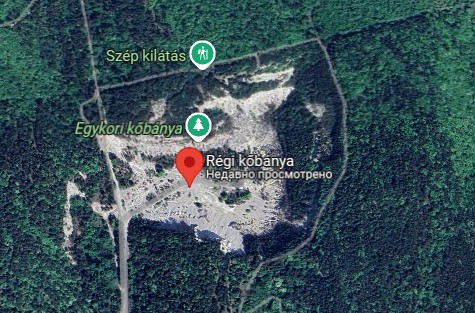
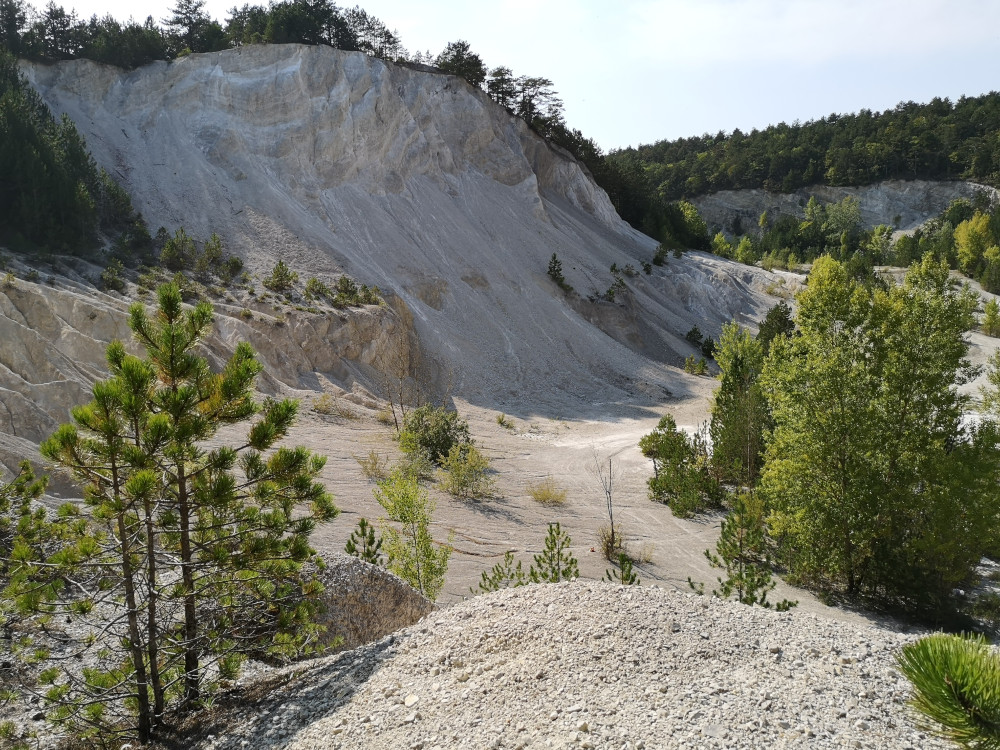
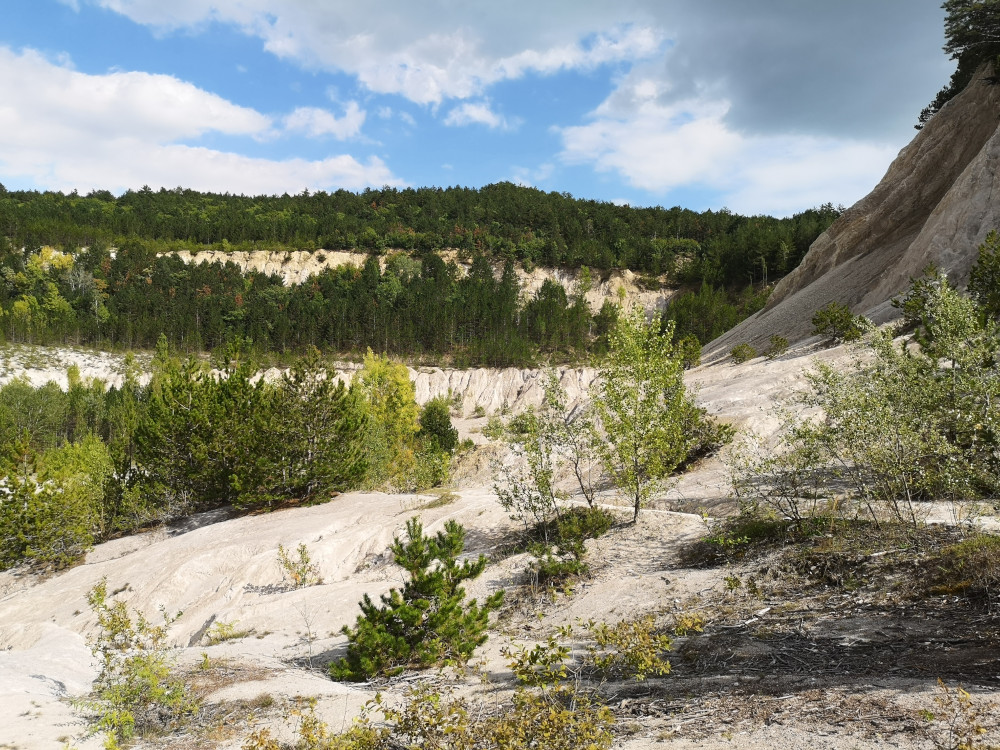
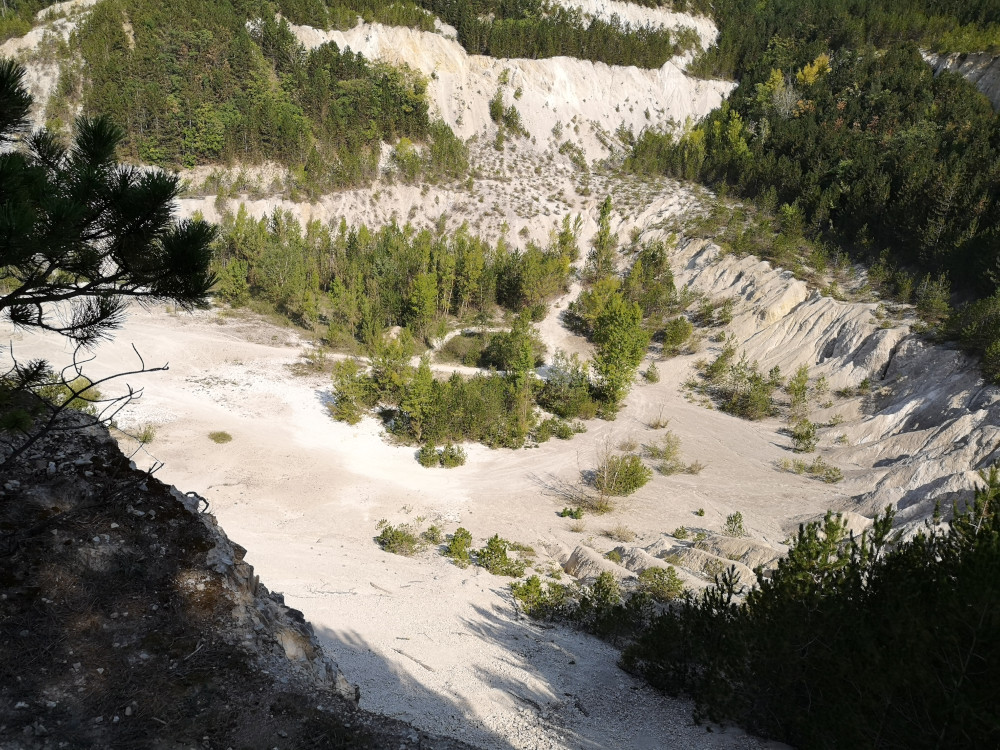
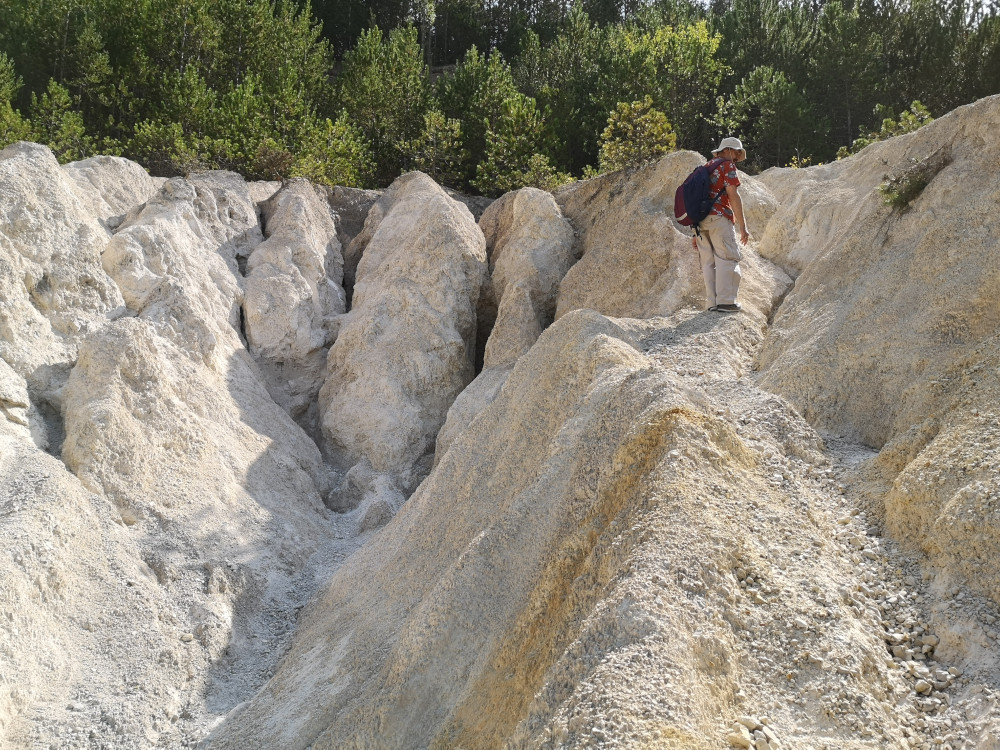
On the northern edge of the Hungarian village of Gyenesdiás, nestled on the slope of Pipa-hegy hill, lies a forgotten landscape — an abandoned dolomite quarry. Its pale grey walls preserve the memory of the ancient Tethys Ocean: more than 200 million years ago, during the Upper Triassic period (237–205 million years ago), warm shallow seas accumulated lime-rich sediments composed of the shells of tiny marine organisms. Through the action of microorganisms, these deposits transformed into a dense, compacted mass of calcium and magnesium carbonates — dolomite.
Covering an area of approximately 400 × 400 meters, the quarry is now silent and overgrown. It is divided by a narrow ridge into a spacious eastern section and a smaller western one. The eastern basin is particularly striking: nature has sculpted ravines, terraces, and canyons whose almost fantastical forms resemble an ancient amphitheater. The slopes and ledges are largely covered with black pine and brushwood, and each groove or outcrop feels like a mark left by both geological time and human intervention.
Once, the quarry supplied valuable materials for construction and industry. Dolomite was used as aggregate in building, as flux in metallurgy, to neutralize acidic soils and enrich them with calcium and magnesium in agriculture, as well as in the production of glass and refractory materials. [ 123 ]
Today, with its industrial role long gone, the quarry returns to nature — and simultaneously opens itself to artistic contemplation and action. As part of the series “The Quarry as Witness,” we approach such places as living archives: not only of geological memory, but of the potential for interaction between human presence, form, and time.
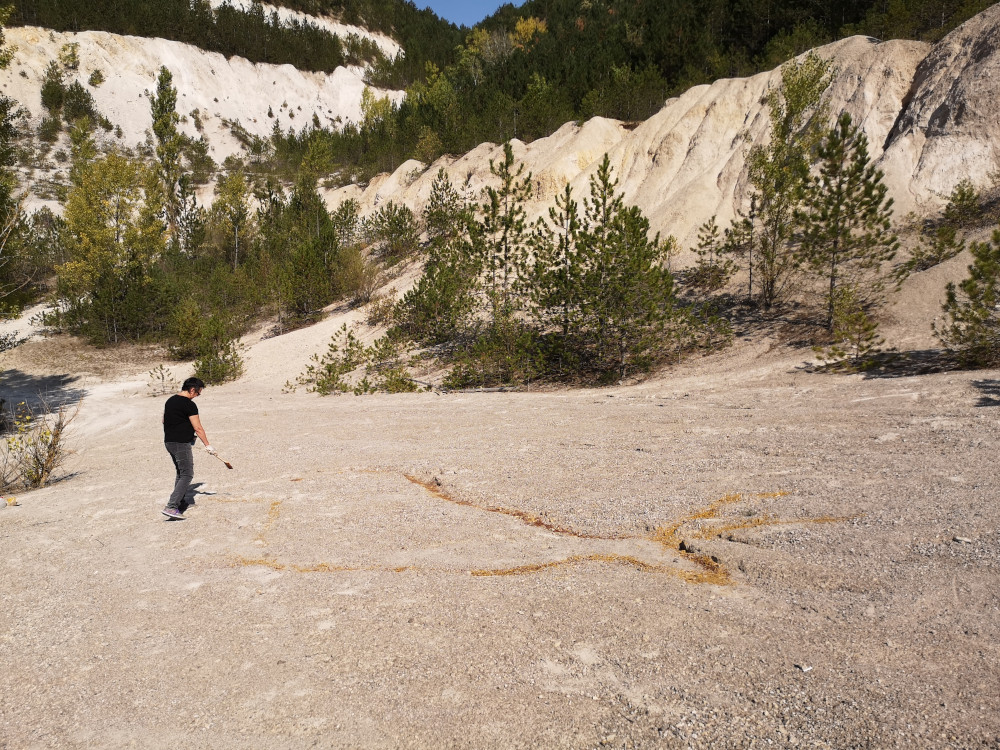
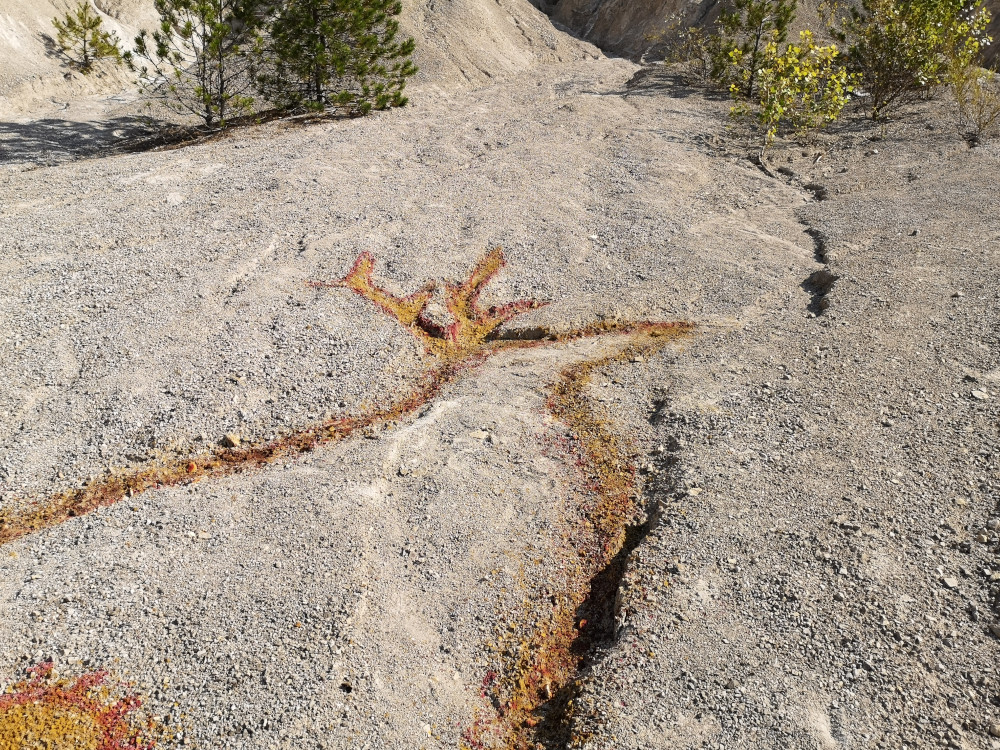
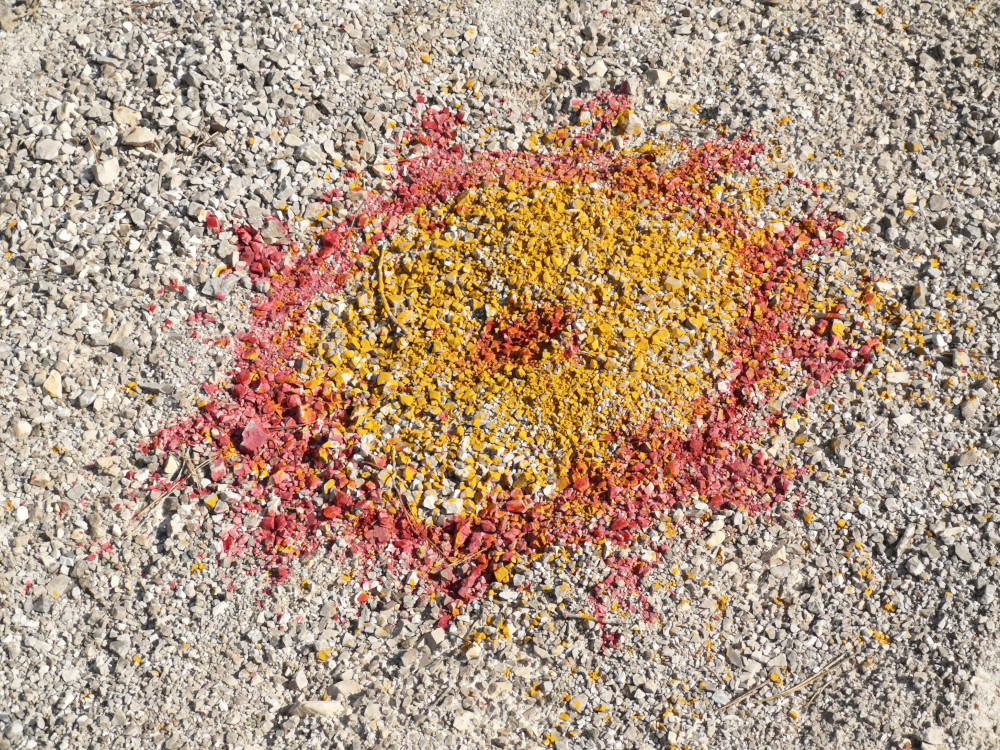
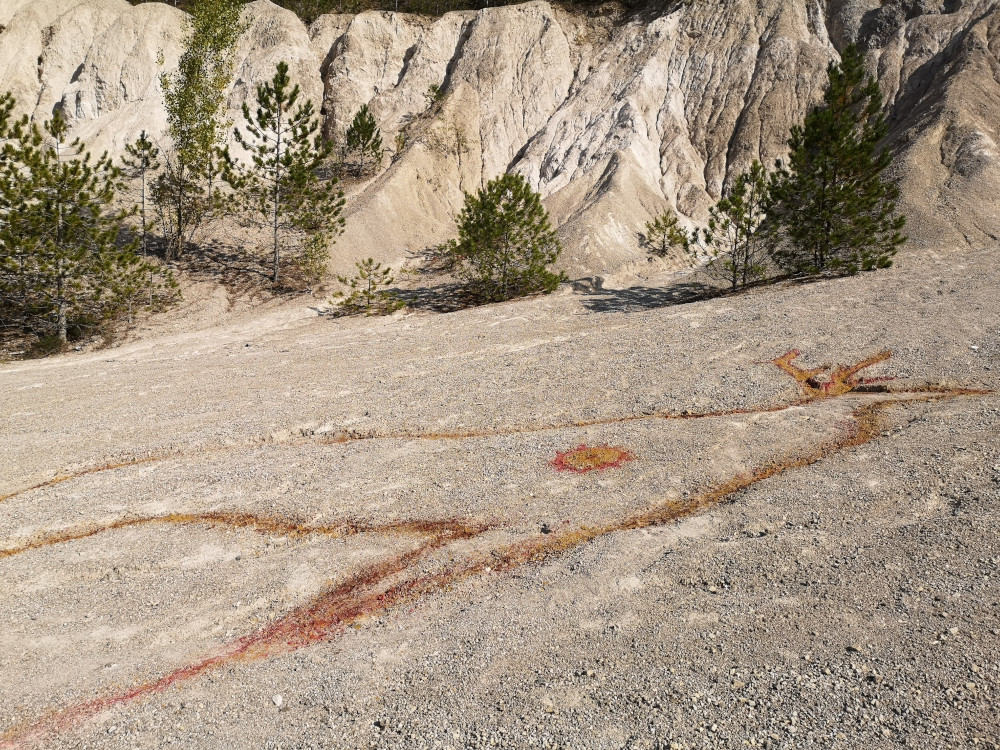
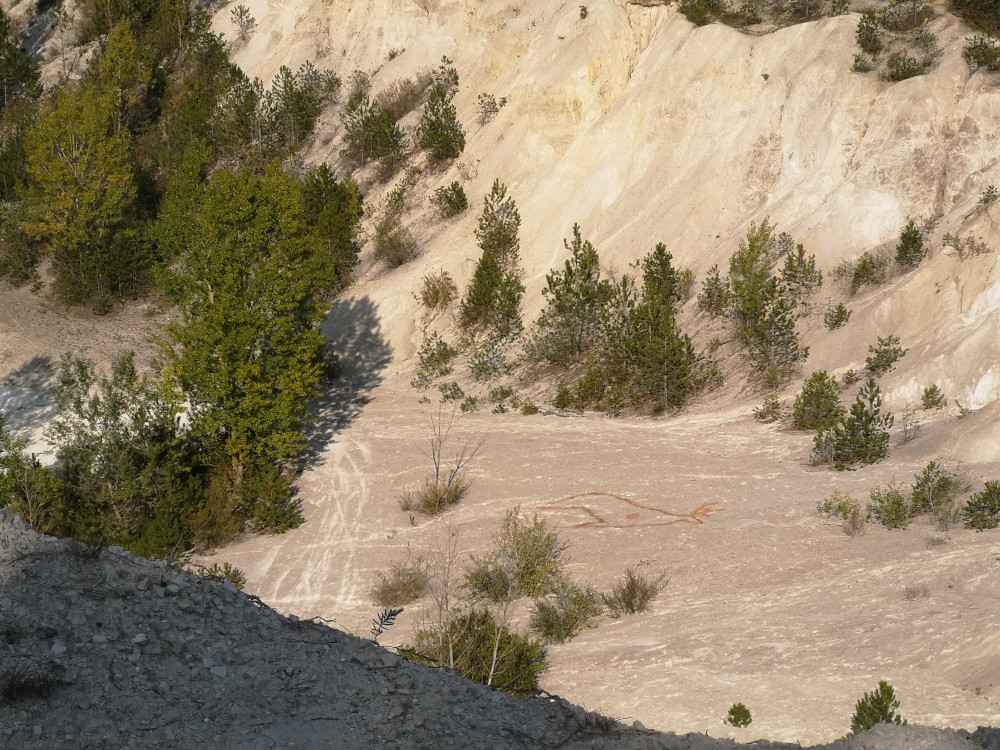
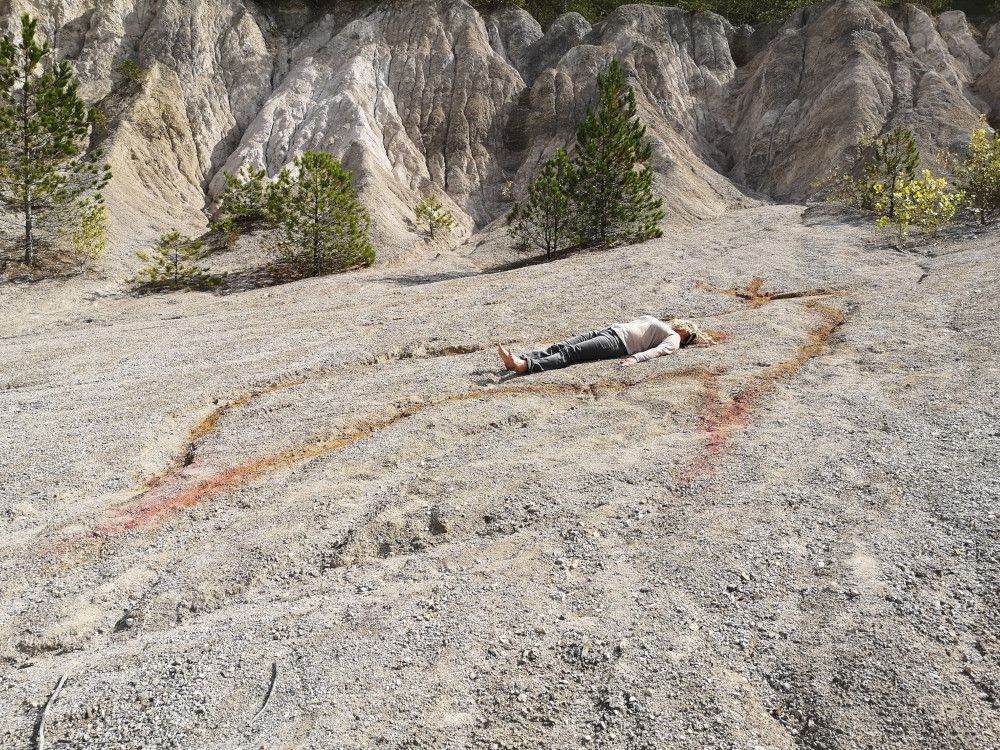
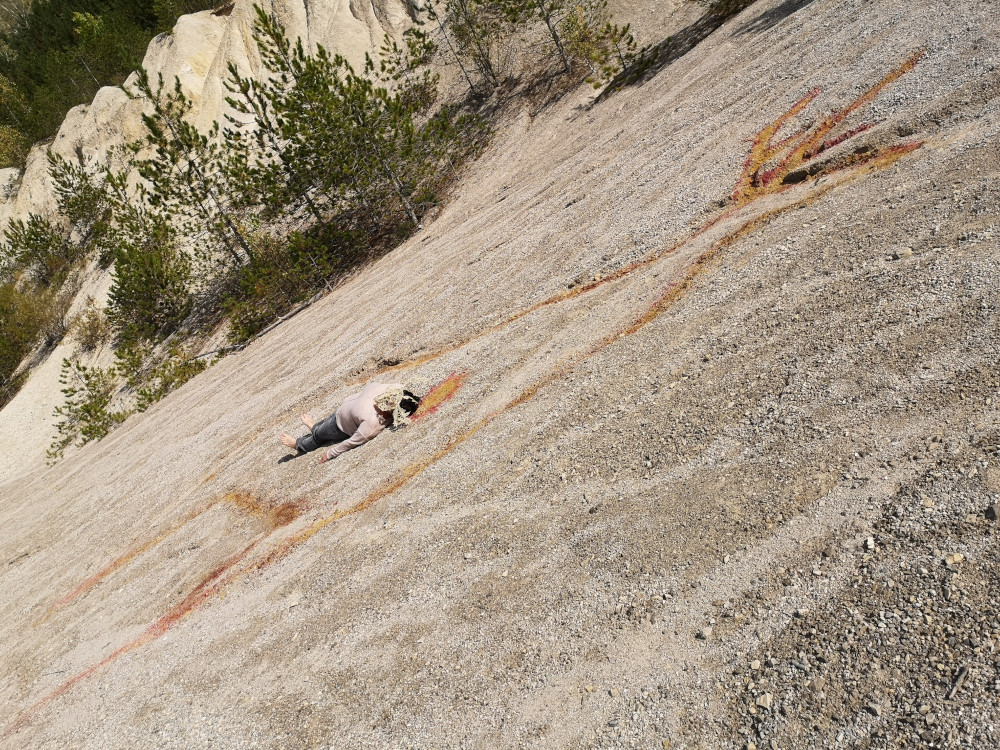
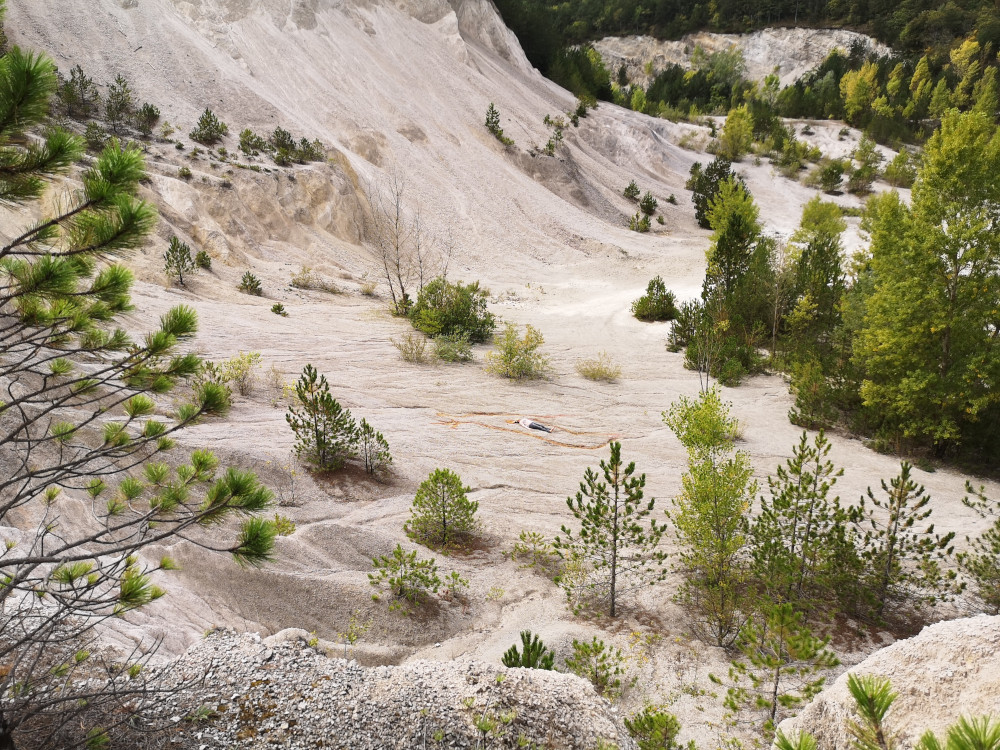
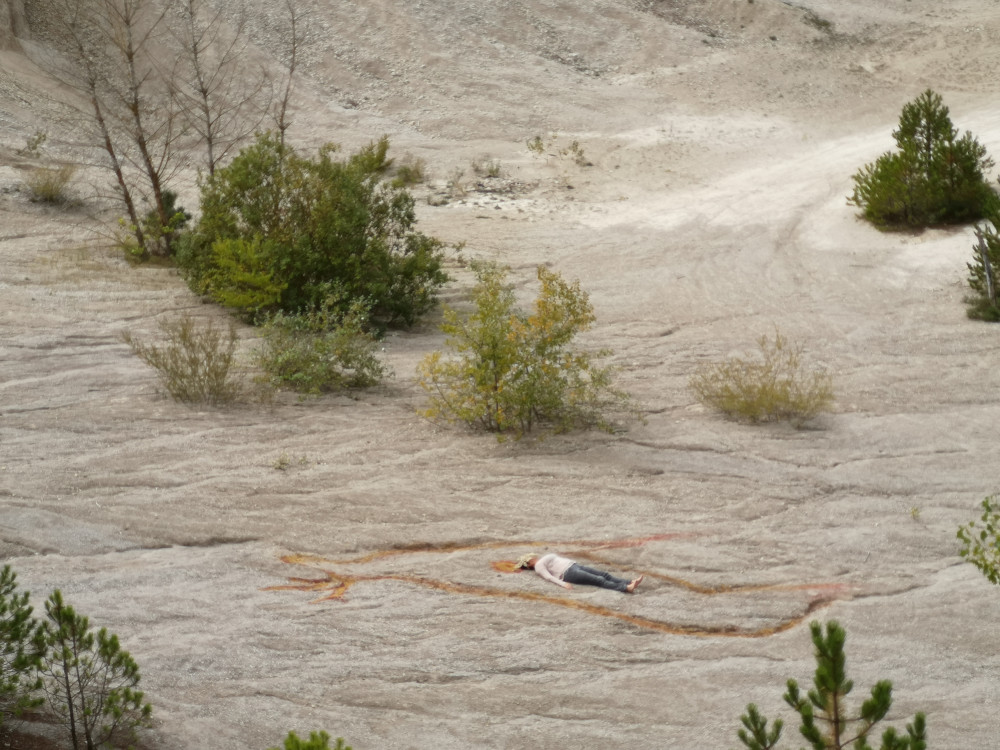
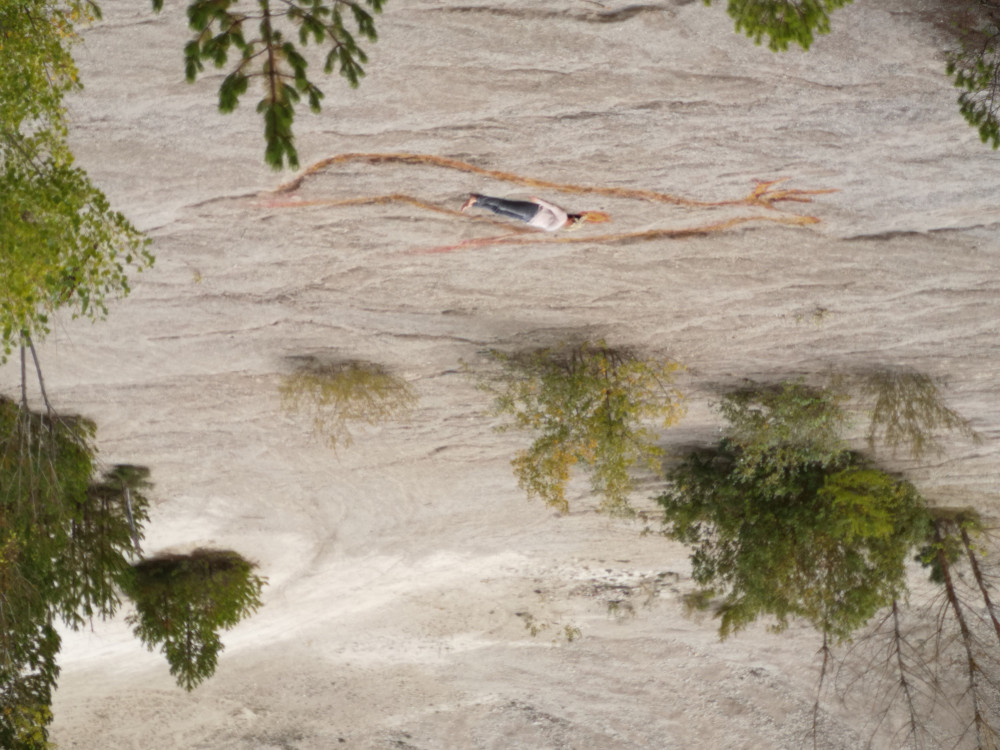
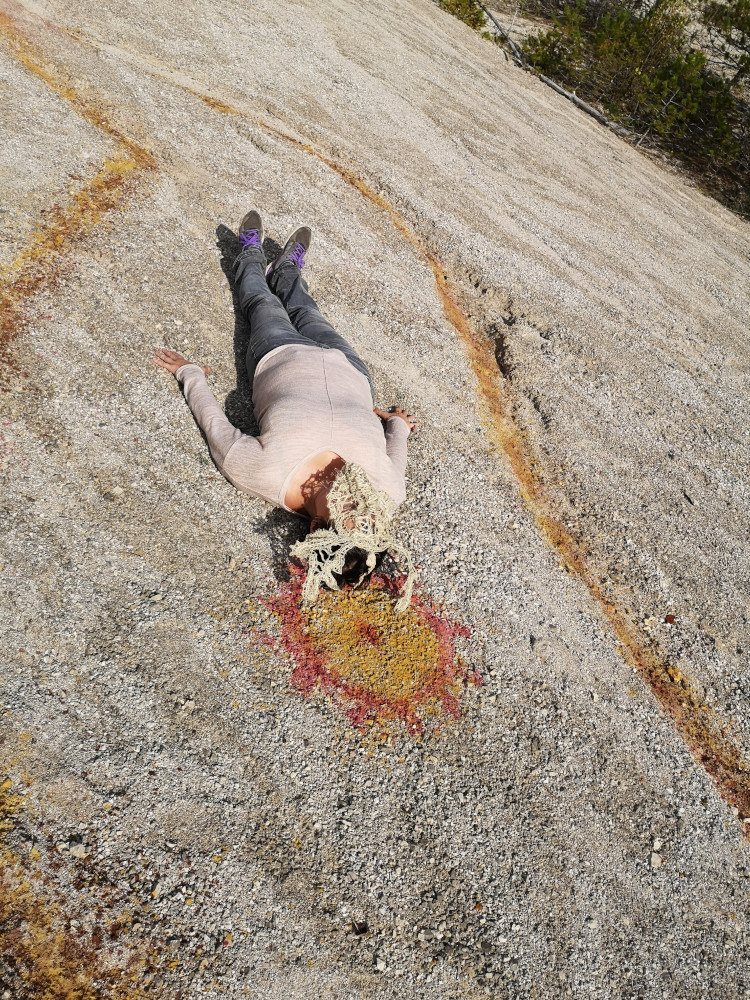
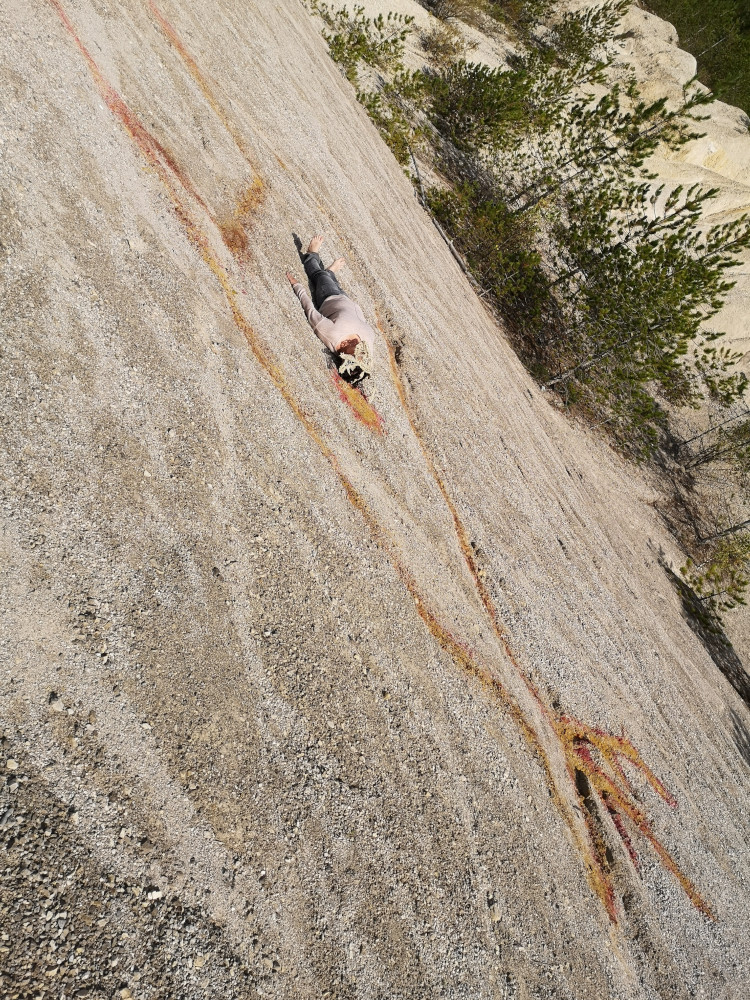
As part of the Deerland art festival in September 2020, we conducted a series of artistic explorations in the old quarries around Gyenesdiás, Hungary. One of the key events was the creation of The Native Deer — an ephemeral geoglyph formed in an abandoned dolomite quarry on the hill of Pipa-hegy. The project became a spontaneous yet profound collaboration with the landscape itself, where natural forms revealed the image that was meant to appear.
Originally, we planned to work in another pristine white quarry, but upon arrival discovered it was again under excavation. We had to change location quickly and chose the old, forest-overgrown quarry. We descended to a light clearing that intuitively called for action.
TheSzamorodni Deer, 2020 (process and details)
Our original sketch — a two-headed elk — didn’t match the terrain. But the natural streams and grooves already suggested another deer’s form. I merely “revealed” it with pigment splatter. Later, a heart appeared in the center, turning into a sun. (Instagram)
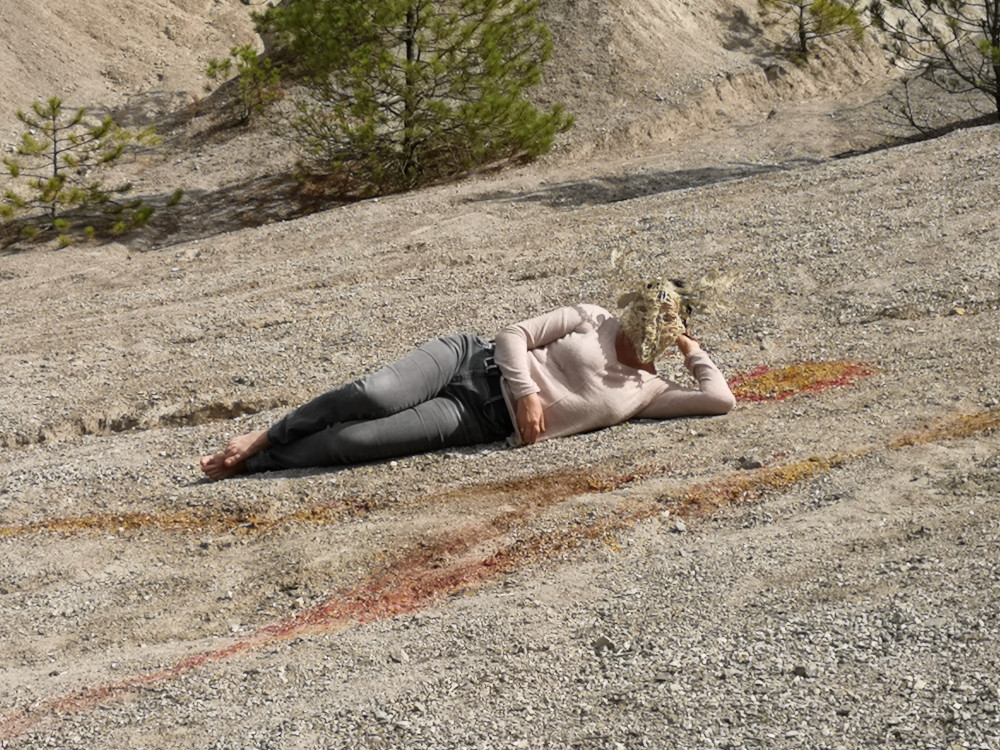
Meditation inside the deer and Performances around
A week after the geoglyph was completed, we conducted a performance inside its outline — a physical alignment with the symbolic shape. The body tuned into the place, activating its latent presence. (Instagram 1234)
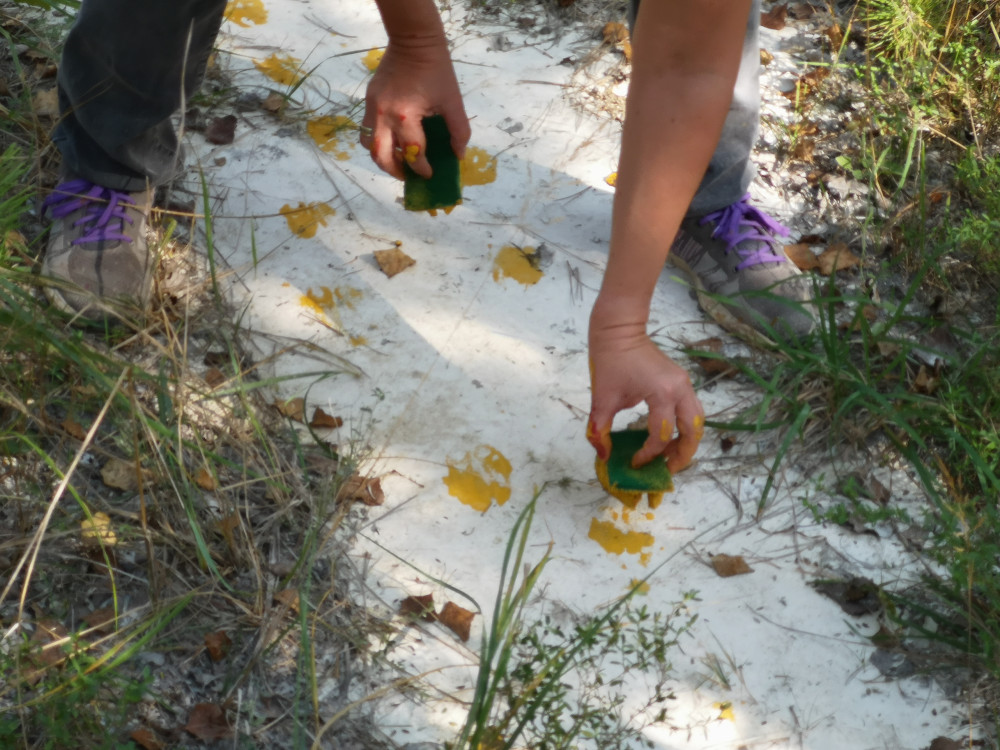
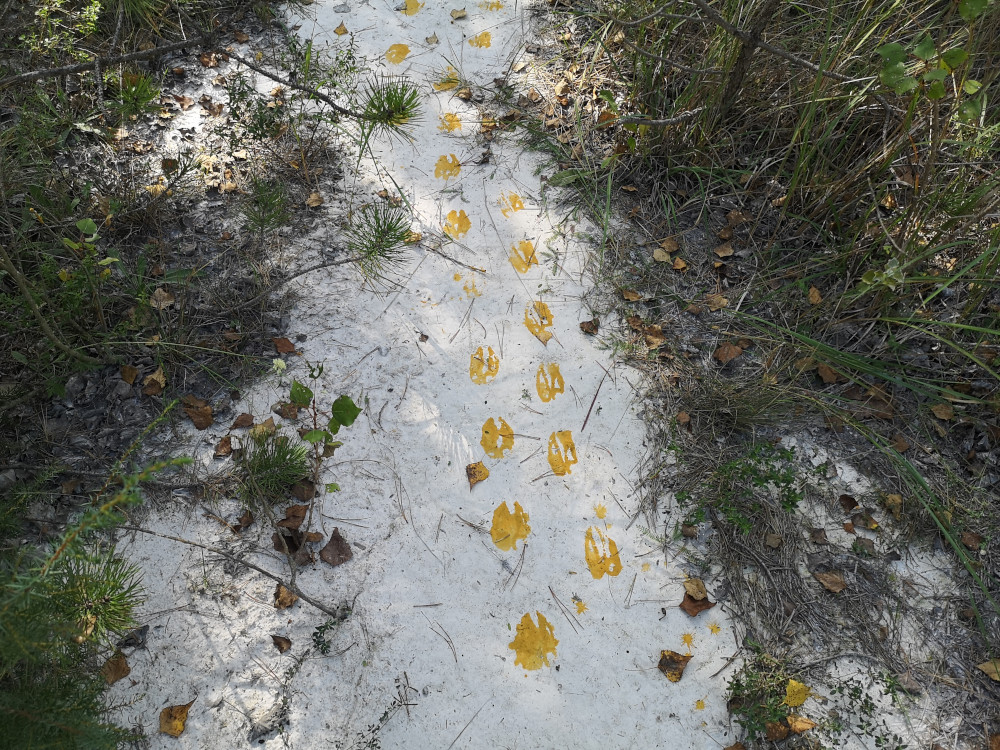
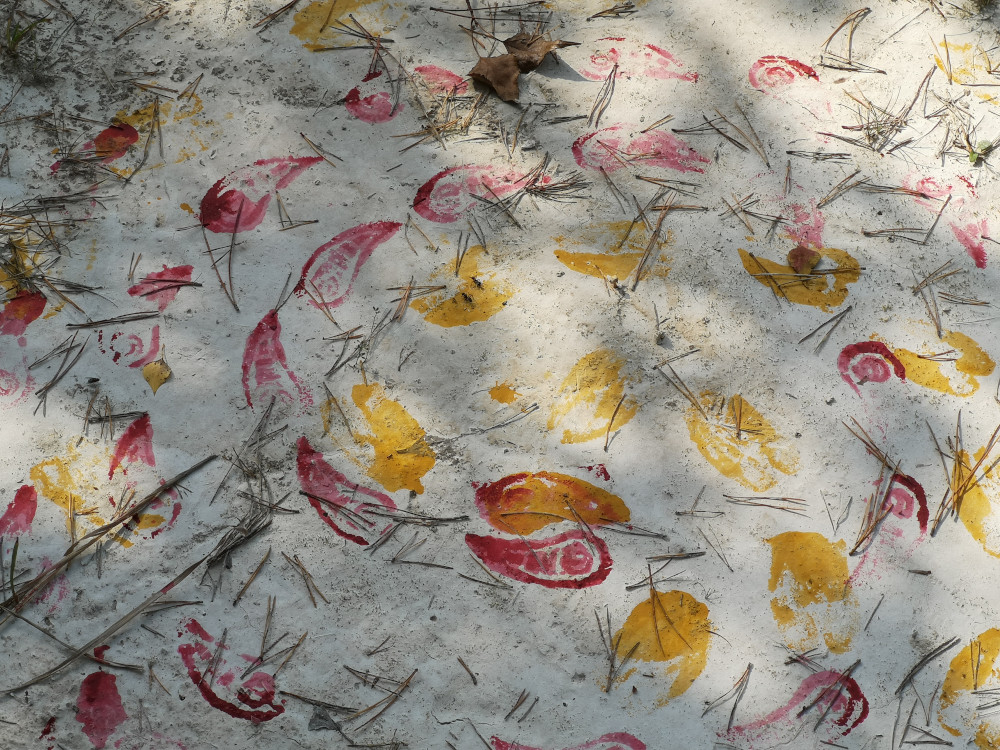
Spiral with a Deer Hoof Stamp
Using a sponge stamp in the shape of a deer hoof, we created a double spiral: coiling inward in ochre, then unwinding outward in red. From above, the form resembled spiraling time — folding and unfolding. (Instagram)
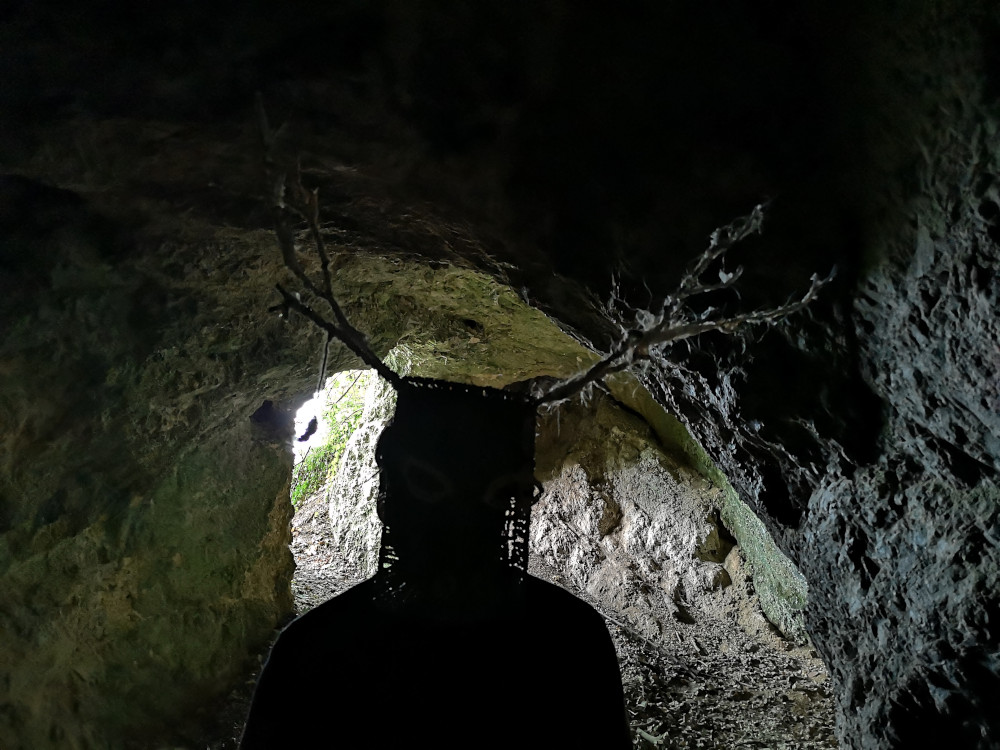
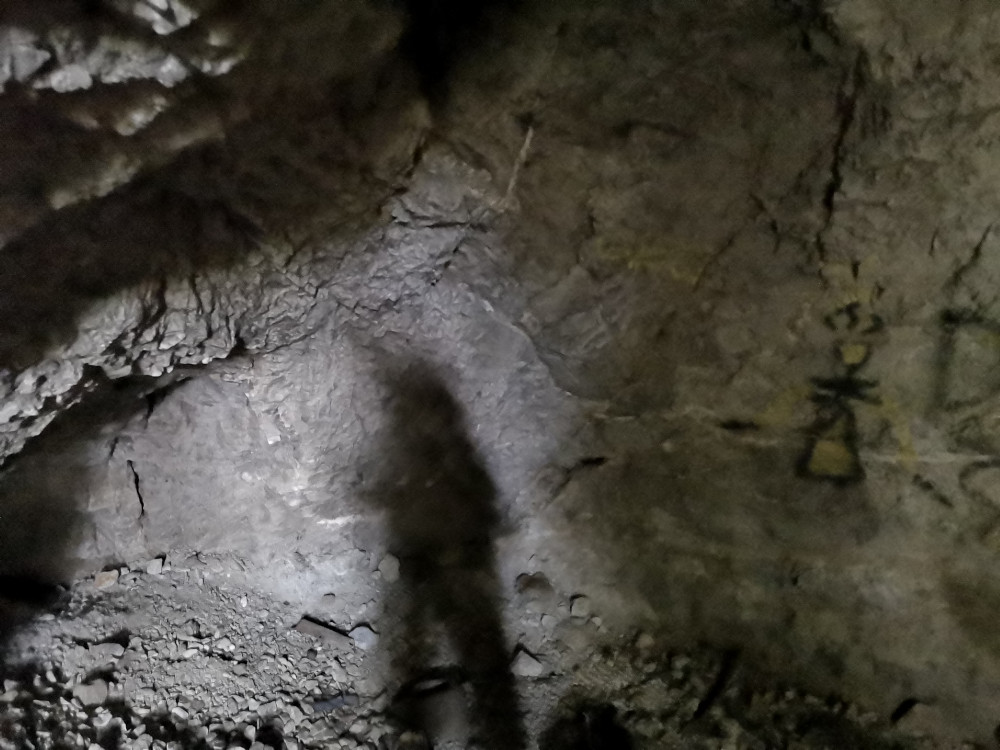
Cave Deer
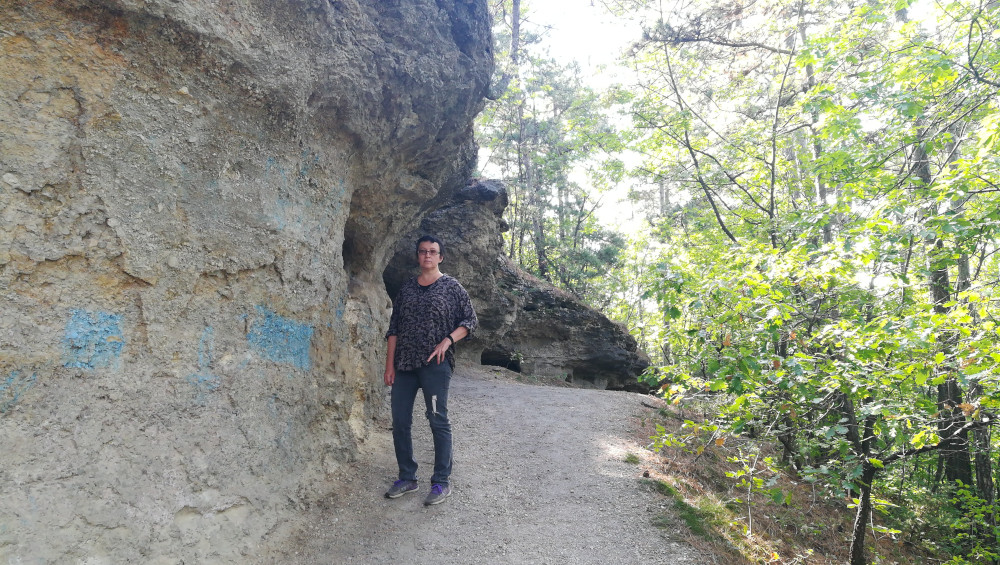
Next to the site, we found a man-made cave — likely carved out during stone extraction. Inside it, we staged a photo performance titled Cave Deer: shadowy images on the walls like memory archetypes. This added a subterranean dimension to the project, deepening the connection between human, stone, and symbol (Instagram)
This work belongs to our practice ofRR-method — an approach where the artist does not impose a new form, but listens attentively and reveals what is already present in the landscape. Here, the environment itself acted as both witness and co-author.
Although nothing went as planned — we changed location, abandoned the original idea, and adapted the technique — the result was unexpectedly precise. We simply uncovered what was already embedded in the place.
That’s how the Samorodny Deer appeared — an ephemeral trace shaped by streams, stones, and light. A month later, it vanished without a trace, as intended. What remains is memory, and the documentation.
But most importantly, what remains is the experience of co-creation with the land — where the quarry was not just a backdrop, but a protagonist.
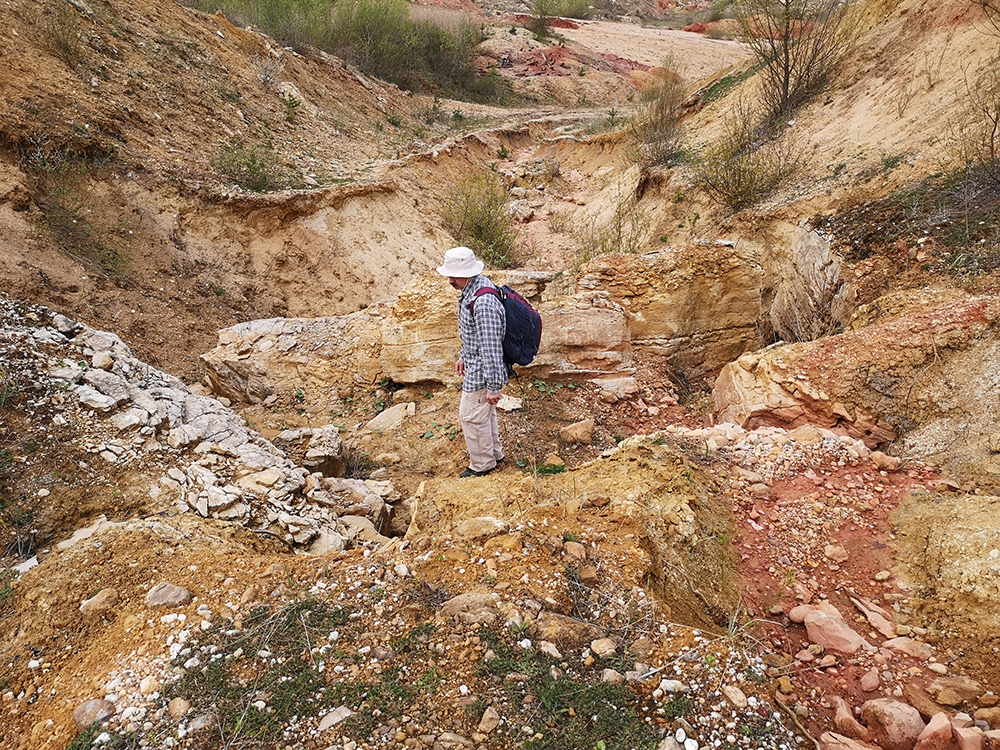
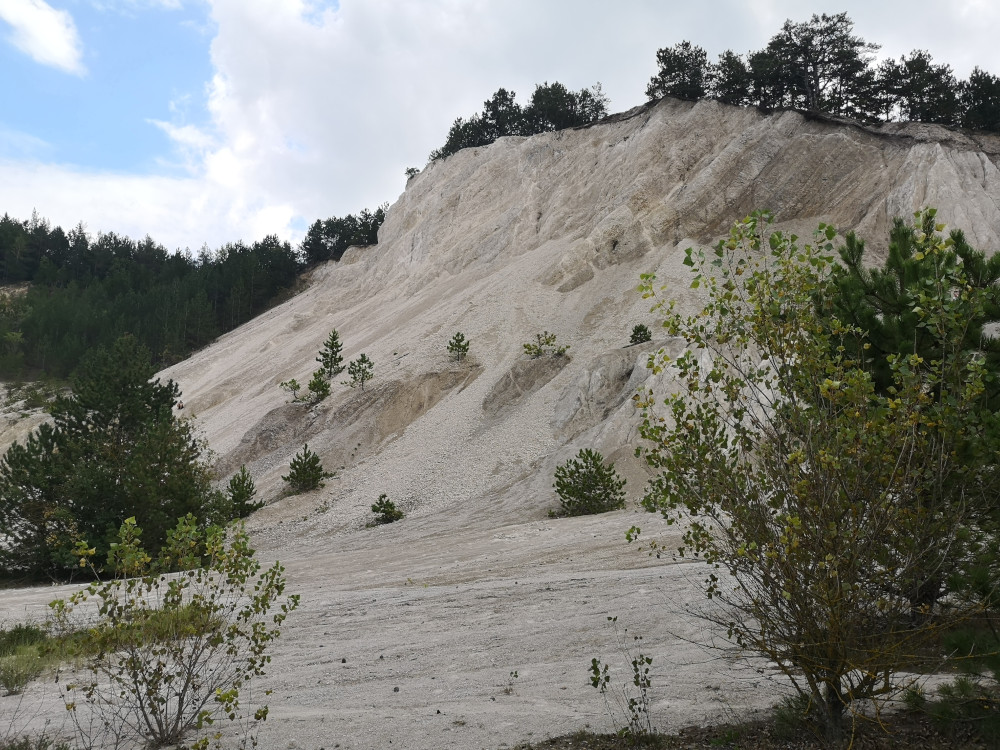
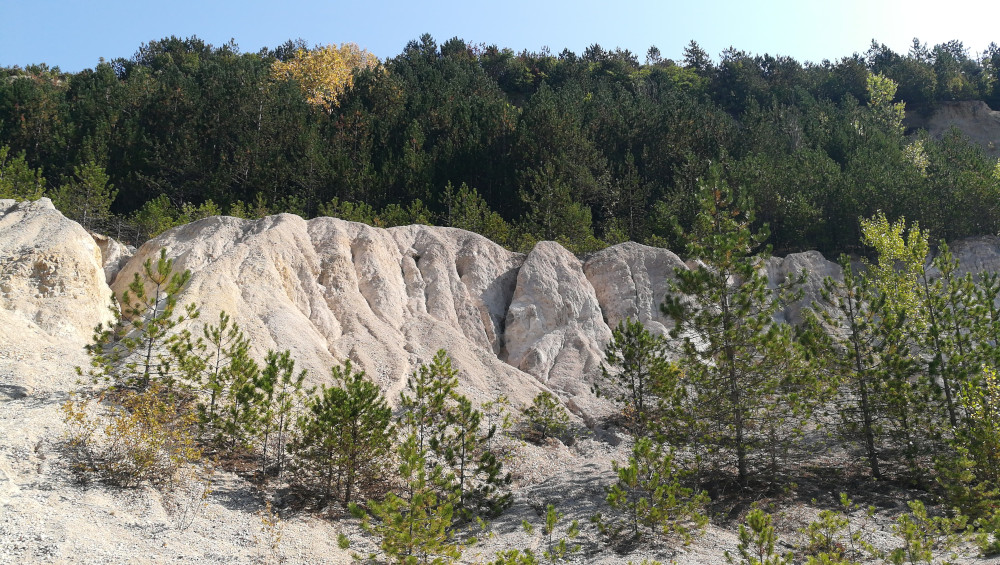
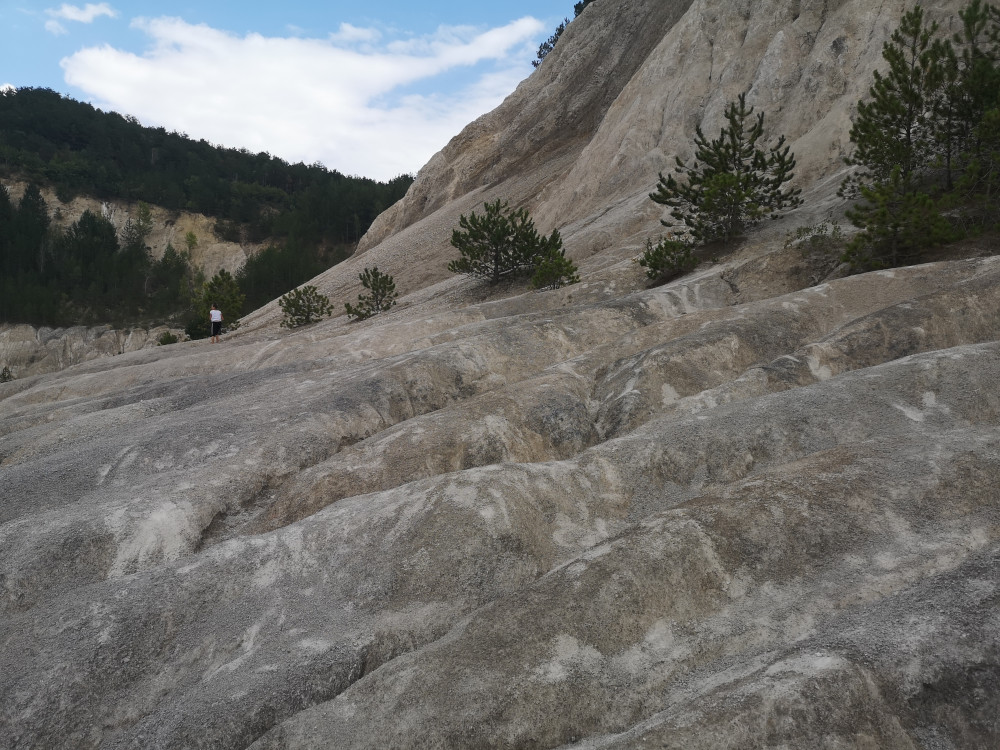
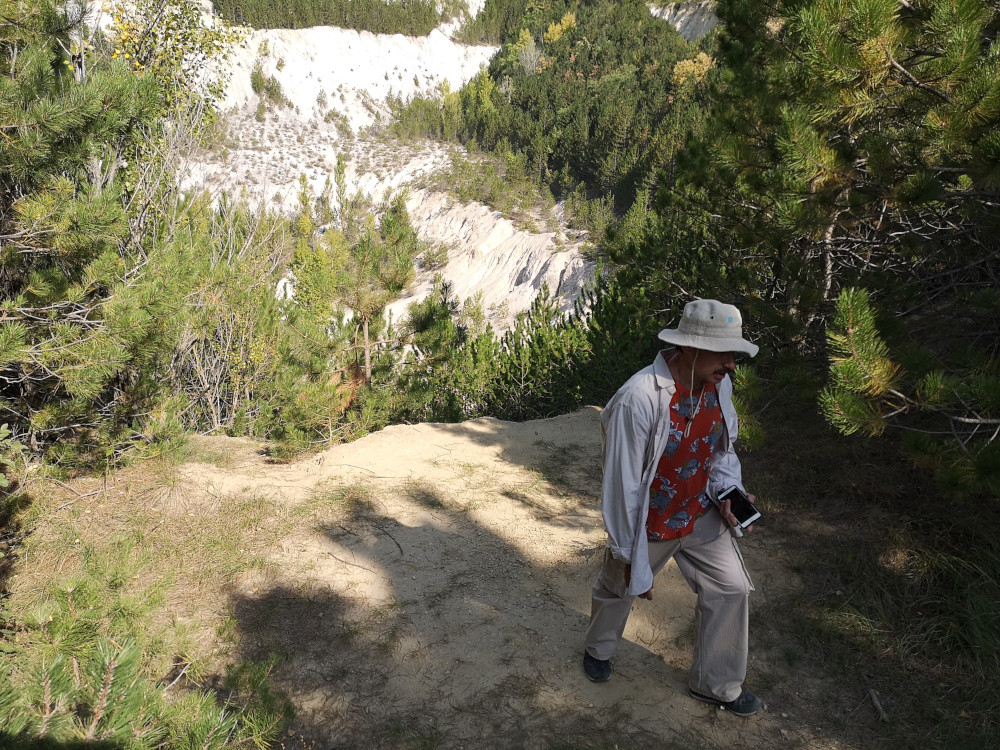
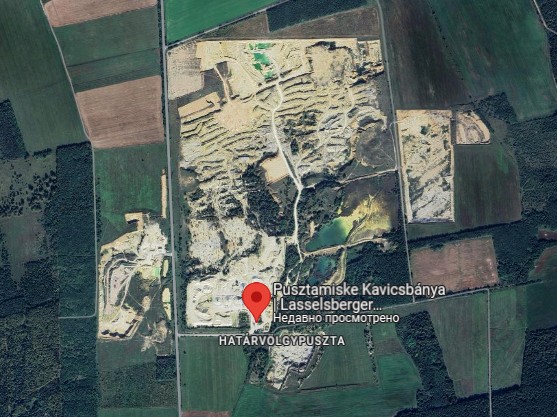
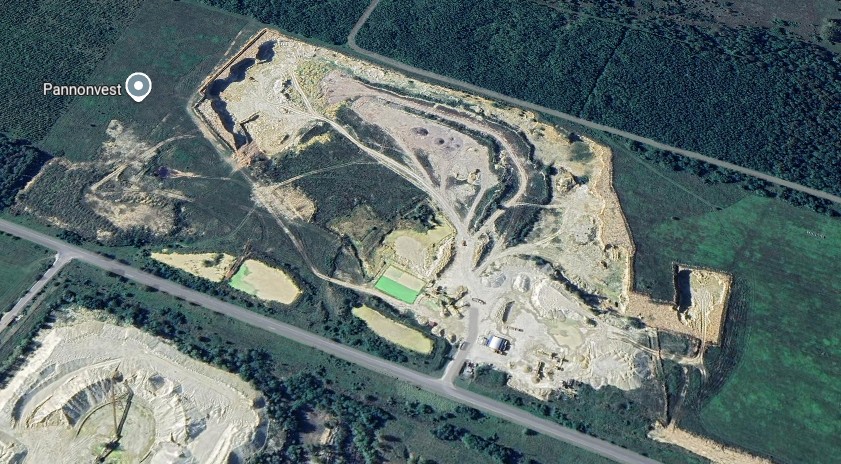
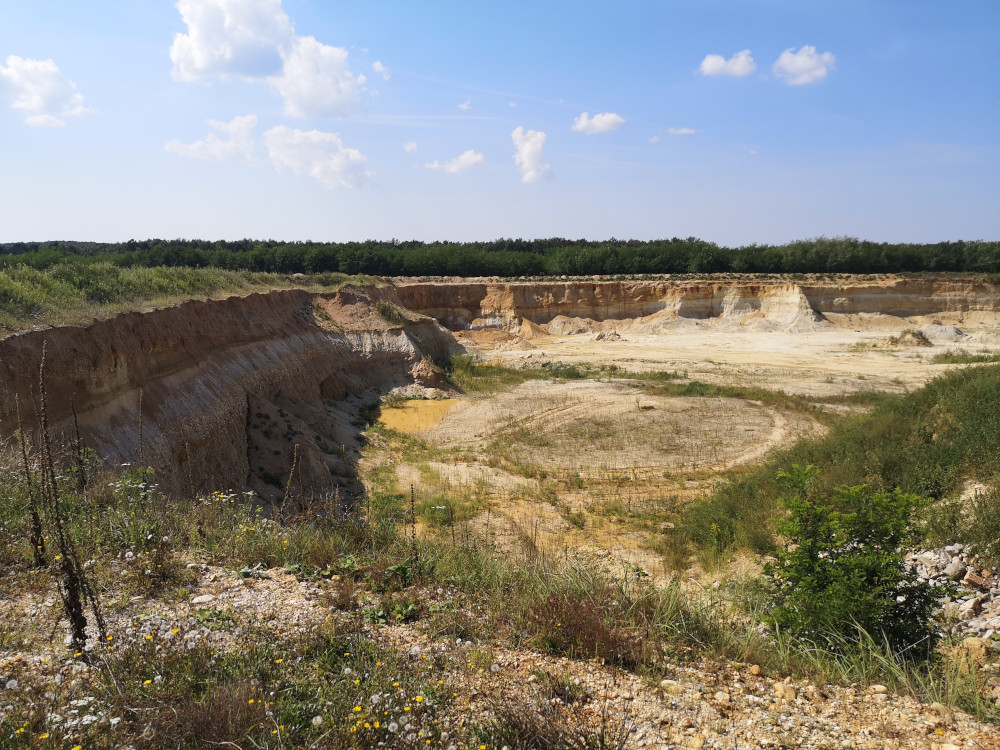
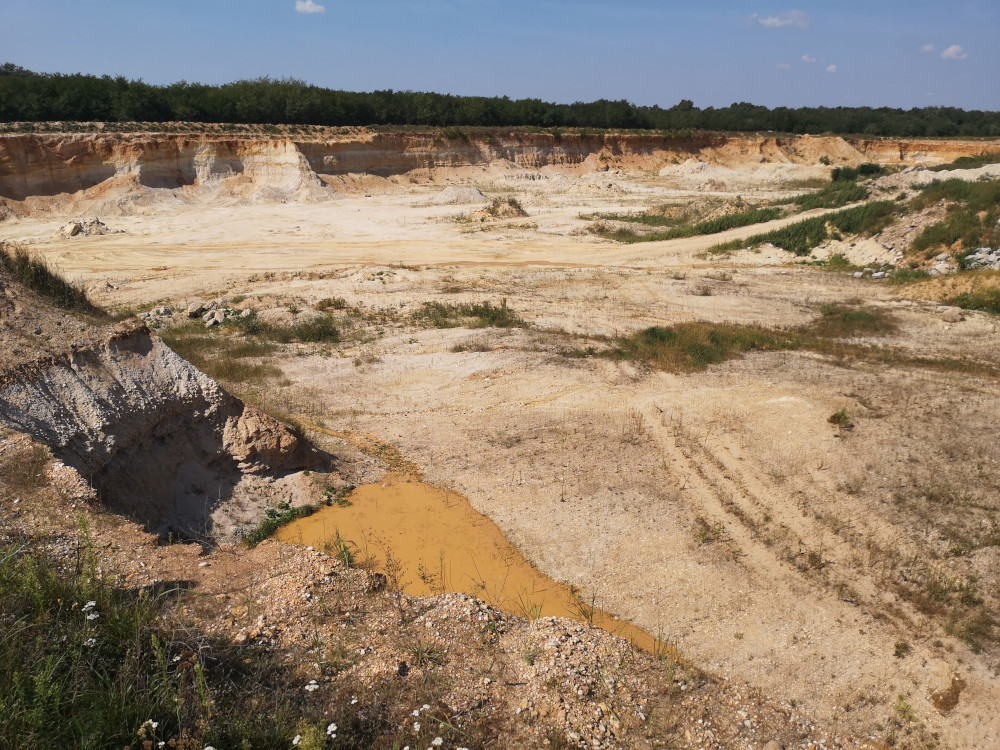
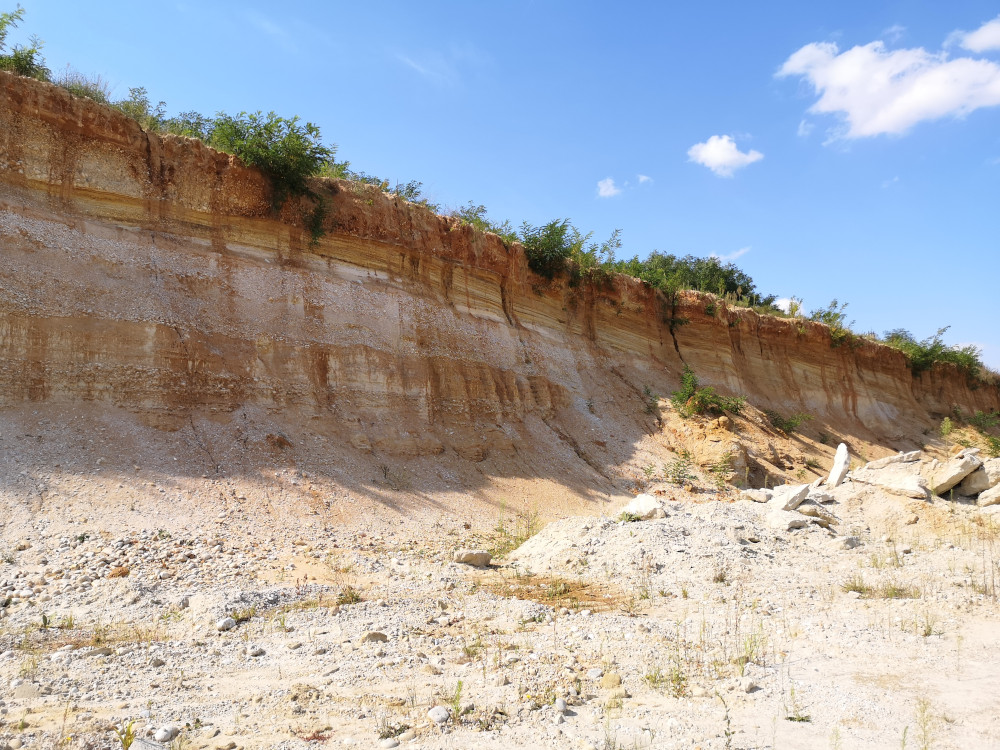
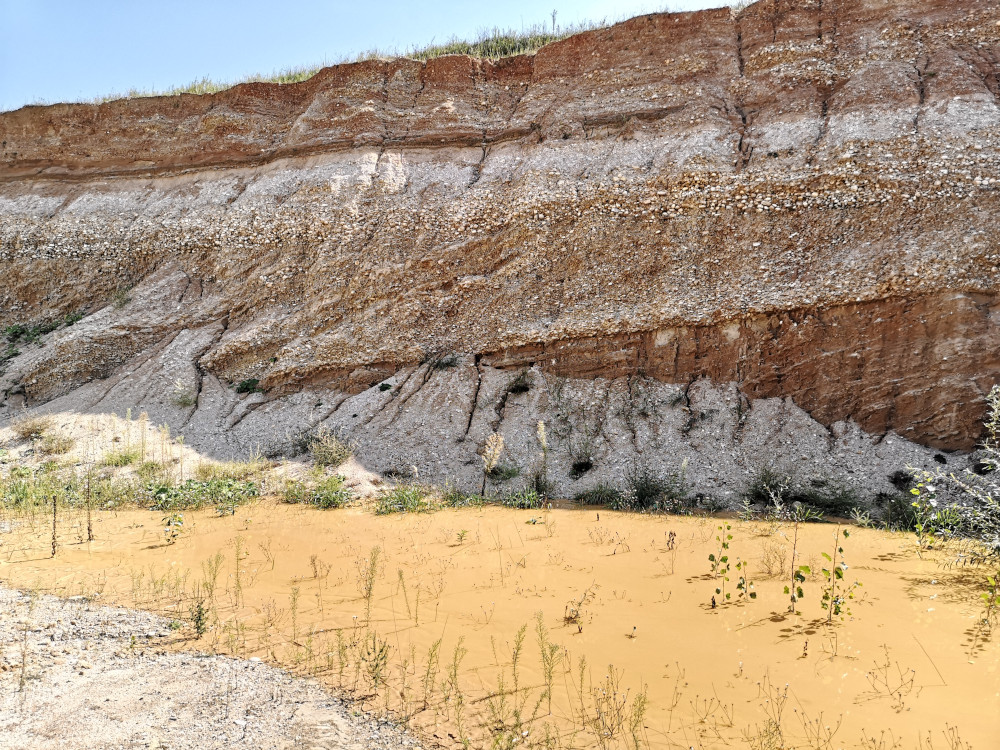
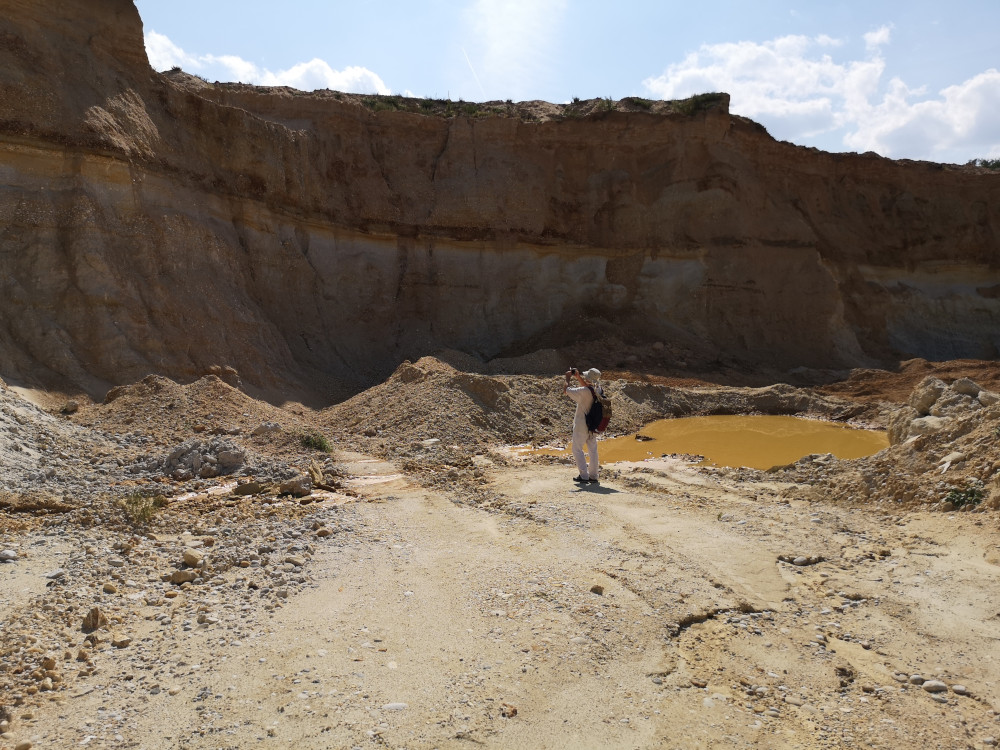
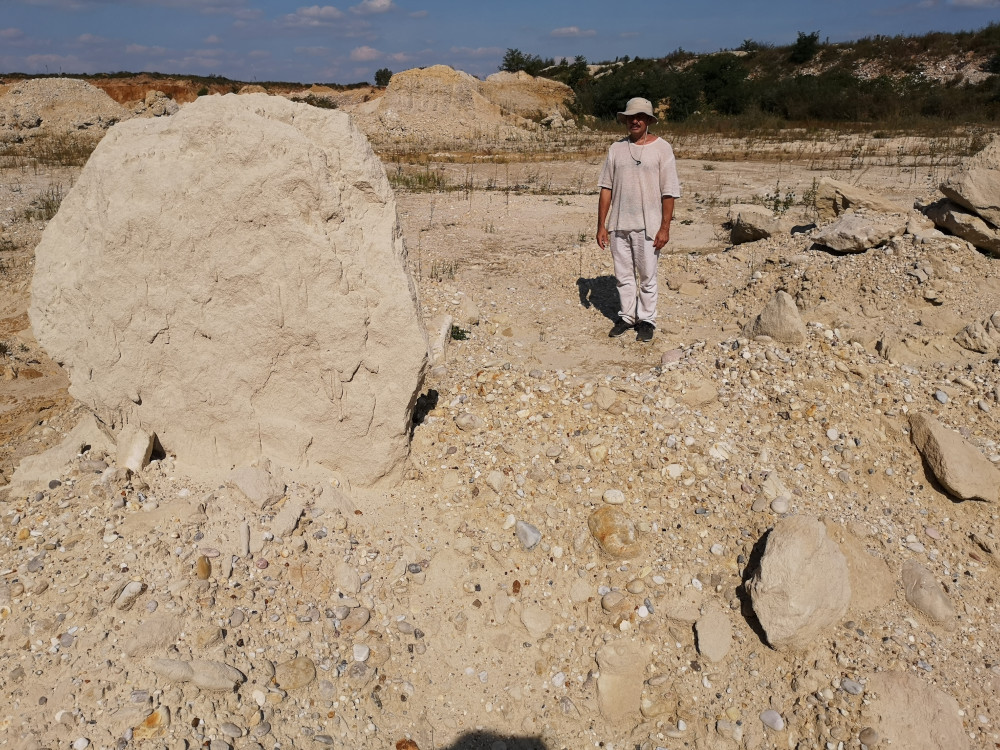
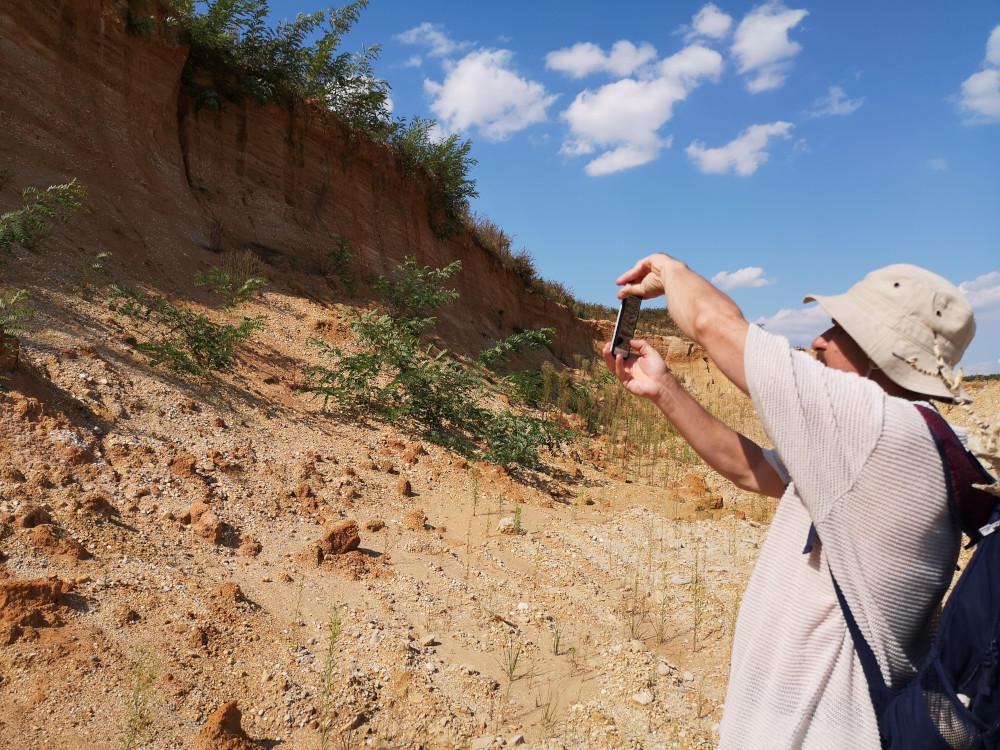
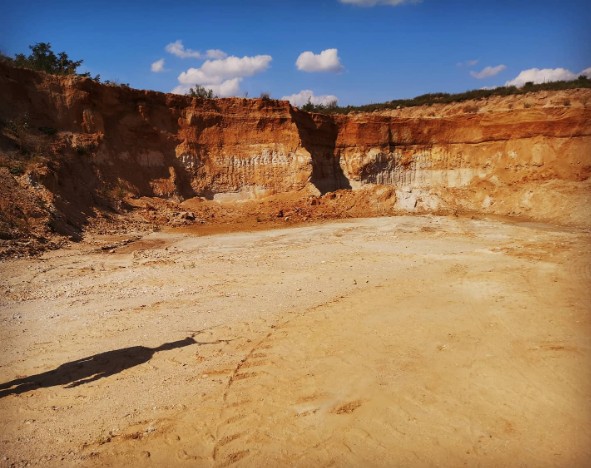
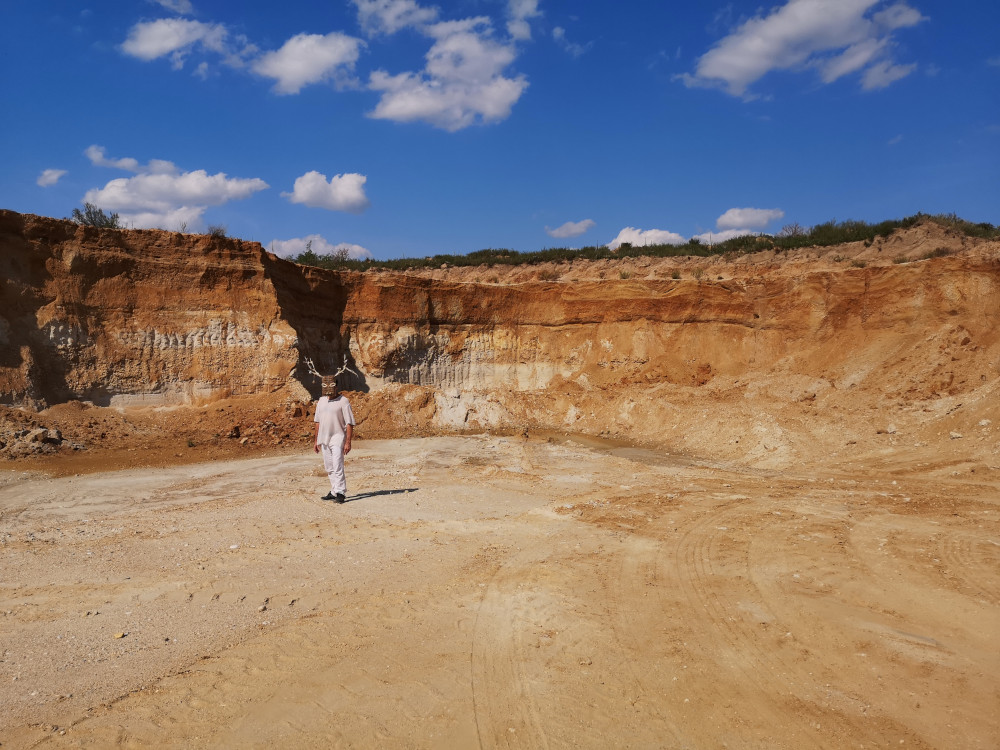
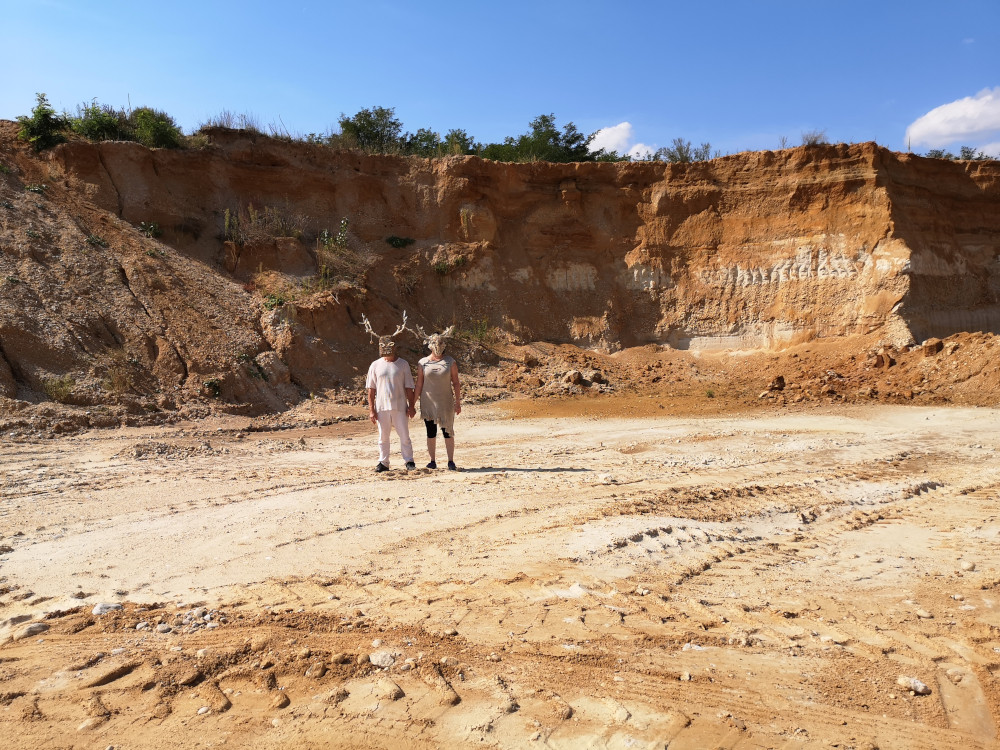
Pusztamiské Gravel Quarry is located 2 km south of the village of Pusztamiske, Hungary. The quarry, approximately 1300 × 1500 meters, is still in operation, though extraction has ceased in some areas. These former work zones are visually divided into two contrasting basins: the southern part is predominantly white, while the northern part displays ochre and orange tones.
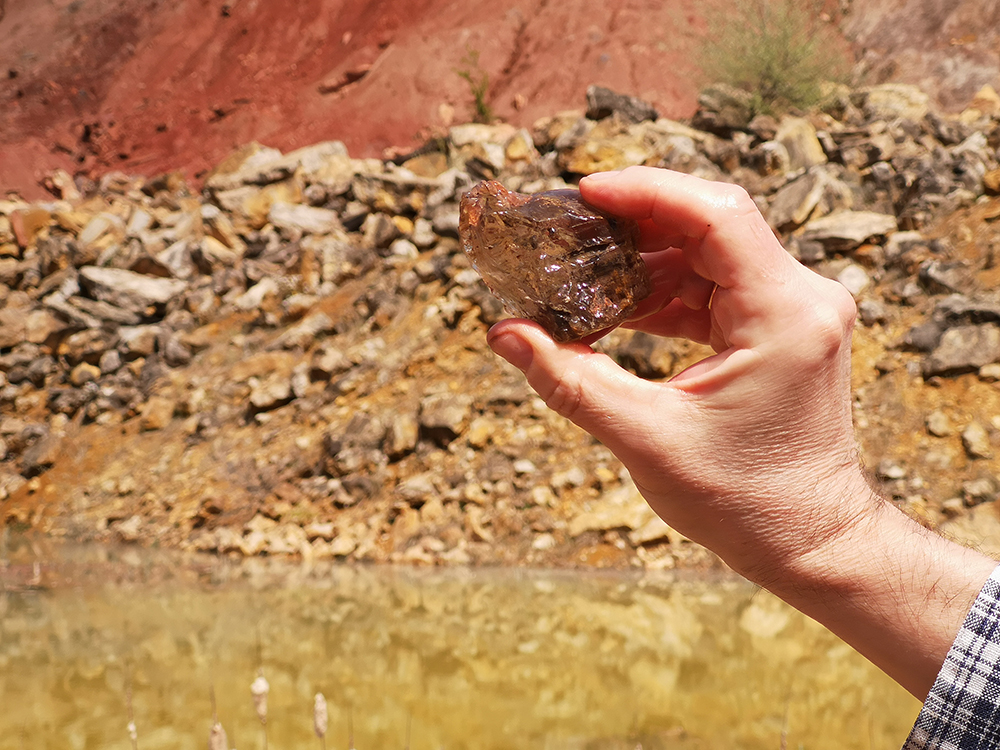
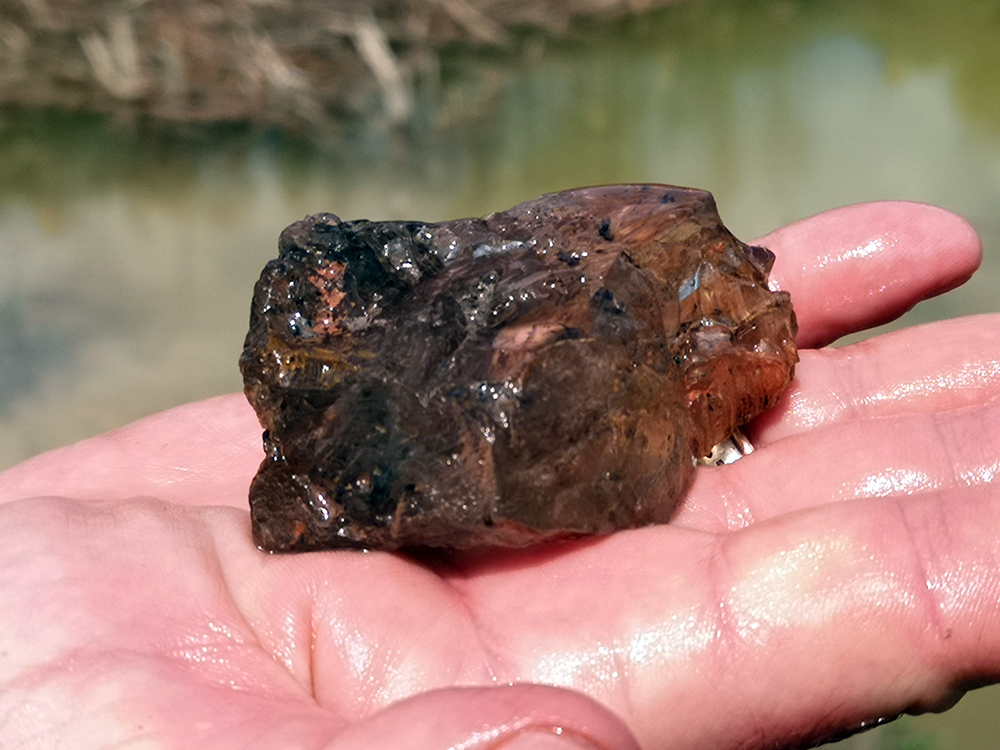
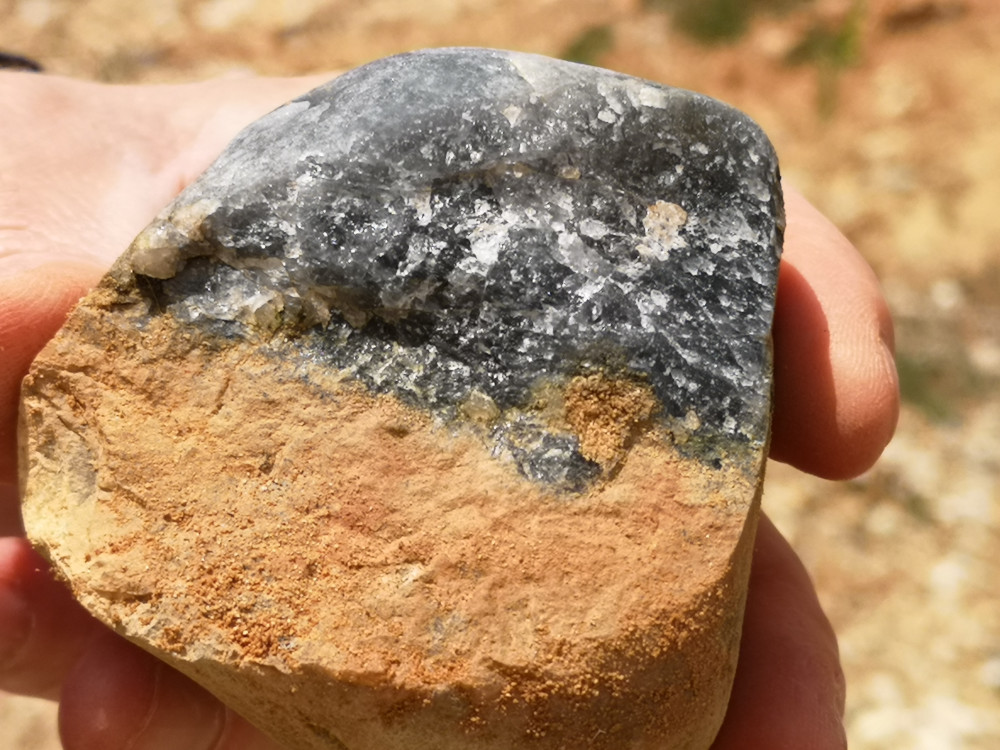
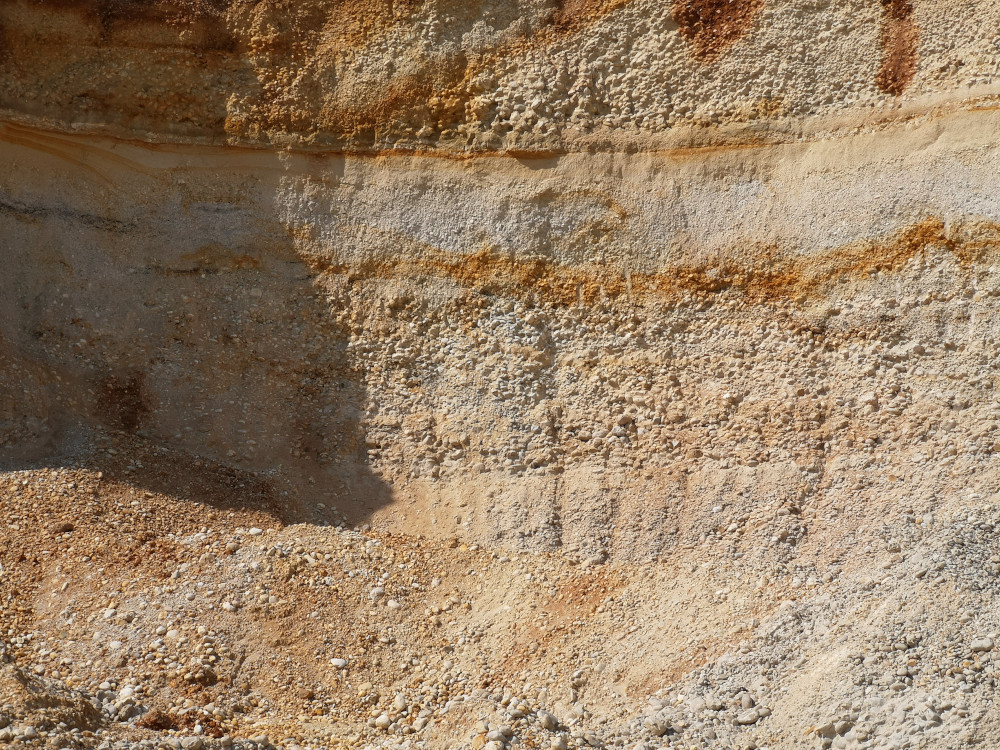
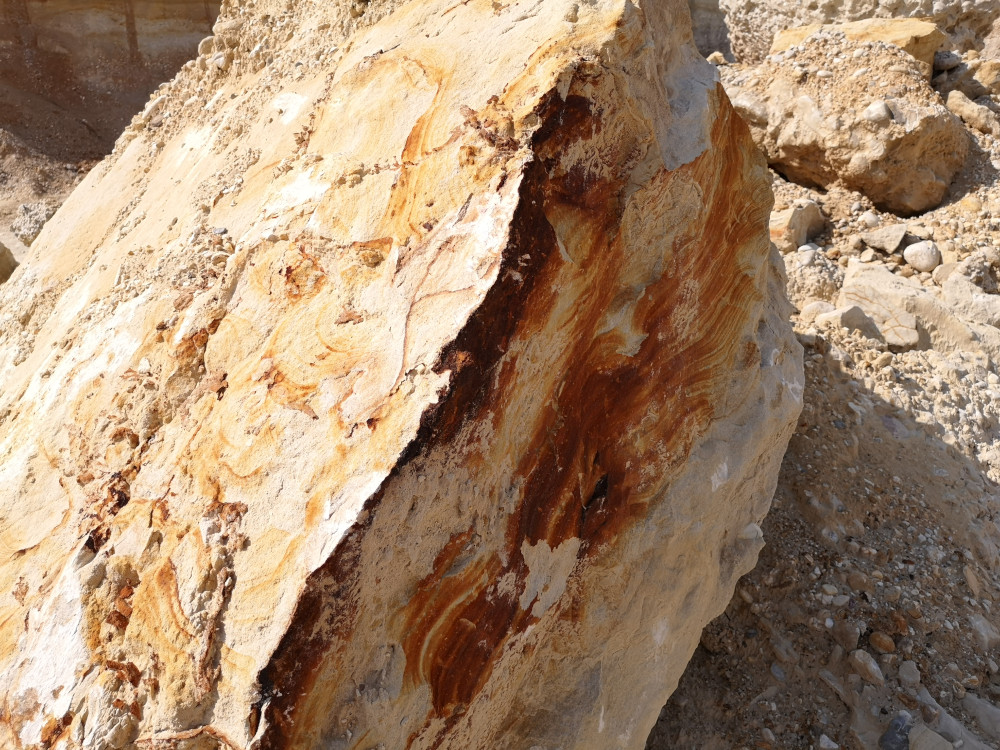
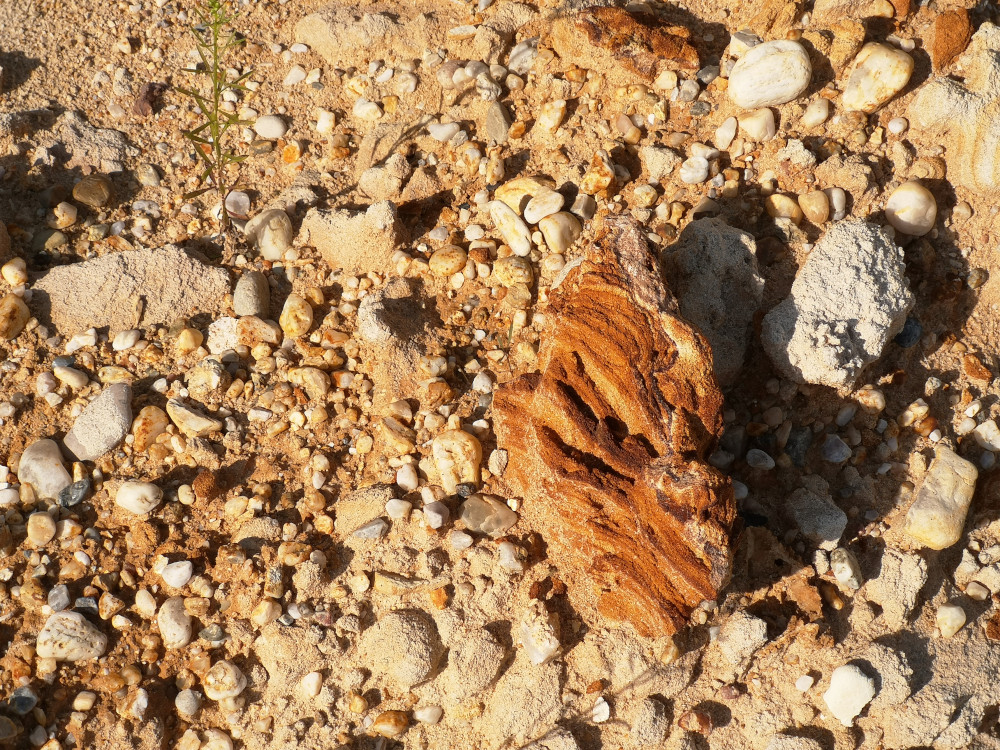
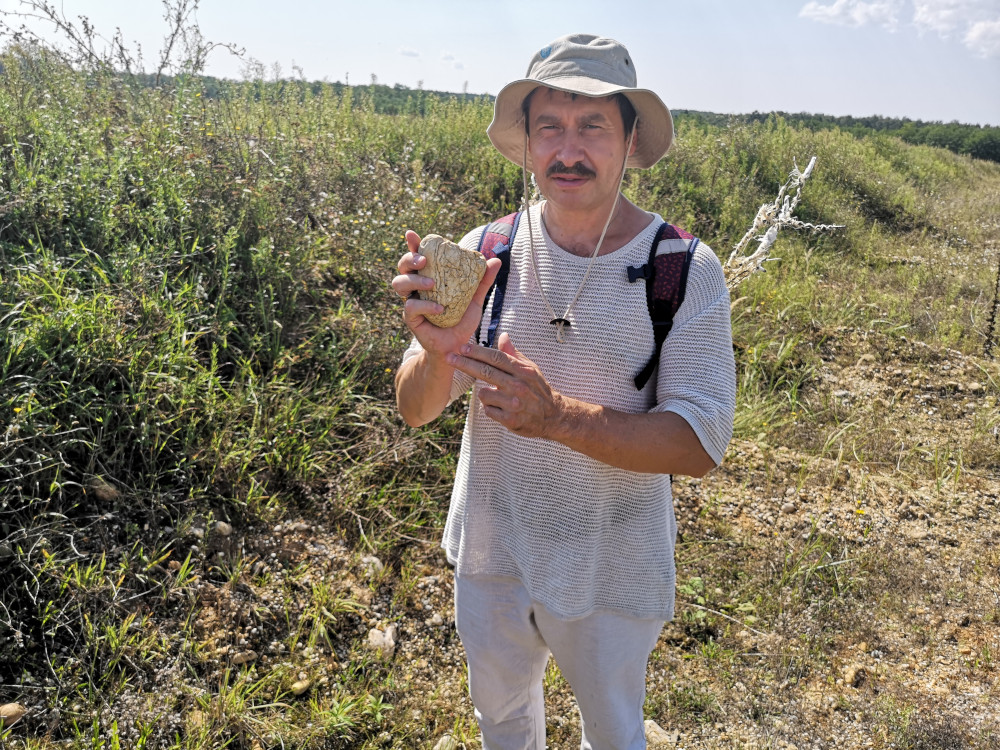
The quarry’s sandy and gravelly layers frequently contain fossilized seashells, sea urchins, corals, and other marine organisms — remnants of the warm Pannonian Sea that covered the region during the Middle Miocene, 12–13 million years ago. These deposits, formed by rivers carrying quartz grains and larger rock fragments, became extensive beds of sand and gravel.
The extracted materials — gravel-sand mixtures, crushed stone, and sand — are processed using modern machinery and used in concrete production, paving bases, landscaping, and even as glass-grade sand. The quarry is developed by the Austrian company Lasselsberger Holding Internationale GmbH, with extraction beginning in the late 1990s. [1, 2]
Pusztamiské is not merely a source of raw material; it is a layered archive, a witness to ancient seas, vanished lives, and present gestures. It holds time not only geologically, but poetically — in deer tracks, in wind-carved sediment, in the color of its cliffs, in the movement of bodies and shadows.
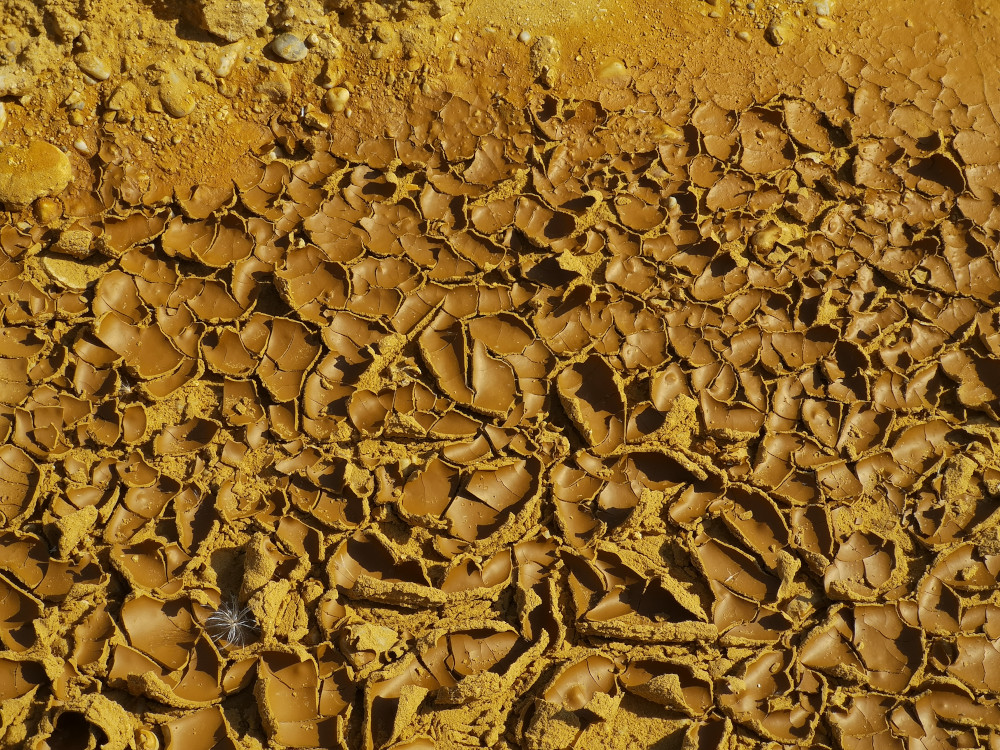
Walls the Color of Time “Walls the Color of Time” is a series of visual and textual observations of the exposed quarry walls, where color, structure, and texture become a chronicle of time. Each stratum carries traces of a sea, a glacier, a forest, or human intervention.
We see these quarry walls as living archives: their palette — ochre, limestone, pale sand, flecks of coal or clay — is not just aesthetic, but a material expression of deep time. The landscape speaks in minerals.
This project combines scientific description with a poetic gaze, recording the moment when the landscape stops being a background and becomes a voice.
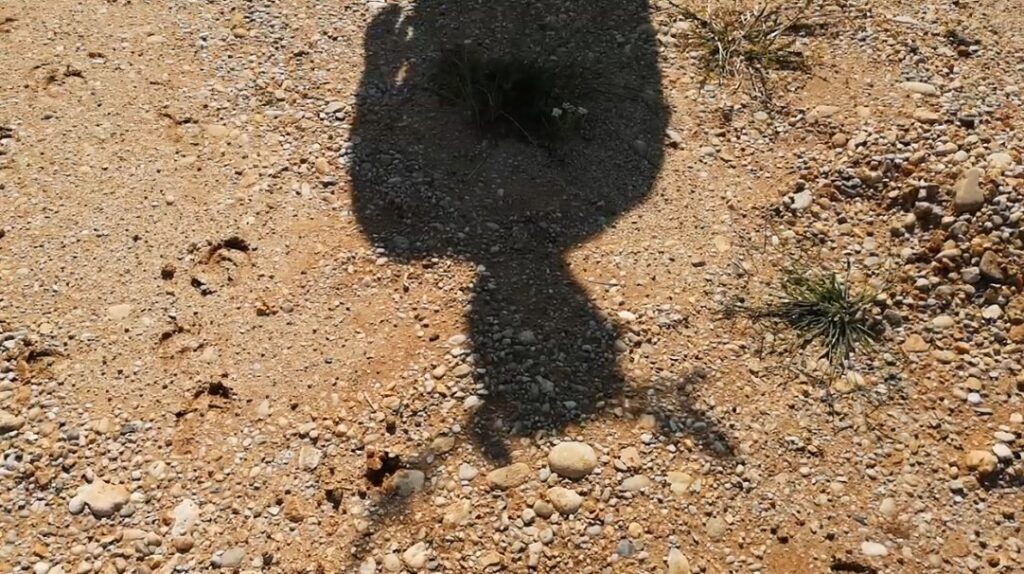
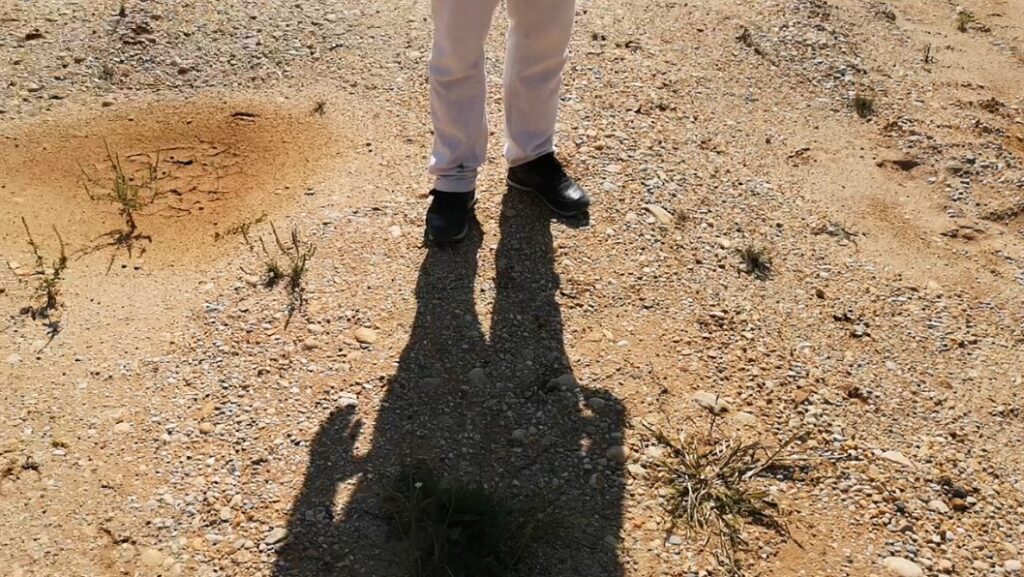
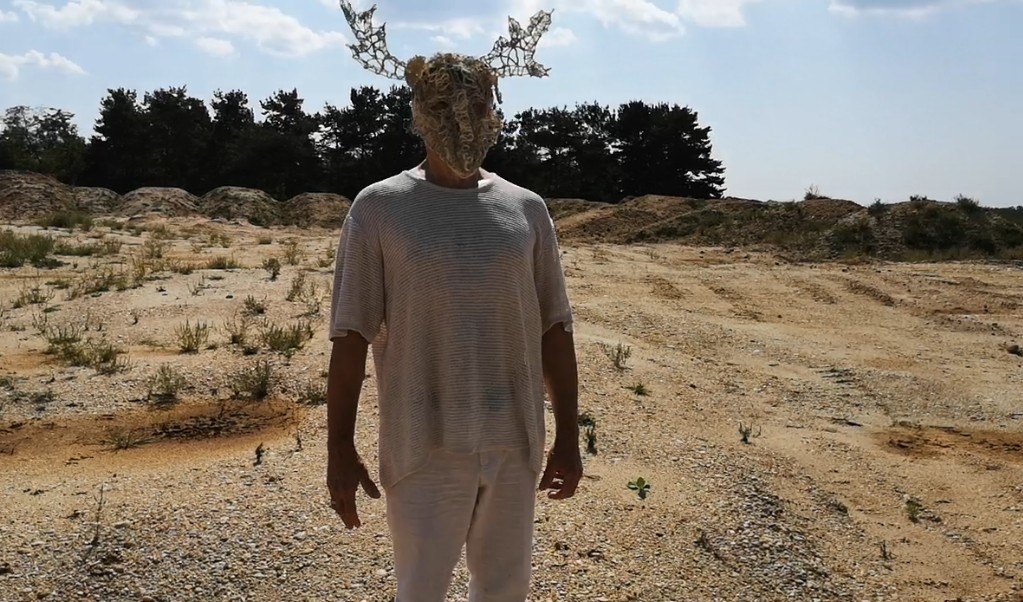
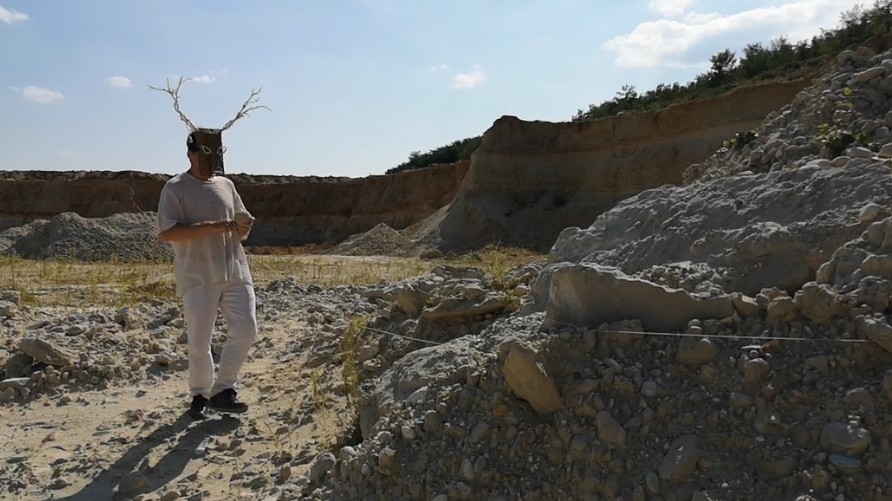
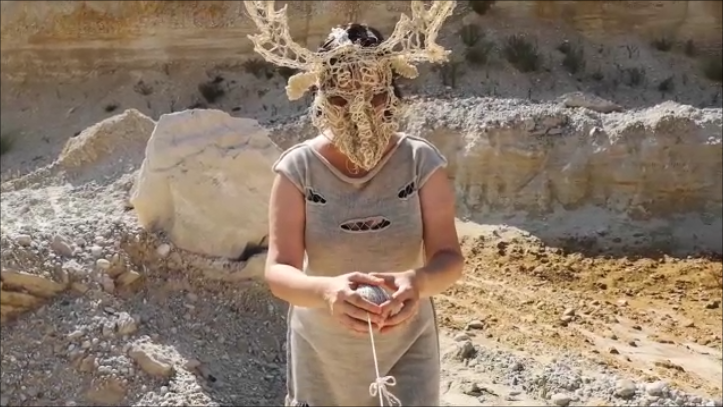
Ritual with Shadows Among the towering walls of orange sand, we staged a performance and photoshoot — figures in deer masks moving slowly across strata, like spectral mediators between epochs.
The quarry’s colors — bleached whites, rusts, ochres — hold the memory of the Pannonian Sea. Its currents, once fast and slow, have left layers like time pressed into pigment. To appear here in deer masks is not masquerade, but listening. The deer, in our practice, is a mediator — one who follows invisible paths, linking the visible with the invisible.
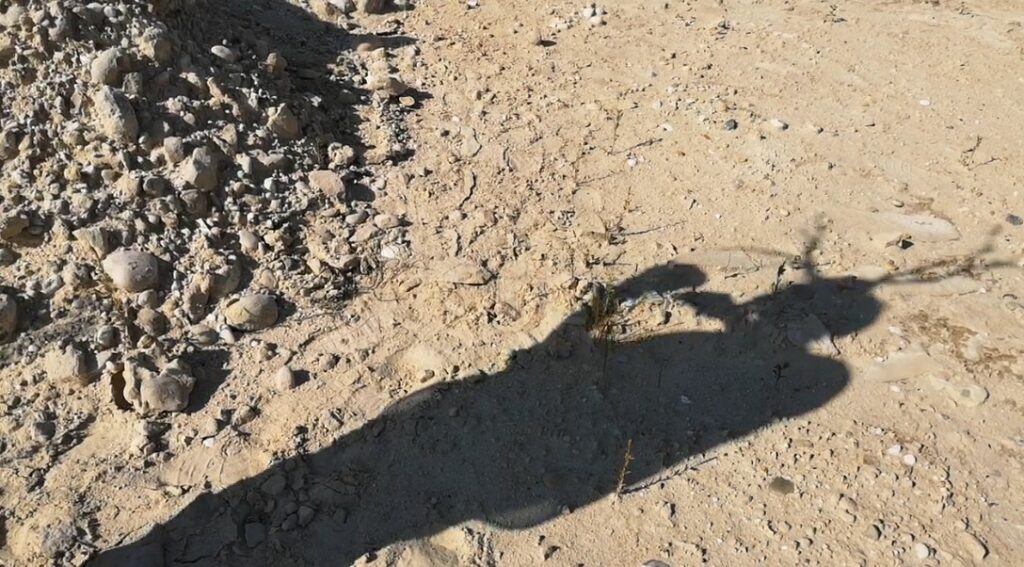
Shadows matter here: they fall across the sand like echoes of past presences. As we move through the light, our bodies become brief projections — alive within the sediment’s stillness.
This ritual is not a reconstruction of history, but an attempt to enter its rhythm, to step into the fluid memory of the landscape and briefly become part of its unfolding.
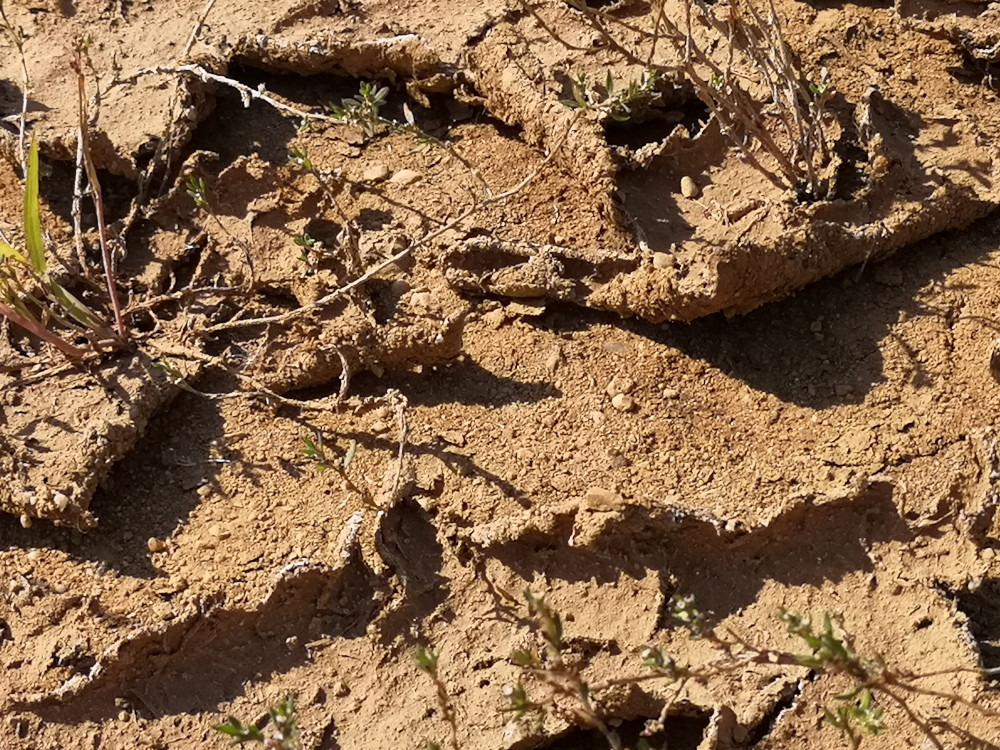
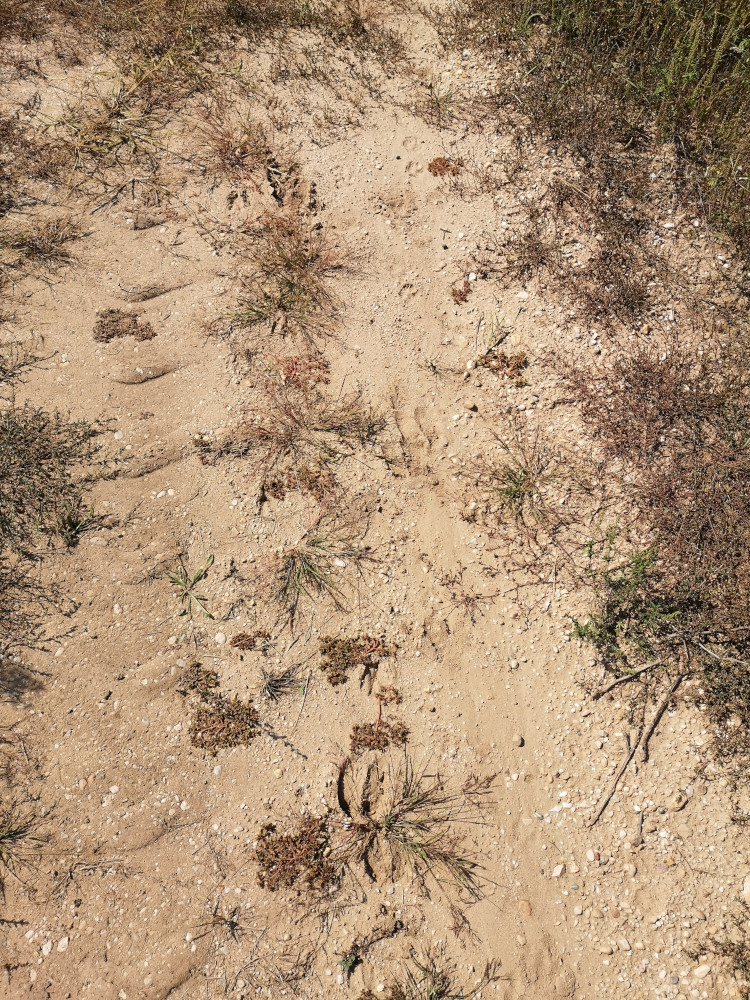
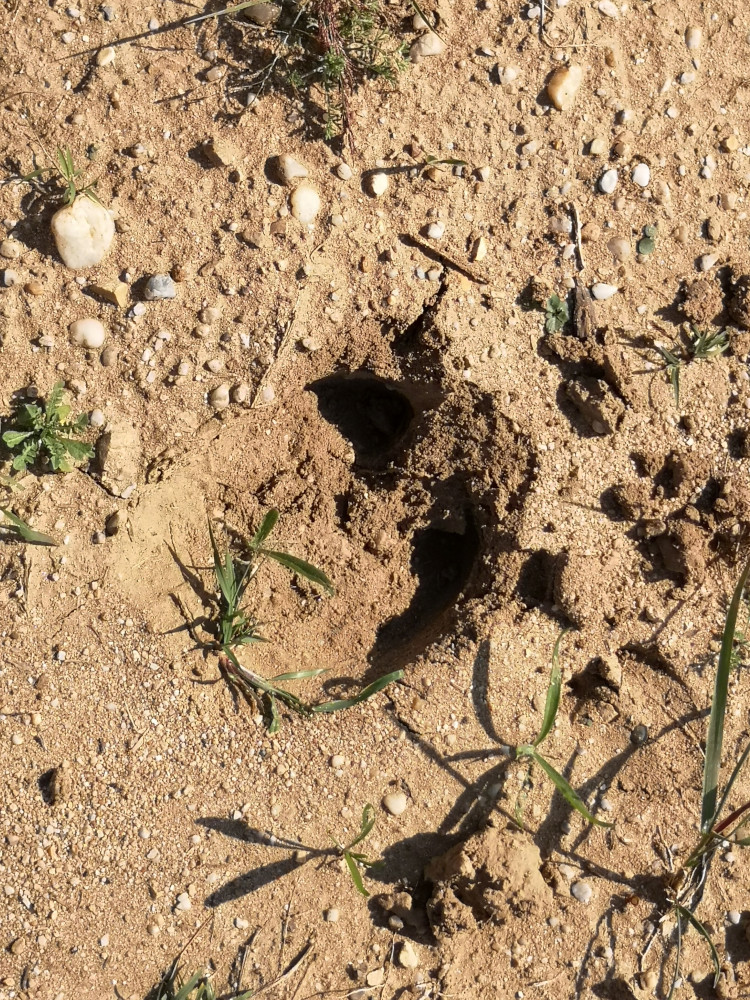
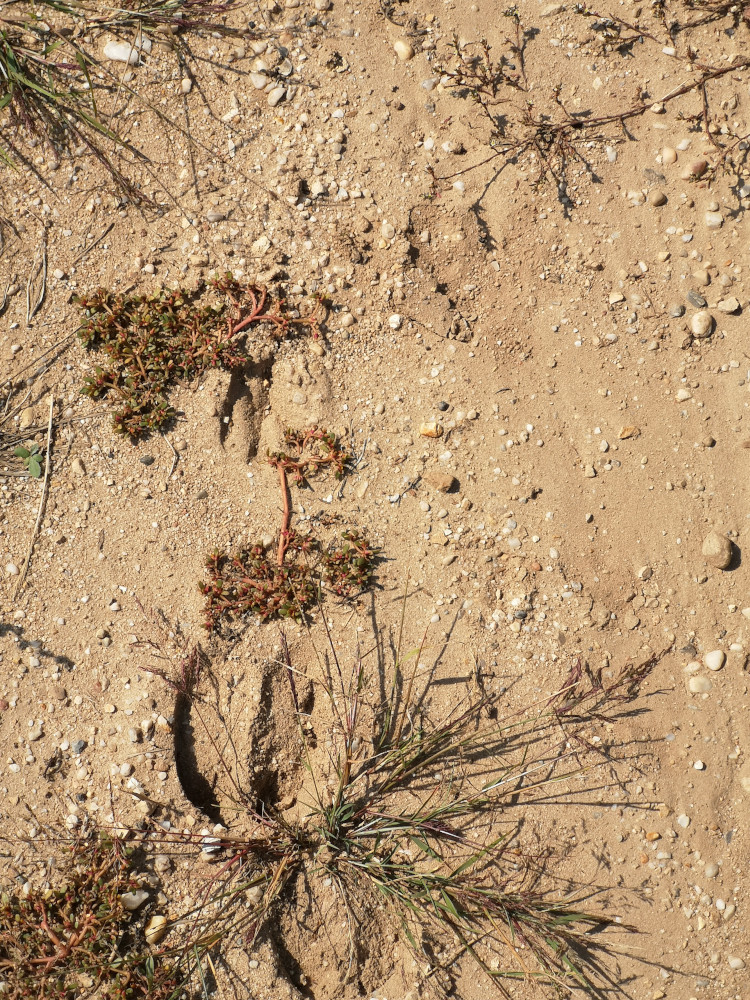
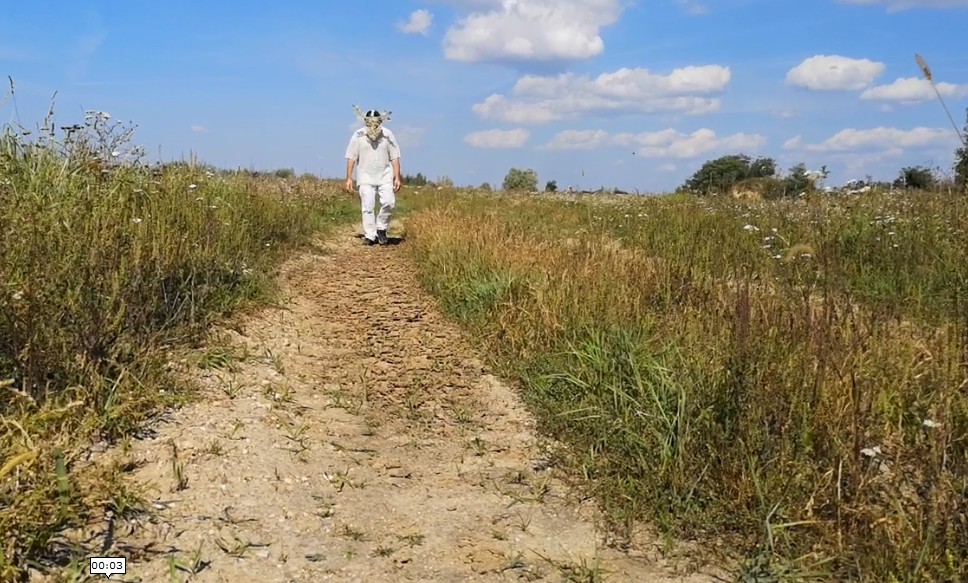
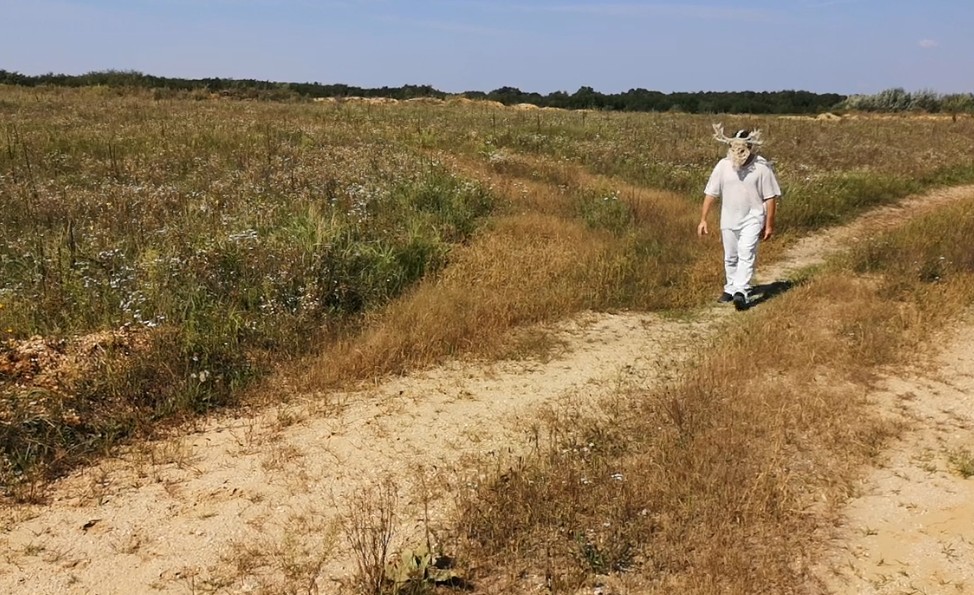
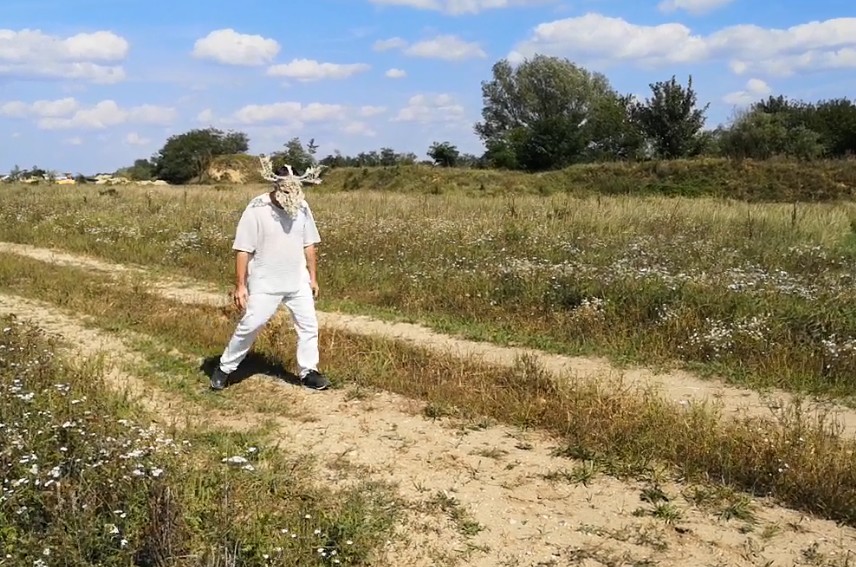
In the Footsteps of the Deer In the inactive zone of the quarry, we found a surprising number of deer tracks. One trail followed a path up a slope, ending on a circular platform — likely used by quarry vehicles — where the tracks vanished.
This moment inspired a video. A masked figure follows the trail. At its end, he notices another pair of legs beside him. He slowly looks up — and sees himself. A silent encounter: a meeting of self with self.
Selected frames from the video “In the Footsteps of the Deer” Director & Camera: Marina Razheva · Actor: Dmitry Razhev Editing & Color: Sasha Snova · Music: Vlad Razhev
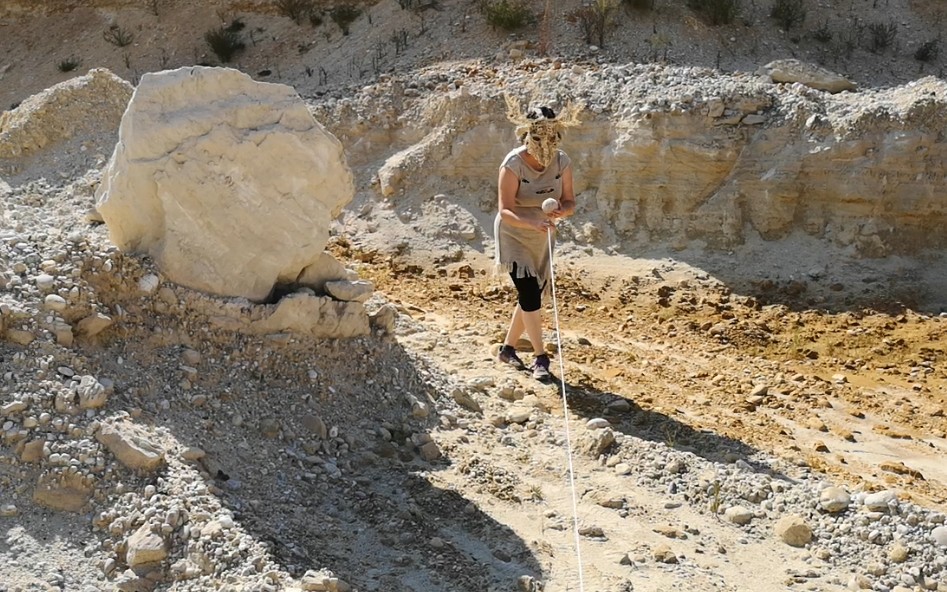
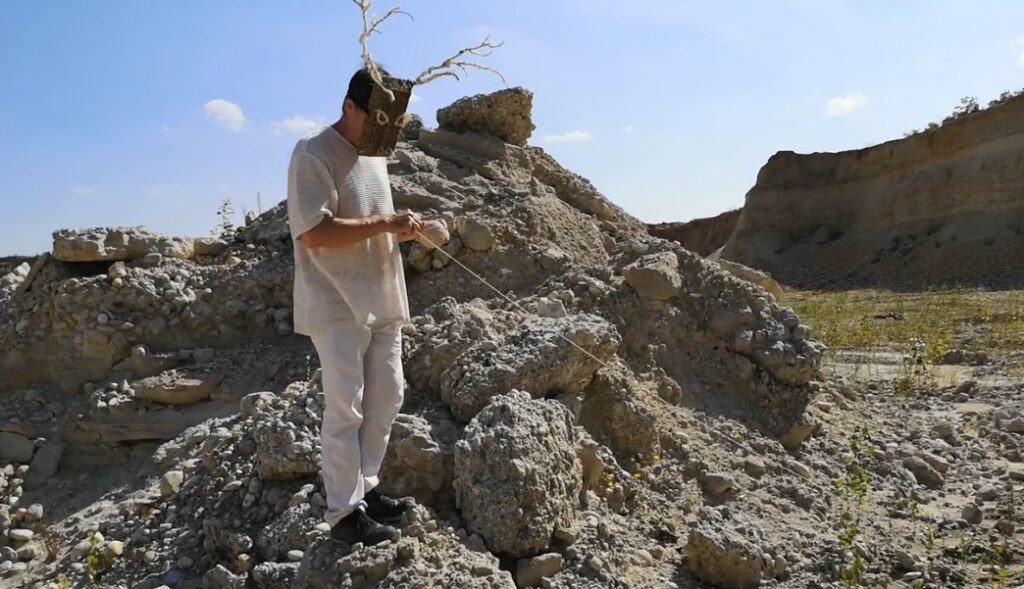
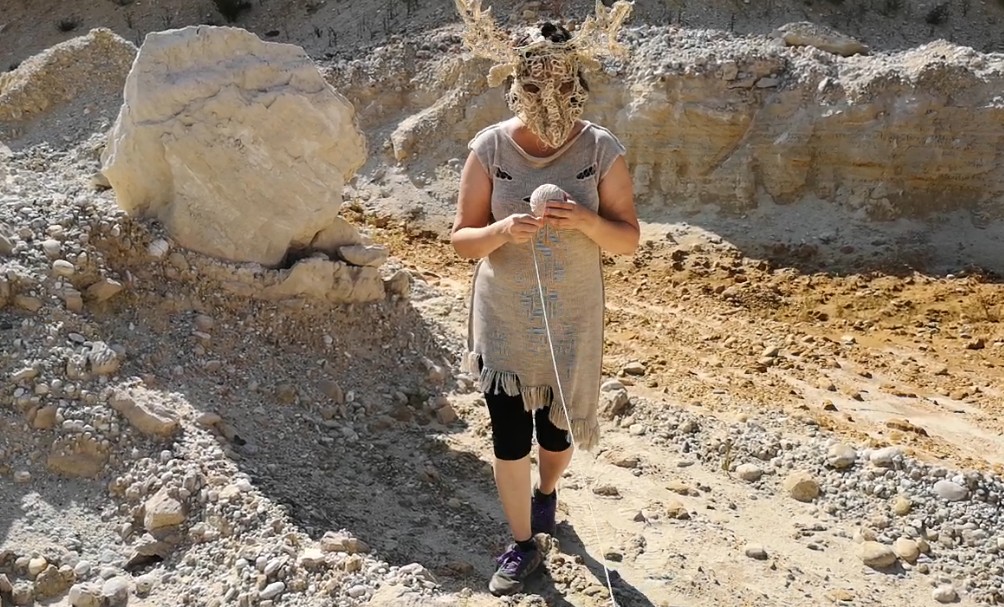
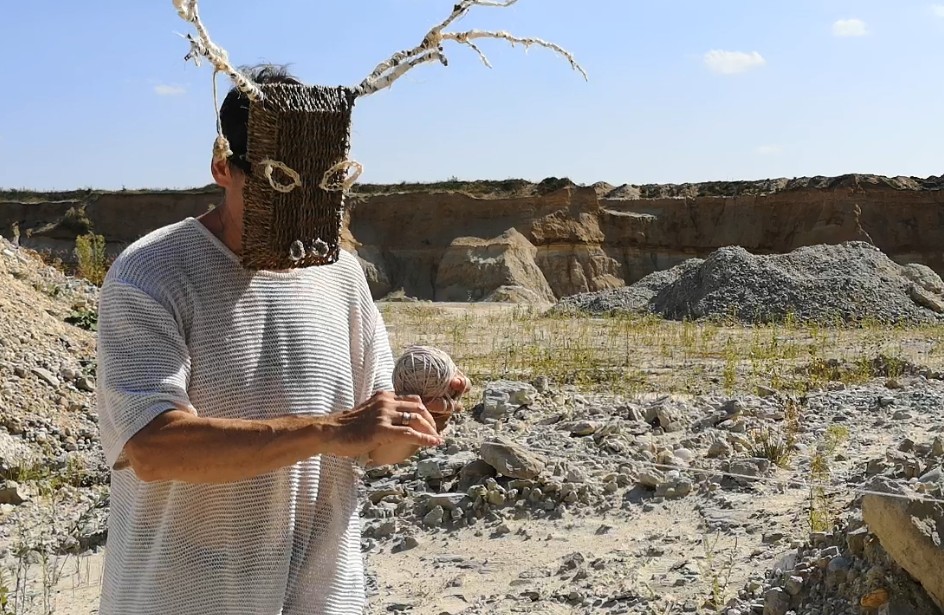
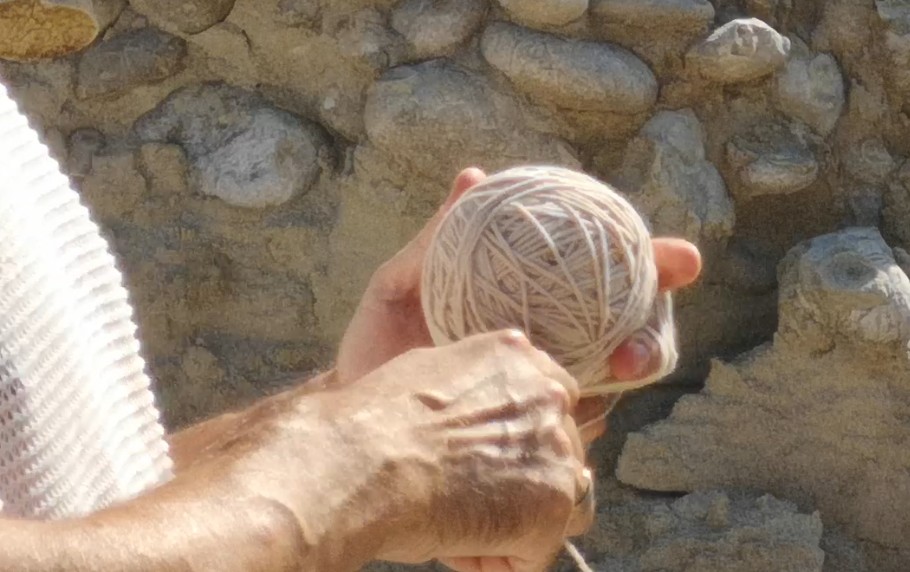
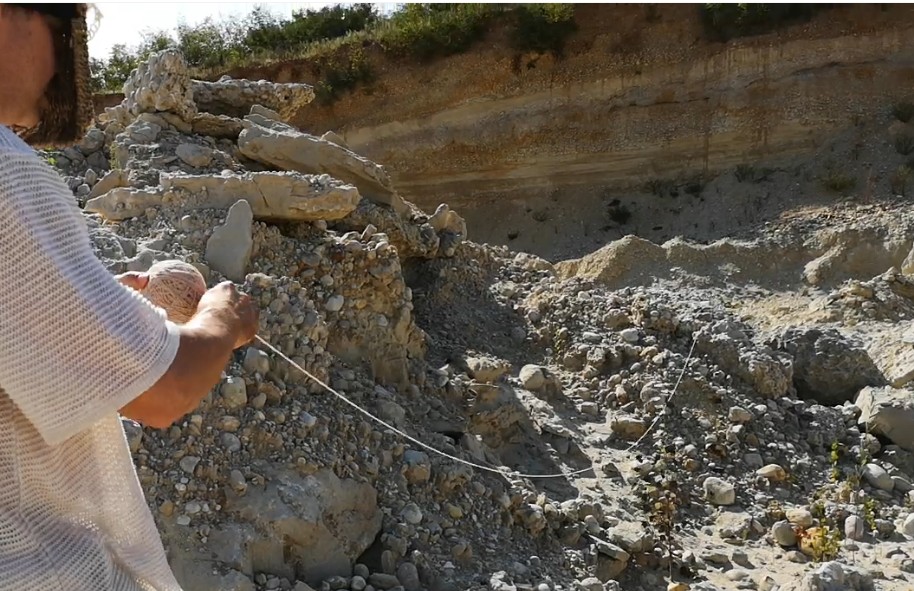
A Meeting Thread In another part of the quarry, pale sand mounds formed a soft labyrinth. There, we filmed a second video: two masked figures walk toward each other, each winding thread onto a spool. When they meet, their threads are already tied in a bow — a symbolic guiding thread that led them to each other.
Stills from the video “A Meeting Thread” Directors & Camera: Marina & Dmitry Razhev Editing & Color: Sasha Snova · Music: Vlad Razhev
This work is part of our ongoing practice of Revealed Realism (RR) — a method that merges artistic intuition with research, myth with landscape, and presence with attention. In this approach, quarries are not neutral scenery, but collaborators. The terrain is active, speaking, remembering.