Yekaterinburg, Russia
Urban intervention
A_REAL001, State Center for Contemporary Art
I mark a distance of 25 steps.
Everything inside it becomes the same color.
__________________________________________________
Yekaterinburg, Russia
Urban intervention
A_REAL001, State Center for Contemporary Art
I mark a distance of 25 steps.
Everything inside it becomes the same color.
__________________________________________________
Yekaterinburg, Russia, 2002
Urban intervention / Public art
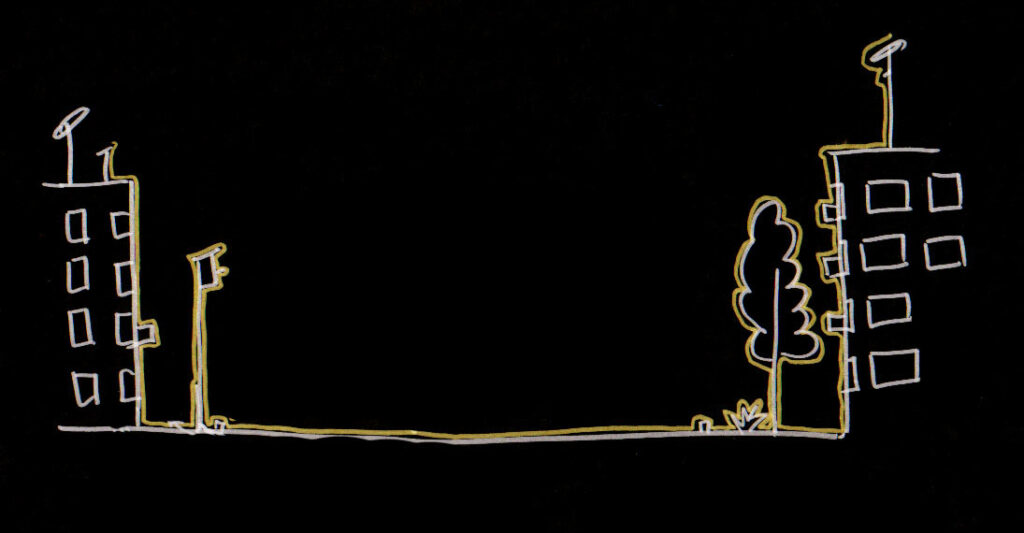
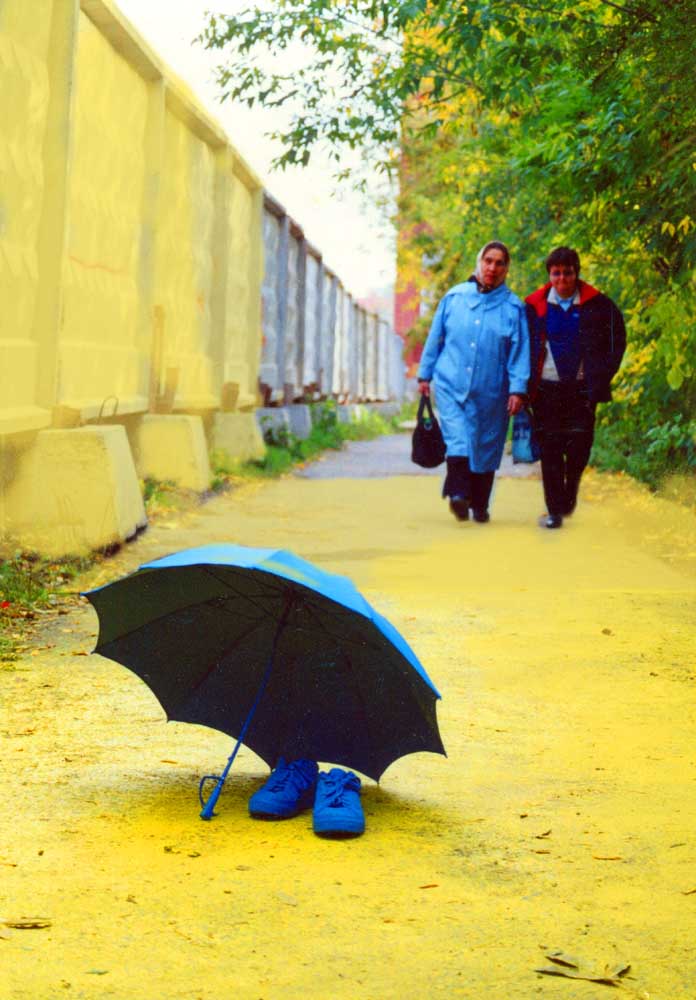
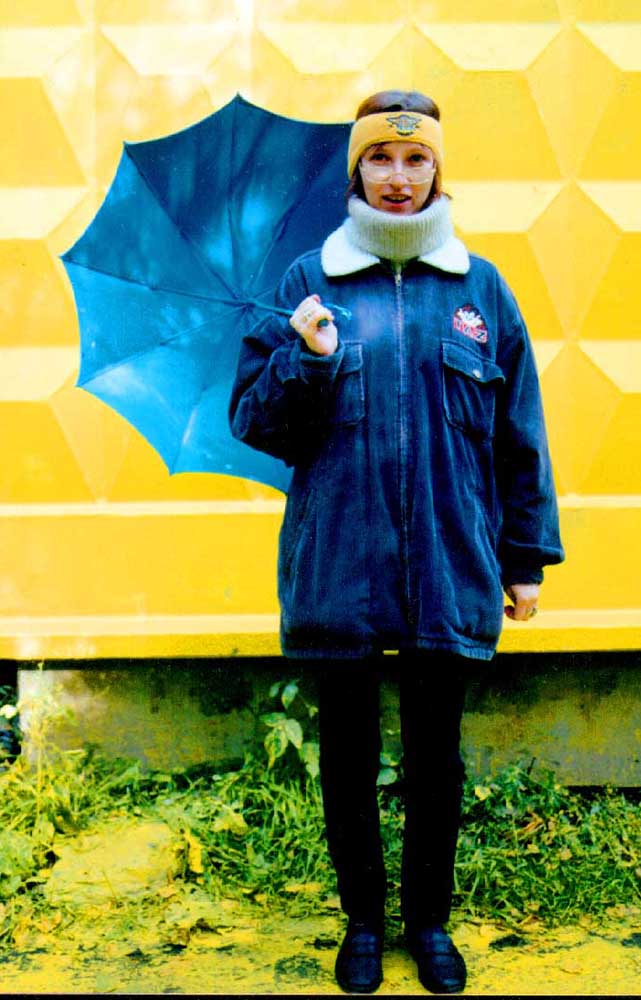
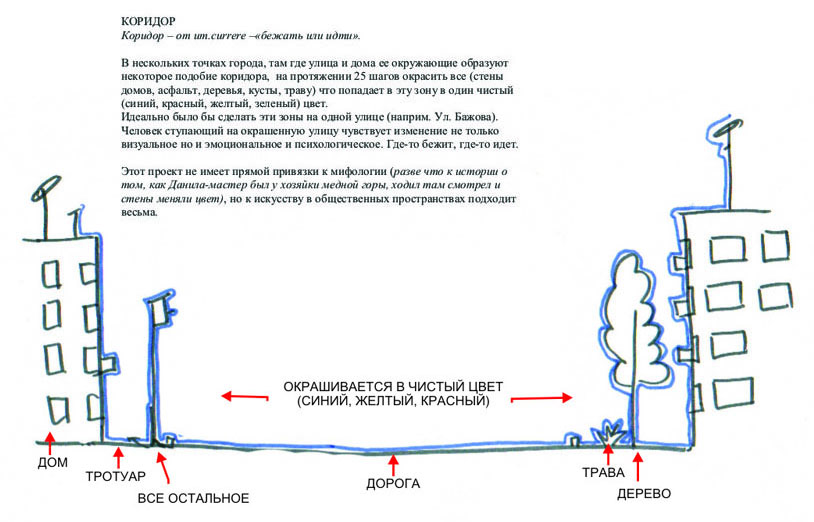
“Corridor” (from currere — Latin, “to run” or “to go”) is a site-specific urban intervention in which everything within a walking path of at least 25 steps is painted in a single pure color: houses, pavement, trees, grass, soil, and other elements. The result is a visual and emotional shift: the colored zone changes not only how the city looks, but also how it feels.
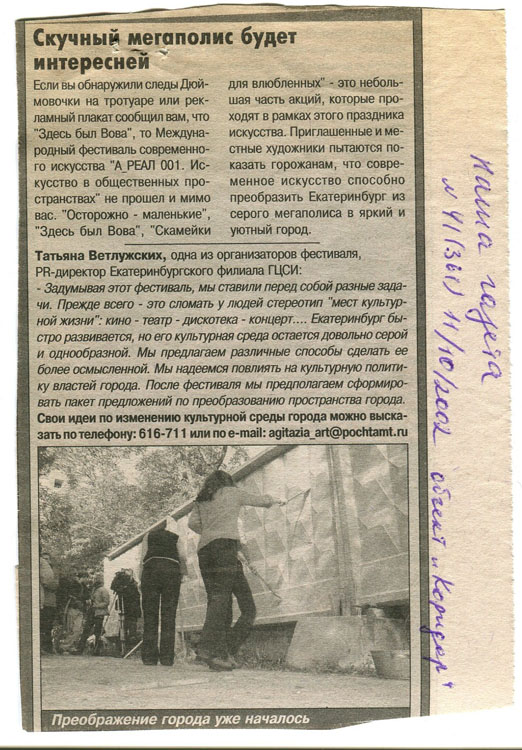
In this iteration, the color yellow was used. Even in bad weather, the space appeared sunlit and joyful. The project invited people to experience the city through a new lens.
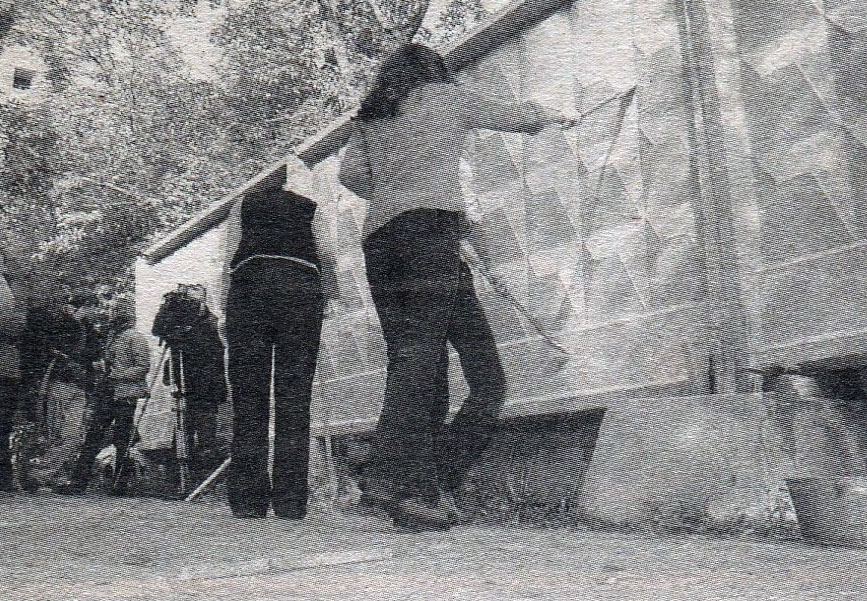
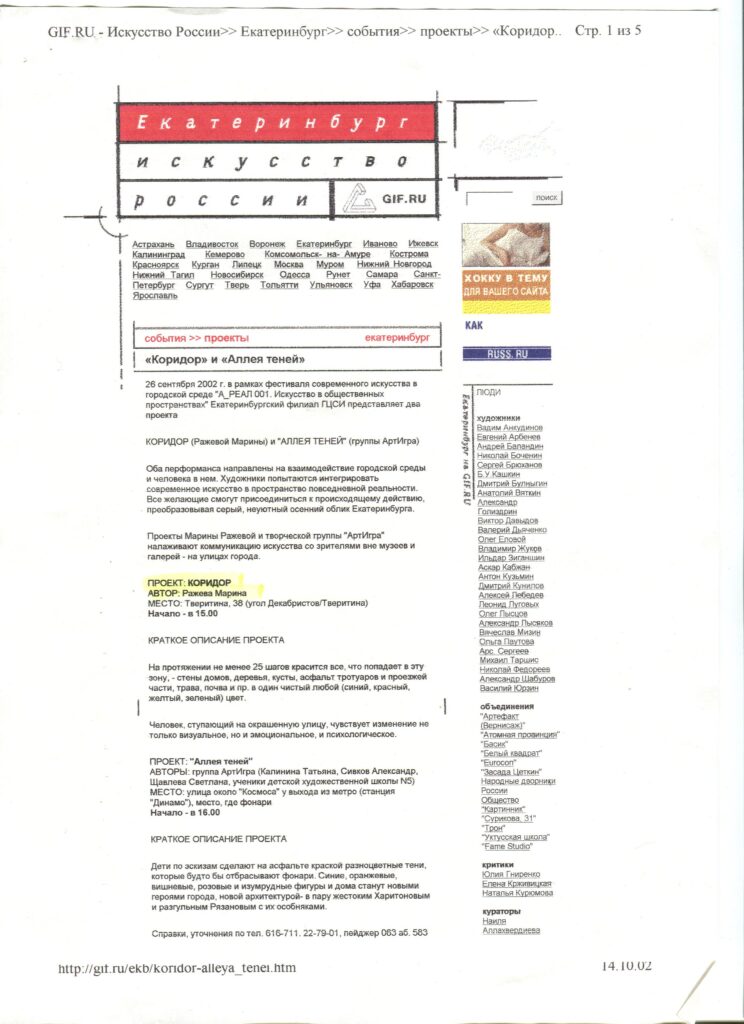
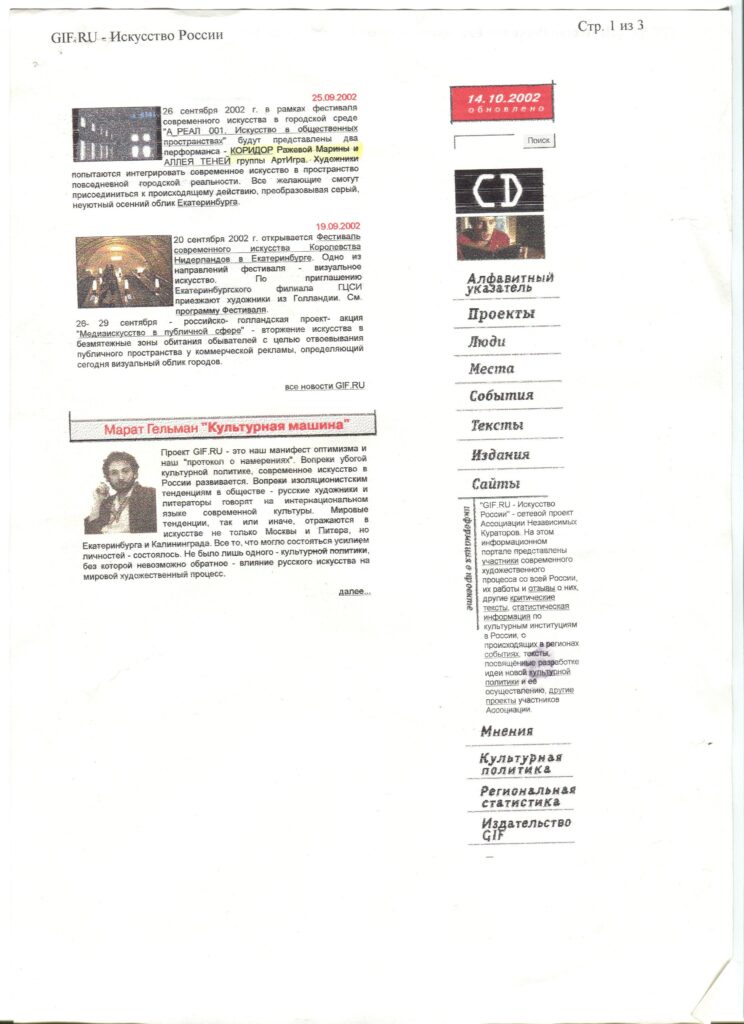
“Corridor” was realized on September 26, 2002, during the international urban art festival A_REAL001: Art in Public Spaces, organized by the State Center for Contemporary Art (GCSI), Yekaterinburg branch. The festival explored the theme “Mythology for the City” and focused on re-urbanization through cultural action. Curated by Arseny Sergeev, Nailya Allakhverdiyeva, and Tatyana Vetluzhskikh.
Artist’s Note:
I wanted to mark a passage: not just a path, but a shift in perception.
When you step into a space where even the grass and asphalt are the same bright color, your body reacts: the city becomes less neutral.
It’s about tuning your attention like walking through a thought.
Press and documentation
THE ANGLE OF VIEW or Fence becomes stairs
Readymade object, 120 x 70 cm, wood, metal. 2002
Consists of two parts: theoretical (written) and practical (object). The theoretical part is a repeatedly printed sentence: “Opposites transform into each other when you change the point of view,” along with the intersection of the words “fence” (horizontally) and “ladder” (vertically). It is printed on textured paper and framed under glass. The practical part is a fragment of a real picket fence. The object is exhibited vertically on the wall.
Fence and ladder are essentially complete opposites in phenomenological, psychological, functional, and other senses. But if you rotate the fence 90 degrees, it becomes a ladder. Opposites transform into each other when you change your point of view.
The object was exhibited in:
The contemporary art festival “Crossing Borders,” 2024, Beka9, Slovenia
The group international exhibition “Eurasian Syndrome 2,” 2002, Yekaterinburg, Russia
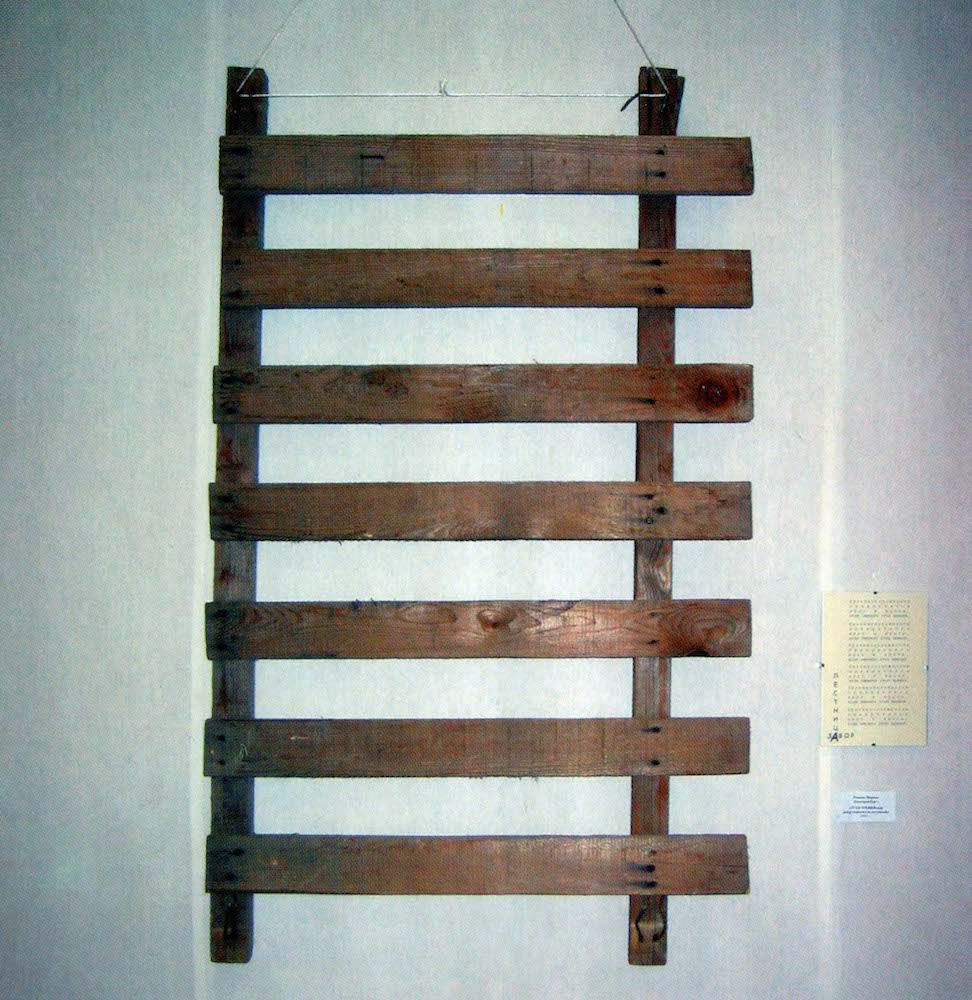
(A Point of View)
Preface 1
If we think of artistic practice as an augmentation of reality, there can be many interpretations.
You can add an object to a room. You can open the doors of a cupboard. You can rearrange them—which is not yet creation, but rather combinatorics. You can open a window. You can remove a wall. You can build another room onto the existing one. That is already closer.
And so on…
Different levels. One goal.
Preface 2
When a small window is opened in an enclosed space, at first the fresh air entering the familiar atmosphere may seem almost sacrilegious, destructive.
Then it becomes ordinary and necessary.
Later, unnoticed.
And at that moment, perhaps, it is time to open the window.
Aesthetics is similar to air. At first it agitates us, then becomes familiar, necessary, natural.
Until the next change.
And the creative act is precisely the opening of the window.
Whether this act is ethical or not depends on the situation.
Clearly, this is a metaphor. But in order to give the metaphor reality, one can perform
the ACTION “On Ethics, Aesthetics and Breathing”:
Breathe into an enclosed space and open a small window.
NOTES
Marina Razheva
Published in the proceedings of the Third International Symposium
Sputnik. Technology of Active Reflection
Kemerovo, 2001.
There are states that cannot be put into words. To try to describe them is like pressing a butterfly into a herbarium.
Familiar states: between sleep and waking, thought and speech, intoxication and sobriety. And there is something greater: between life and death…
These BETWEENS do not leave us alone. It seems that revelation, clarity, and the essence of things are hidden there. It seems that just a little more—and you will enter, you will touch it, you will finally understand…
But then: either you wake up, speak, sober up, come alive—or you fall asleep, remain silent, become intoxicated, die.
Once again, you have slipped past it.
The most important moments of transition are beyond our ability to comprehend. The origins of the universe, of life, of the human being are examples of this.
Something happens in the process of transition that leaves us with a profound amnesia.
In therapy, one way of bringing something back from amnesia, whatever its cause, is through provocation: placing a person in a similar environment, creating sensations resembling those associated with the forgotten experience.
This project is an experiment—an attempt to place the viewer in a state that is normally inaccessible to conscious memory.
We are accustomed to the beating of the heart. Yet we hear it from the outside, through the “drum” of the chest.
From the inside, however, instead of metronomic beats, something entirely different can be heard: noise, whistles, gurgling, the sound of liquid moving…
Physiologically, it is simple. The work of the heart as a pump, the pulsation of the atria and ventricles, the opening and closing of the valves, the sound of blood being moved through the body—all of this is what each of us heard during those months when we already existed, but had not yet been born.
Could this be why so many ordinary sounds of everyday life—the sound of rain, the murmur of a stream, birdsong, the rhythm of wheels—can simultaneously soothe and disturb us?
Could it be that they do not pass unnoticed because they are fragments of a single polyphony, the soundscape of what once was “between worlds”?
Can a recording of the sounds of the heart restore something of what we experienced in the womb?
Can these sensations place us at a point of singularity—the one moment when there is already being, but not yet birth?
Can such a state awaken memories?
Text written for the project in 1999.
PROJECTED / EXHIBITED
December 24, 1999 – January 24, 2000
Ural Museum of Youth, Yekaterinburg, Russia
Group exhibition Three Dots Above I, within the international arts festival End of the Century on Voznesensky.
June 2001
Krasnoyarsk, Russia
4th Krasnoyarsk Museum Biennale, KKIМК.