Artist: Marina Razheva
Date: 11–29 December 2000
Location: Ural Museum of Youth, Yekaterinburg, Russia
Type: Installation, participatory project
Materials: Everyday household objects, wooden lattice screens, fabric, window frame, silver enamel paint
Duration: 19 days
Work Description
Once Upon a Time… New Year’s Syndrome was a room-sized installation in which every object, from a teapot to a window frame, was painted the same silver. Stripped of their original colours, familiar household things became an alphabet through which visitors were invited to read their own idea of a home.
The guest book was intended to become the real exhibit: a place where visitors’ memories, associations and interpretations accumulated.
Concept
The project takes the form of a mock scientific study of “New Year’s syndrome”: moments of stillness interrupting everyday routines, the feverish search for gifts, the urge to decorate, the expectation of a fairy tale and the feeling of approaching a threshold.
The accompanying text follows the structure of a research protocol—aim, material, method and results—while proposing several possible versions of the house. It might be an enchanted kingdom; the home of a plaster Girl with an Oar and her mannequin relatives; one of Vera Pavlovna’s dreams, in which everything is made of white metal; the dwelling of the boy Electronic and his dog; or a house in the age of space-age materials.
The text also plays with the language of optics. The invented term gala-gram combines gala (festive), galerie (gallery) and galena (a silvery lead sulphide), while echoing the word hologram. Two beams originating from one source, one reflected, interfere to produce a volumetric image. In the installation, the artist’s collection of objects acts as one beam, the viewer’s memory as the reflected beam, and the image emerges where they meet.
The Installation
At the centre of the room hung a large cone of pleated fabric with a window frame set into it, surrounded by dark drapery. Open wooden lattice screens stood around it. On the floor, small “islands” of domestic life were arranged: a table laid for tea with a teapot, cup and lace; a flower in a bottle; a cage with a small creature; pies on a baking tray and a rolling pin resting on brick supports; an open tin with a fork; a pair of children’s shoes; glasses lying on a closed book; a birch broom in a basin; a ladle and a carpet beater hanging from the lattice; laundry on hangers; a radio-cassette player; and apples in a basket.
Every object was coated in the same silver enamel, known in Russian as serebryanka. The paint was supplied for the project by Опытное производство лакокрасочных материалов (OPLM; Experimental Production of Paint and Varnish Materials).
The uniform surface transformed recognisable things into something between domestic remnants, theatrical props and fragments of an unfamiliar world. The room offered no single narrative. Its inhabitants and events had to be imagined by each visitor.
Method
Departure from colour through material.
By coating disparate objects in a single silver finish, the installation suspended their ordinary identities without erasing their recognisability. The resulting “little house,” assembled from fragments of daily life, invited visitors to complete the image through their own memories and associations.
Reception
Press Response
In Vecherny Yekaterinburg on 16 December 2000, Ekaterina Balueva’s article “The Silver House and We in It” described the installation as an invitation to invent one’s own model of a home. She imagined pies ready for the oven, a child who had just run past and knocked over a basket of apples, and a key dropped in the pre-holiday bustle.
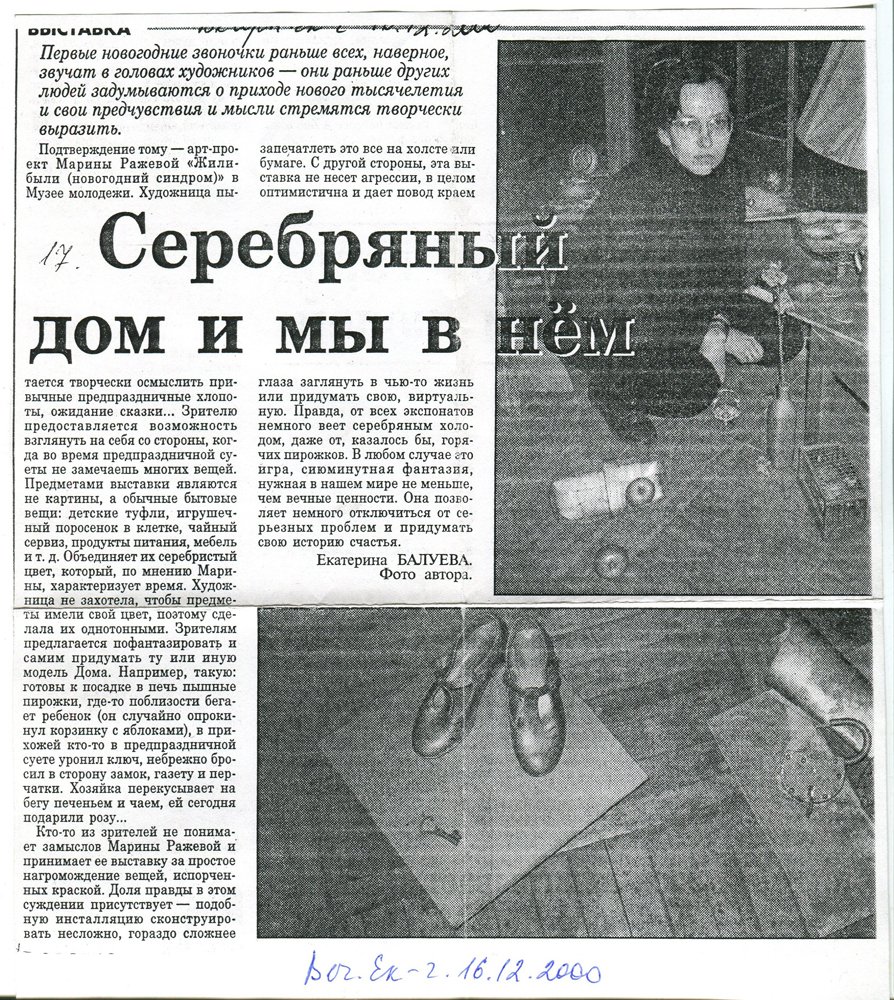
Balueva also noted a contrasting response: some visitors saw only a heap of objects spoiled by paint.
Elena Solovyova’s Text
In “Marina’s Alphabet (The Silver Alphabet),” written for the exhibition, Elena Solovyova interpreted the work as an interactive game and the guest book as the real exhibit.
The Guest Book
The guest book, kept during the exhibition from 11 to 29 December 2000, recorded widely differing associations. Visitors wrote that the installation “smells of grandma” and was “like from a distant childhood”; one found it “very beautiful, but a little lonely.” Another suggested “Silver” by the band Bi-2 as a soundtrack, while someone else asked where the vodka bottle was.
Together, these responses formed a collective portrait of the installation—not a definitive explanation, but a record of the memories, humour and expectations that the objects set in motion.
The Residents
For the artist, the most important outcome was that visitors joined the game and began to discover the installation’s imagined “residents.”
In 2001, a courier from a dairy factory brought Razheva photographs from Serov, Sverdlovsk Region, showing silver-painted sculptures standing outdoors in front of wooden houses. The photographs extended the project beyond the museum: the silver world of the installation had an unexpected counterpart in the everyday landscape.
The “residents” thus became a continuation of the work, revealing how its visual language could be recognised and reinterpreted elsewhere.
Documentation
The installation was documented on colour film in 2000. The photographs reproduced here are scans of the original film prints. Grain and colour variations belong to the original photographic material.
The archive also includes the exhibition poster, a press clipping, pages from the guest book, Elena Solovyova’s text, the project text and photographs of the “Residents” taken in Serov in 2001.
The four lettered cubes mentioned in the Artist’s Note have not yet been identified in the surviving photographic documentation.
The “Residents” photographs date from 2001, after the exhibition had closed.
Related page: Once Upon a Time… New Year’s Syndrome — Project Page